
Readers' Letters: Scotland can't afford this bloated public sector
Jobs must be cut from Scotland’s ‘obese’ public sector, says reader
There may be no growth worth talking about across the economy and growth prospects remain muted, much to the Chancellor’s chagrin, but that’s not the case in Scotland’s public sector, apparently.
Nearly 600,000 people are now employed there: that’s 22 per cent of total employment compared with 17 per cent in England. Moreover, between 2019-2024 public sector pay rose on average by an eye watering 5 per cent “above” inflation, according to analysis just released by the Institute for Fiscal Studies (IFS). The UK equivalent was 0 per cent. Equally concerning was the observation by the IFS that the benefits associated with this extra expenditure, which only comes courtesy of the taxpayer, are proving hard to identify.
I believe in the mixed economy but Scotland’s looks badly out of kilter. Like the health of the nation, Scotland’s public sector is in danger of becoming morbidly obese – unable to curtail its appetite for more and more scarce resources at a time of near national crisis and unable to reform itself through a fitness regime that measurably improves its efficiency and productivity.
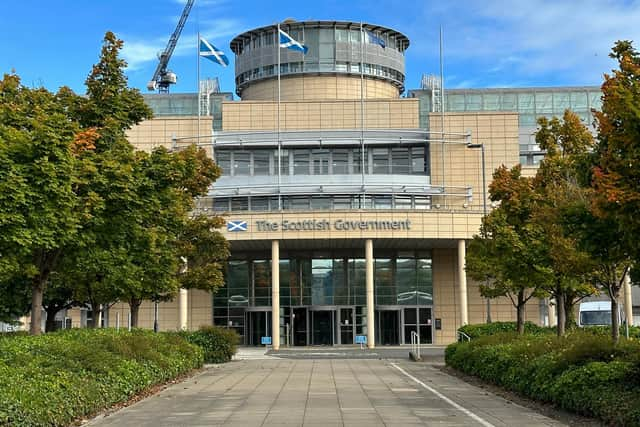

The risk is clear, the dead weight of Scotland’s public sector is in danger (either directly via labour market pressures and/or indirectly via reductions/diversions in taxpayer support for business and economic development) of crowding out the private sector on which sustained long-term growth and a steady flow of taxes to pay for public services ultimately depends.
Holyrood, get a grip!
Ewen Peters, Newton Mearns, Glasgow
Respect women
I have been following the employment tribunal of Sandy Peggie against NHS Fife. It is not for me to comment on the specifics of the case as reported. However, I do wish to say that women are, and always have been, the absolute backbone of the NHS – from the nurses and midwives to other health professionals, domestics, cooks, admin staff etc etc.
For any NHS employer to disrespect all these women, past and present, and to not even have discussions with them prior to opening up their single sex spaces is quite simply, beyond belief. It is also a reflection of the dismissive attitude shown to women in elitist Scottish society.
We have seen former first minister Nicola Sturgeon’s refusal to meet with women and women’s groups who had legitimate concerns about the Gender Recognition Reform Bill, the expressed aim to “re-educate” women rape survivors who wished female only refuge support aka Edinburgh Rape Crisis Centre, and the attempt to criminalise or end the careers of women who question aspects of transgender ideology.
Why is it proving so difficult for employers, and those in authority, to respect and listen to 50 per cent of the population? I can only assume a pervasive, persuasive misogyny both within that ideology (as it is currently being espoused) and society in general.
Rona McCall, Gairloch, Highland
Private space
Anent the various recent reports and letters referring to the provision of toilet facilities, particularly in schools but also other public institutions such as hospitals, can anyone provide me with a rational explanation of the need for so-called unisex toilets?
I for one cannot understand what was or is wrong with separate toilet facilities for boys and girls (or men and women).
David M Steel, South Queensferry, Edinburgh
More heat, please
The Scotsman Editorial (15 February) writes that “last month was the hottest January on record at 1.7Cabove pre-industrial levels”.
Not in the UK it wasn't, according to the Met Office: “Temperatures in January were below average, with the UK recording a provisional mean temperature of 3.0C, -0.9C below the long-term average. All four nations recorded provisional mean temperatures below average for January.” I expect February will also show below average temperatures too. Why do we accept the premise that there is a single figure for global temperature?
Personally I would like to see Scotland's temperature rising, giving us milder winters, lower heating costs and a longer growing season. And I believe that the billions spent on net zero would be better employed elsewhere. Money should be spent on prevention against weather events instead of foolishly trying to control the climate of our planet.
William Loneskie, Oxton, Lauder, Berwickshire
Wake up, Europe
When are we going to wake up? Britain does not have a special relationship with the United States. Europe does not have a special relationship with the United States.
In a new multi-polar world, we have to choose our partners carefully and transactionally, just like the present US administration. Europe should indeed start to look after itself, guarantee its own security, without its erstwhile most important partner.
Trevor Rigg, Edinburgh
Hostages betrayed
Of course everyone is delighted when we hear of “hostages” being released but let’s get to grips with the facts. 1) They are prisoners – taken as a result of an obscene raid that resulted in death, rape and other atrocities; 2) They are being used as pawns to gain release of murderers and other criminals at an unbelievably favourable rate of exchange; 3) Hamas is being encouraged in this vile and illegal trade-off by the West, who allows them to use any release as a massive recruiting and publicity stunt.
I suggest the time has come to put an end to this monstrosity by refusing to cover the staged release and covering only the return, and demanding all hostages, including presumably a number of bodies, are released immediately.
Failure to do this will only result in “hostage taking” becoming an acceptable and profitable way of terrorists getting “recruitment” publicity and achieving their aims.
James Watson, Dunbar, East Lothian
Clean break
Lyndsey Ward (Letters, 15 February), James Orr and Georgina Coburn (14 February) and John Heathcote (11 February) all object to local wind farm developments when the UK’s energy security from homegrown sources is more important than ever, with threats from Russian expansion in Europe, US protectionism and populists in Europe.
It is important to put the argument supported by all parties in Scotland except Reform. The UK is reliant on clean power generated in Scotland to reduce emissions and realise the UK government’s goal of net zero, ending reliance on world gas markets through cheaper homegrown renewables. Holyrood and Westminster governments recognise that renewables are the cheapest form of generation and are investing in grid connectivity and battery storage to reduce constraint payments. Scotland will power itself and much of the rest of the UK with clean energy well into the future.
The government public attitudes tracker shows only 13 per cent of the public opposing local wind farms. For James Orr and Richard Heathcote they spoil the view, while Georgina Coburn echoes Reform, stating “the claim of cheaper bills is a lie… with no long term benefit and no energy security” when renewables are the cheapest form of generation. What are their alternatives to an electricity pricing model based on rising international gas prices to ensure energy security and falling bills?
Neil Anderson, Edinburgh
Out of depth
In the past month Scottish Government ministers, and in particular Gillian Martin MSP, holder of the rather long-winded title "Cabinet Secretary for Net Zero and Energy”, have approved two controversial planning applications – the Strath Oykel wind farm and the Dumfries and Galloway pylons and overhead lines. Both of the proposals were objected to by their regional councils and then recommended for refusal by the government-appointed reporters. Both proposals went to public inquiry, which is extremely costly and time-consuming for local residents, the regional councils and the government. All of this is paid for by taxpayers.
Members of planning committees are generally well-educated about planning policy and knowledgeable about their area, and they make decisions based only on planning policy and material considerations. The government-appointed reporters are people who have vast experience of the planning system, often having held high-ranking positions in the planning departments of regional councils.
Yet, for some reason the Scottish Government has decided none of this matters. The knowledge, experience and expertise of the councillors and the reporters apparently do not outweigh that of Ms Martin who, prior to this position in government, seems to have had zero experience in the net zero area. According to Wikipedia, prior to entering politics “[Martin] ran her own business in video production and training for the energy sector. She was the manager of an emergency media response team for oil and gas companies for ten years.” As these ten years were spent with oil and gas, I am guessing little of her time was spent discussing renewables, for which she is now at the helm.
Martin, much like Chancellor Rachel Reeves, seems to be lacking in the qualifications, experience and expertise needed to be in the position, able to override recommendations by those who are genuinely in the know. In any other place of work, the SNP’s behaviour would be considered rogue and called into question. Why are the other parties not doing this?
Denise Davis, Kiltarlity, Highland
Write to The Scotsman
We welcome your thoughts – NO letters submitted elsewhere, please. Write to [email protected] including name, address and phone number – we won't print full details. Keep letters under 300 words, with no attachments, and avoid 'Letters to the Editor/Readers’ Letters' or similar in your subject line – be specific. If referring to an article, include date, page number and heading.
Comments
Want to join the conversation? Please or to comment on this article.