
Readers' Letters: Schools must get tough on unruly pupils
The ‘epidemic’ of violence in Scotland’s schools concerns a reader
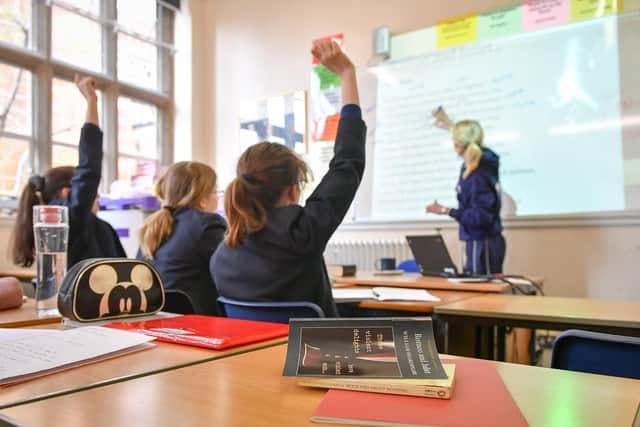
It is no wonder that school standards in Scotland have declined while the tide of classroom violence has increased to epidemic proportions (your report, 3 January).
The “soft touch” approach to kids who are out of control clearly doesn’t work. Recent Scotsman articles touch on this but do not provide a solution. It is all very well for union leaders to blame school leaders or local authorities for not curbing unruly kids, but these children will have already developed bad habits before they reach school.
The statistics tell us how many incidents of violent behaviour there are but not how many pupils are involved in violent incidents. Are the same kids involved repeatedly? If so, surely they need to be isolated – taken out of the classroom – and exposed to a strict regime. They would therefore truant? Then perhaps the most obdurate of them would need to be gathered in a residential unit where they can be shown the kind of standards that are expected of them. To those who would complain about that, I’d say: is it better to let out of control children grow up into out of control adults?

For those currently of school age, a radical solution is required. For those yet to reach school age, perhaps society as a whole needs to be made aware of what kind of conduct is acceptable and what isn’t. Parents need to understand that small children should learn about boundaries from the start. This can be instilled in them in a loving but uncompromising way.
Most parents know that, but clearly some do not.
Jill Stephenson, Edinburgh
Like two peas
I read that the president of a country has just ordered his armed forces to invade another country. I thought, here we go, Vladimir Putin is at it again, then I read on and find it's not Putin but Donald Trump who gave the orders.
These two guys have similar thoughts and tendencies. It's not to protect the people of the invaded countries that they carry out these deeds, it’s to grab the mineral wealth that's underground in these nations, in other words greed/money.
Maybe I’m wrong, but I think history will eventually show that they both benefited from it personally. As Mark Twain said, it’s easier to fool people than convince them they have been fooled
J Moore, Glasgow
Sick society
When will the political classes of Scotland finally wake up to the real pandemic afoot in our nation, namely the combined endemic and epidemic of chronic debilitating disease that immiserates for a couple of decades before it finally puts you out of your misery with an early bath.
The shocking revelations regarding “health span” in North Ayrshire reported by Alistair Grant should represent the straw that breaks our collective denial's back regarding the lamentable physical and mental health of the nation and all the social and economic consquentials (2 January).
The very sad reality that the average male and female citizen in North Ayrshire begin their chronic suffering at a mere 52 years is a canary in a coalmine indicator of a nationwide phenomenon in our grossly and grotesquely unequal neoliberal colonial society. The statement in the article by Public Health Scotland consultant Dr Rishma Maini sets forth the origins of this suffering and, refreshingly, debunks the nonsense that it lies either in genetic factors or is in any way related to “healthcare” expenditure per se.
The “Glasgow effect” famed in epidemiology circles is now given headline status “doon the watter” in North Ayrshire but is incubating in all our cities, and also in vast areas of rural poverty.
It is not just about money, it’s about a perceived sense of worthlessness and learned helplessness in a so-called meritocracy founded on fallacious neo-Darwinian principles of survival of the fittest and competition rather than co-operation.
It may come as a revelation to Scottish Certificate of Education “O” grade biology alumni of the Eighties that Homo Sapiens and other advanced apes are anatomically and physiologically evolved to serve primarily a commonweal as a prerequisite of individual survival.
The President of the Royal College of Physicians of Edinburgh and leaders of all elements of healthcare have publicly called for both an NHS and public health summit to rescue this nation from a real pandemic of chronic physical and mental disability.
This must be a supreme priority for the SNP government, but blaming politicians will avail us nothing. We, the people, individually must ask ourselves whether we can continue to have our priorities dictated by a Disunited Kingdom parliament or whether charity and clarity begins at home. The causes of ill health are essentially political in origin. The solutions likewise.
(Dr) Andrew Docherty MRCP, Selkirk, Scottish Borders
Building a legacy?
As John Swinney hopefully nears the end of his political career, perhaps the one thing he will be remembered for, if indeed he is remembered, is being the MSP who wasted the most taxpayers' money on incomplete and overbudget construction projects.
From hospitals, prisons and roads to the world-famous Calmac ferry catastrophe, has anyone kept a record of how many hundreds of millions of pounds are tied up in “stalled” contracts awarded by the SNP?
He's not finished yet. He now tells us that negotiations are at an advanced stage to buy the Ardrossan Harbour facility in order to expand it and accommodate the Glen Sannox and Glen Rosa. The Glen Rosa might never go into service and if experience shows us anything, Glen Sannox will have been retired long before the new harbour is completed.
Wouldn't it be better to finish all the outstanding contracts before starting any new ones, and then live within our means?
Bruce Proctor, Stonehaven, Aberdeenshire
Write to The Scotsman
We welcome your thoughts – NO letters submitted elsewhere, please. Write to [email protected] including name, address and phone number – we won't print full details. Keep letters under 300 words, with no attachments, and avoid 'Letters to the Editor/Readers’ Letters' or similar in your subject line – be specific. If referring to an article, include date, page number and heading.
Comments
Want to join the conversation? Please or to comment on this article.