
Readers' Letters: Russian interference in Brexit claim is a red herring
Readers warn Andy Burnham against closer ties with the European Union
“Brexit was won due to Russian intererence” is the latest salvo from those who have worked tirelessly since the people voted to leave the undemocratic EU and take back control of our country.
Yes, all leave voters opted to leave because of Russians influencing their mindset. Absolutely nothing to do with being totally fed up being told that we couldn’t do this or we must accept the other because of EU edicts tying the hands of our parliament.
Nothing to do with wanting to regain the ability to forge our own way in the world and trade with other countries on our own terms.

Nothing at all to do with regaining fishing rights in our territorial waters along with the ability to control others’ entry if stocks required protecting.
Brexit voters could continue this list but the bottom line is we felt that our country should and could be better free from constraints imposed from others.
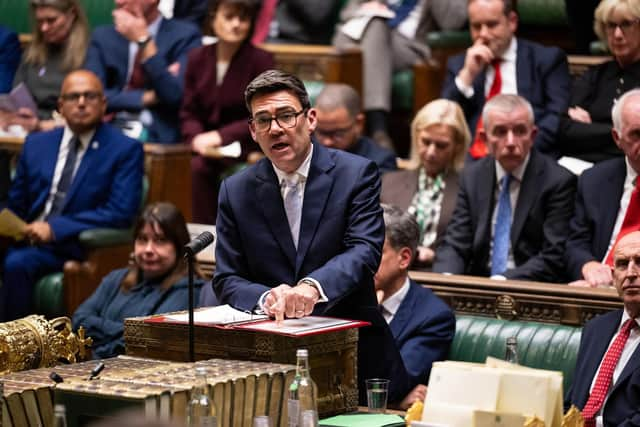
Now we have a new Prime Minister parachuted in to save the Labour Party daily turning up the rhetoric on how leaving the EU was a bad decision made worse by voters listening to and being influenced by malign outside influences. His officials have assured him that they have solid evidence to back up this claim.
My answer to that claim is, if there is evidence let us see it in its entirety, unredacted and we will judge the veracity of the claim ourselves.
A Lewis, West Linton, Scottish Borders
Stay out
The Prime Minister has decreed that “rejecting closer ties with the EU would be a dereliction of duty” as it would boost growth and help tackle illegal immigration.
However, he is ignoring several points, first of all, the 17,410,742 people who voted to leave, the main reason being illegal immigration.
Second, the EU is a bloated, bureaucratic, undemocratic union forged by France and Germany for the benefit of France and Germany. It is also possible to enact legislation into law without the agreement of the European parliament.
Thirdly, the UK would pay a fee for closer ties etc, which of course could lead to full membership costing billions per annum, less any available grants.
Remember the old saying: “Beware what you wish for.”
James Macintyre, Linlithgow, West Lothian
Serve the public
What has happened to our politicians (“Burnham set to push for new post-Brexit deals”, Scotsman, 13 October)? Mr Burnham never asked the British people to appoint him prime minister. Almost worse, he told the Makerfield voters he would not try and change Brexit. Now we are facing Brexit 2 as well as indyref 2. Well done, Mr Burnham.
Similarly, John Swinney spun the facts over pensions to suit himself but somehow this has been cleared by Holyrood. Mr Swinney thinks nothing of Mr Flynn’s lack of knowledge about ferries. Then we have the Scottish Greens’ lack of questioning over whether Zionism really qualifies as racism.
Politicians on the left appear oblivious to letting the public down at every turn. Long gone, it appears, is the thought of actually improving public services without also asking for ever more tax.
As our public services languish, our politicians are more keen to waste taxpayers’ money – all the way from unnecessary artworks to ferries to trips to the World Cup and reneging on the outcome of national referendums. Most politicians claim they are in the job to serve the public. The public is, understandably, increasingly dubious.
Gerald Edwards, Glasgow
Nordic model
With ex-Prime Minister Gordon Brown providing the warm-up, Andy Burnham used the Innovation Nation Summit in Manchester last Friday to argue that the UK’s core economic weakness is not a shortage of science or talent, but a failure to convert innovation into rapid business scale-ups, and internationally competitive firms of global significance.
The solution on the table is a structural shift involving deeper, constitutionalised regional devolution.
Scotland was invoked as a positive comparator showing what devolved powers can achieve (for example, innovative clusters in fintech, energy-transition technologies, life sciences, digital gaming, quantum technologies etc).
But it is also abundantly clear that the current status quo in Scotland is insufficient to produce well-anchored firms of global significance in meaningful numbers. Consequently, the value of Scottish invention and innovation continues to leak south to London and overseas.
Additional institutional powers and capabilities may well be needed if this fundamental problem is to be fully addressed. But what might these be? The Nordic model shows how small economies can successfully nurture indigenous flagship firms of global significance.
These economies operate both inside and outside the EU, and have the ability to lever state-level powers and capabilities including sovereign capital, fiscal autonomy, regulatory control, immigration, and industrial strategy tools etc.
However, drawing on these models implies more – much more – than “devolution Burnham-style”. Short of independence, a federal-style model of governance could possibly provide the greater institutional scope needed, tailored to the Scotland environment.
Extending the logic of “deeper” constitutionalised regional devolution in this direction, however, is likely to prove a step too far for the present government.
Nonetheless, the relevance of the Nordic experience to a more federal solution could/should be explored and carefully evaluated to establish the relevant costs and benefits for Scotland’s future and, indeed, the other nations of the UK.
Ewen Peters, Newton Mearns, East Renfrewshire
Time for change
It seems incredible that not only devoted Conservative Party members, but some supposedly open-minded regular letter writers to The Scotsman, advocate returning to traditional Tory policies. Margaret Thatcher’s mass sell-off of council houses, the privatisation of water, energy and British Rail, followed by de-regulation of the financial markets by Gordon Brown, substantially contributed to the UK’s economic and social demise. The proliferation of financially rapacious PFI schemes to build schools and hospitals coupled with a disastrous “hard Brexit” have left a fiscally-restricted Scottish government attempting to mitigate the worst consequences of these policies.
Now we have the Labour Party at Westminster, which aided and abetted the Tories in bringing about the cost-of-living suffering now experienced throughout the UK, claiming to be able to restore the UK’s fortunes while promising even more billions to a defence department which has wasted many billions of pounds in reckless procurement decisions (on a scale massively greater than that of spending on “the ferries”).
What will it take for those still wedded to the UK to finally realise that “Scotland deserves better”, as do England, Wales and Northern Ireland, and that fundamental constitutional change offers the only realistic path for the countries of the UK to achieve the dynamic rates of growth of other countries in Europe?
Stan Grodynski, Longniddry, East Lothian
Fake news
President Trump’s energy ceasefire is fake news. Putin has responded by doubling down Russian attacks on Ukrainian energy targets, saying Ukraine does not deserve a ceasefire. So much for America’s influence, Trump’s time is running out and the midterm election results will make him even weaker. As for his so-called deal with Russia to import diesel, less than a single day of US supply has been pledged, given Russia is short of fuel due to Ukrainian strikes and had imposed an export ban. The markets know this and the oil price has continued to rise. This is more about politics and corruption than pump prices.
Meanwhile the EU has just imposed a further 1,600 sanctions on Russia, which sends a signal that European nations are doing something but Ukraine needs interceptor missiles urgently so that Ukrainians can keep the lights and heating on this winter. It’s inconceivable that rich European countries pledging higher defence spending can’t buy or provide interceptors until Ukraine develops its own FP7.
Ukraine is our front line with Russia yet it seems neither the US nor Europe are willing to provide the support it needs. It’s almost as if, like Putin, they want the war to continue. Putin is preoccupied and Russia’s economy continues to suffer so that’s fine. Andy Burnham claims Putin is expected to have the means to attack Nato countries by 2030 yet he fails to commit to the 3 per cent defence spending target by then.
Neil Anderson, Edinburgh
Friend indeed
The First Minister John Swinney is asked by Laura Kuenssberg on her Sunday show if he and Nicola Sturgeon are still “friends” after her criticism of the SNP election campaign. “Yes,” declares Mr Swinney. With friends like that who needs enemies.
Richard Allison, Edinburgh
Round the bend
John Swinney thinks the SNP has “turned the corner” on independence (Scotsman, 12 October). The 3.4 million Scottish voters out of the 4.3 million electorate who didn’t vote for his party in May would probably agree because he’s driven them round the bend. He’s there already. Round the bend, I mean.
Allan Sutherland, Stonehaven Aberdeenshire
Write to The Scotsman
We welcome your thoughts – NO letters submitted elsewhere, please. Write to [email protected] including name, address and phone number – we won't print full details. Keep letters under 300 words, and in the body of the email – no attachments – and avoid 'Letters to the Editor/Readers’ Letters' or similar in your subject line. If referring to an article, include date, page number and heading. No poems or open letters.
Comments
Want to join the conversation? Please or to comment on this article.