
Readers' Letters: Reform's policies are not far right, they're common sense
Reform has plenty to offer moderate voters, says reader
David Hamill (Letters, 9 June) writes that Reform is preaching “far right poison” while the new Hamilton MP, Davy Russell, stated that “the poison of Reform is not us”, although 7,000 of his constituents voted for Reform. Anas Sarwar has described Nigel Farage as a “pathetic little man”. Inflammatory language has no place in political debate
I doubt if any of the Farage haters have ever looked at Reform's policies, which are available for all to read online in a 28-page document. They challenge much of the current policy consensus across Labour, the SNP and the Conservatives and I suppose that is what so enrages those who do not believe that this consensus has failed Britain and Scotland.
The party's aspirations include cutting migration, with the UK already having a population density of 300 people per square kilometre; stopping the Bank of England paying £35 billion a year in quantitative easing interest; lifting the income tax starting rate to £20,000; cutting the 6,700 EU laws still in use hindering growth; abolishing corporation tax for 1.2 million SMEs; scrapping net zero, saving billions; reforming the NHS to cut waiting times, but keeping it free at the point of use; putting bobbies back on the beat; removing transgender ideology from schools; and reviewing diversity, equality and inclusion policies.
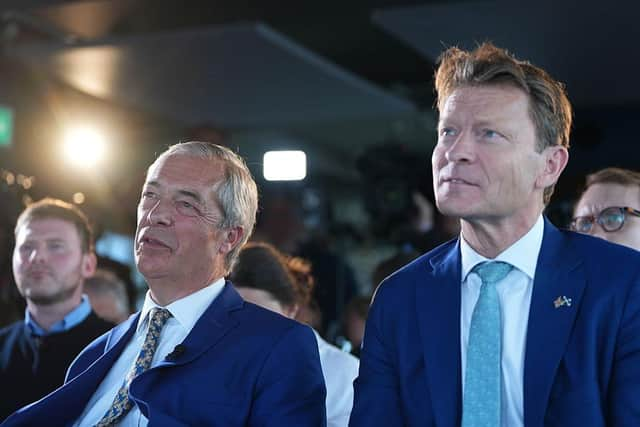

These are not far right polices, there are simply sensible policy proposals which much of the electorate regard as common sense. Too many of our politicians fear to speak out against their party policies which they know are wrong.
William Loneskie, Oxton, Lauder, Berwickshire
Denial duo
What do David Hamill and First Minister John Swinney have in common? Following the Hamilton election they are both in denial.
Mr Hamill says “three-quarters of the voters in Hamilton want nothing to do with the pernicious, far-right poison preached by Reform” but neglects to say that 87 per cent of the electorate didn't vote for the SNP.
Mr Swinney says “the SNP is in the process of recovery”, but with a swing away from the SNP of 16.8 per cent, what does he think will constitute a full recovery?
Bruce Proctor, Stonehaven, Aberdeenshire
Turn the tide
Ian Murray MP wants to “turbocharge” the economy with nuclear power (your report, 9 June). A far cleaner, cheaper, low-tech way to cut electricity prices would be to harness the tides. A 2021 paper to the Royal Society claimed that a Severn Barrage alone could supply 6-7 per cent of UK demand; sling road/rail across the dams and it's a double bonus.
Scotland, with its indented coast, would be ideal for such projects, in particular the Black Isle firths, where the boost to the northern economy would be significant, and the Invergordon to Nairn drive cut by a whopping 15 miles.
George Morton, Rosyth, Fife
Nuclear nod
A long time ago I used radioactive isotopes to study smallpox and an antiviral agent that had the potential to stop it in its tracks. Ever since I have made it my business to evaluate the safety of nuclear reactors and nuclear waste, and have concluded that with the exception of the Soviet Union, our obsessional attention to safety in their design and use means that it has not been possible to ascribe any health harm to humans from them, unlike coal waste at Aberfan or oil extraction like Piper Alpha, or, worst of all, climate change-causing CO2 waste generated by burning fossil fuels.
So I consider the SNP and Greens’ antinuclear policies based on arguments about safety (your report, 9 June) to be evidentially wrong. In any case, they will soon be overtaken by events. When the gas has run out and the wind doesn't blow, to prevent blackouts Scotland will be obliged to import electricity generated by nuclear reactors from England.
Hugh Pennington, Aberdeen
It’s over, John
In addition to points raised in The Scotsman’s report on John Swinney's BBC Sunday Show interview (9 June) he was still touchingly clinging to the independence panacea, citing polls claiming 54 per cent support for the SNP.
That doesn't stack up with Hamilton. On a turnout of 44 per cent the SNP got 30 per cent of the votes. That's only 14 per cent of the total electorate. Applying these numbers to the 4.3 million voters in Scotland their 2014 Indyref total of 1.6m votes plummets by one million to around 600,000.
Come on John, you know it's over, so why not publicly announce you're jacking it in. Then Holyrood 2026 can be about which party has the best policies and candidates to halt our health, education, worklessness, Net Zero and public services nosedive.
Allan Sutherland, Stonehaven, Aberdeenshire
Who cares?
Otto Inglis (Letters, 9 June) writes an excellent assessment of the Hamilton by-election, but for all the analysis and comment, it should be noted that almost 56 per cent of the electorate could not be bothered to vote, so really don’t care who represents them in the Scottish Parliament.
Malcolm Parkin, Kinnesswood, Perth and Kinross
Spad news
The SNP have announced that their bill for Spad services in the previous year has been a jaw-dropping £1.7 million of our taxes. In any case, considering the party's image plunged to rock bottom in the period, they should be asking for their – our – money back.
Alexander McKay, Edinburgh
Do nothing
I recall, many years ago, being on a course to help senior doctors to become managers in the NHS, as if there weren’t enough of them already! We were taught that among the many actions that might be employed to solve any problem there was always the “do nothing” option.
I am currently suffering from a progressive and untreatable lung condition. I am in constant distress due to shortness of breath which is only partially relieved by Oxygen therapy. I can do little more physical activity than shuffle around my house and the condition is putting extra strain on my heart.
Last week, still being of sound mind, I obtained, with no problem, a form I can carry around which says that should I have a cardiac arrest, I do not wish to be resuscitated. Here is a perfect example of a problem where doctors can, without risk of retribution, apply the “do nothing” option, while at the same time, not reneging on their Hippocratic oath, which says “first do no harm”.
While the assisted dying issue rages on, could not resuscitating be construed as doing just that, by the back door?
(Dr) S R Wild, Edinburgh
Reform Forces
Introducing the Defence Review, Prime Minister Sir Keir Starmer repeated words he heard on HMS Vanguard, “nothing works unless we all work together”.
Money is short. The Defence Secretary John Healey spoke of “defence reform” and he should question the need for three services. Most of the RAF’s 30,000 personnel are in the UK, as are most of its 500 aircraft (including 46 support aircraft, 37 helicopters, 160 trainers, 90 gliders). The RAF has 75 per cent of all MoD aircraft and 50 per cent of frontline aircraft, the other half being Army or Navy. Only 20 per cent of RAF personnel have flying duties, most of its “aviators” are ground crew or support staff, yet 20 per cent are officers – including 40 air marshals and 100 air commodores.
Most RAF operations support land forces, some support Maritime Britain. With 60 uniformed personnel for every aircraft, trainer and glider, the £10 billion-plus a year RAF, with its ten display teams, seems overmanned and under-employed. In times of plenty all this may be justifiable – it’s not today.
Defence costs too much to maintain three services. Unsentimental reorganisation of HM Forces would help make them “battle-ready”, providing huge savings, advancing the government’s “defence dividend”. There is no need for a separate air force. An army and navy with RAF air assets and personnel transferred would see defence emerge leaner and more cost-effective and, importantly, be operationally more efficient with no loss of air capability.
“Nato first” would be better achieved by the UK being tasked as the principal maritime power in the eastern Atlantic, the land powers of the Continent providing the principal armies. The Defence Review should prompt radical change here and in Nato.
Lester May (Lieutenant Commander, Royal Navy – retired), Camden Town, London
Power babies
Rarely has the saying “the love of money is the root of all evil” borne such lethal purchase than during the monumental falling out between Donald Trump and Elon Musk this past week. It seems a long time ago that Musk and his fellow oligarchs made up a billionaire front row for Trump's inauguration as president.
Their fallout has been a long time coming, not helped by Musk's infamous Nazi-style salute on that occasion. He never recovered from the deserved barb that he was unelected, all the while wielding a hacksaw indiscriminately through whole swathes of US life in the notorious DOGE.
It says everything about US politics that the Democrats would now even consider taking Musk's money. The whole affair stinks of two-uber rich big babies tossing their grown-up toys out of the pram.
Ian Petrie, Edinburgh
Write to The Scotsman
We welcome your thoughts – no letters submitted elsewhere, please. Write to [email protected] including name, address and phone number – we won't print full details. Keep letters under 300 words, with no attachments, and avoid 'Letters to the Editor/Readers’ Letters' or similar in your subject line – be specific. If referring to an article, include date, page number and heading.
Comments
Want to join the conversation? Please or to comment on this article.