
Readers’ letters: Reeves should cut government spending, not increase taxes
A reader says the Chancellor must switch her focus away from tax increases which will stifle growth
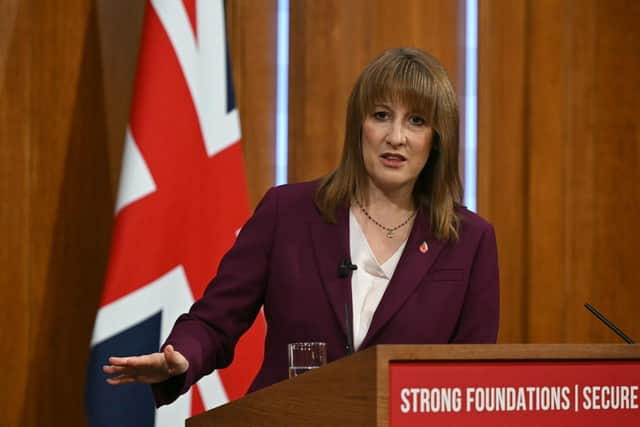
Brian Monteith (Perspective, 4 November) is right to call out Labour’s “economic doom loop”, keeping coming back for more, but fails to mention the cause being out-of-control record public spending. When Labour took power Rachel Reeves had a chance of becoming the next PM by achieving her ambitious growth strategy. Rather than deliver growth she has dug a bigger chasm than the £20bn black hole Labour allegedly inherited and supposedly plugged in the last Budget. Given she and the PM are silent on breaking manifesto commitments, we must all “do our bit” she says, essentially pay more tax.
Taxing more, given already record post-war levels approaching 38 per cent of GDP, would risk accentuating the effect of the employer National Insurance tax grab, stifling growth and jobs. Cutting spending in areas that little impact growth and taking measures to stimulate private investment are more sensible options. Businesses face uncertainty over inflation and tax but falling mortgage rates are fuelling the housing market and consumer spending is picking up. Speeding up reform of the planning system and cutting waste in government departments would accelerate house building and curb the £1 trillion annual central government budget with its half a million civil servants.
Ms Reeves, however, seems set on more “tough decisions”, like raiding pension tax relief and increasing income tax, unpopular and damaging to the economy. Unless she addresses rising public spending (45 per cent of GDP), particularly welfare, and resultant debt interest costing more than the education budget, her and the Government’s days are numbered. Like Labour, Mr Monteith’s friends in Reform have pledged to solve this but given their flip-flopping on tax cuts and lacking in a plan could they do better?

Neil Anderson, Edinburgh
Taxing pensioners
As an 88-year-old in receipt of the state pension I feel I cannot complain if in the national economic interest that money is taxed to help the Chancellor achieve a long-overdue balancing of the national books.
In fact, none of us pensioners should complain because it’s at least partly our fault the economy is in a dire state. After all, it's our generation that consistently, whether by omission or commission, allowed into power clearly incompetent wannabes who couldn’t run even the proverbial in a brewery. If, instead, we’d all stayed at home, refusing to support politicians and parties which promised the moon despite a continuous and almost unblemished record of failing to protect the earth, we’d now be enjoying perhaps a lower standard of living, but definitely a better quality of one.
I, for one, am desperately ashamed of the mess we older folk have made of things. We owe our children a deep apology.
Tim Flinn, Edinburgh
Democracy denial
Separatist contributors to your letters page have complained about a supposed “democratic deficit” or “democracy denial” in relation to the UK Government’s ability to veto a referendum on separation.
Another common thread is that, with the discovery of oil and latterly the development of renewables, Scotland has huge natural resources and would be a prosperous country if it did not have to support the rest of the UK.
This is disputed by most, but let’s imagine for a moment that it is correct. What kind of democracy would it be where, after enjoying 300 years of equal rights and representation, a faction of a population of approximately 8 per cent of the UK total, decided to make off with their newly acquired wealth and leave the rest to struggle on. If that was allowed, London and the south-east of England could have ditched the rest of us many years ago.
The SNP like to portray Scots as being fairer and more caring than others, but their party’s purpose is akin to someone winning the lottery and leaving the rest of the family (who incidentally have all been contributing to the development of renewables through their energy bills) to fend for themselves. This would be morally wrong but would be even worse on discovering that the lottery win was a hoax, leaving everyone worse off and full of bitterness and resentment.
Mark Openshaw, Cults, Aberdeen
Medieval licence fee
How many nails must be hammered into the coffin of the BBC before the government frees us from the medieval licence fee?
Over the past few decades successive governments have shown themselves to be completely out of touch with the wishes and feelings of the electorate. While pure direct democracy on the scale and form of ancient Athens is clearly impractical in a modern context, elements of it are currently used in several countries, including Switzerland and certain US states. The need for fundamental change to our present form of democracy, through more direct decision-making by citizens, has been brought into stark reality by Brexit, illegal Channel immigration, assisted dying, Sir Keir Starmer’s proposed BritCard and now the BBC.
Smartphones and AI create the possibility of instant voter-wide consultation on all proposed government bills, giving citizens the ability, right and duty to vote on each and every bill before politicians consider them in parliament. The results of such consultations would be made public. Politicians would know exactly where the public stands on proposed issues. And the public would know the politicians know their wishes.
Doug Clark, Edinburgh
Bias in the BBC
I am concerned by reports of bias at the BBC. The issue of the son of a Hamas official being allowed to produce a documentary is one obvious case. How many 13-year-olds anywhere can produce a documentary, let alone one in a war-torn place like Gaza?
BBC TV certainly does not seem especially favourable to anything that is not “progressive”. What a nice word that is for a viewpoint which is actually simply left-wing and as progressive as progressive dementia. Call it what it is.
However, one thing which really bugs me and is beyond the control of The Scotsman and all other media outlets are the rules governing their output coming from Ofcom. Readers may be astonished to find Ofcom saying, of “Anthropogenic Global Warming” that, regarding, “paragraph 1.37 of Ofcom’s Guidance on Section Five of the Code 1 relating to due impartiality... does not appear to be challenged by, for example, established political parties or other significant domestic or international scientific institutions… example of an issue which Ofcom considered to be broadly settled is the scientific principles behind the theory of Anthropogenic Global Warming”. Forget about all the prominent scientists who have appeared before Congress to dispute the “climate change” fad. It is “decided”.
Unconvinced? Then how about Ofcom on gender? GenderGP on 1 July 2025 reports Ofcom as saying, “broadcasters must continue to include and respect the view that trans women are women. Trans men are men.” Remember that the Supreme Court stated that a “woman”, means a “biological woman”.
This (like free speech throughout the UK) must be sorted out.
Andrew HN Gray, Edinburgh
Justified criticism
I am sorry that Charlie Selcraig (Letters, 4 November) feels the need to berate Susan Dalgety for her article on Police Scotland. Perhaps he does not realise the extent of the anger felt by many of us at the conduct of the police at a For Women Scotland rally at Holyrood last month. A man attempted to disrupt the event by drowning out speakers with a hideous “boombox”. The police stood by and did nothing to induce him to cease this offensive behaviour even when asked to do so.
Mr Selcraig asks if it was necessary for Susan to mention that the man making the flagrant attempt to disrupt that authorised event was a "male stripper”. Actually, it is a relevant part of his identity as an LGBT activist, given that trans activists have a track record of harassing women’s gatherings.
Mr Selcraig may not be aware that Police Scotland has been captured by “gender” ideology, to the extent of wearing trans rainbow insignia and festooning cars with these partisan colours. Susan is parti pris in the sense of supporting women’s rights and women’s safe spaces. Good on her. If the police had behaved in a less partisan way, she would not have written as she did.
Jill Stephenson, Edinburgh
Scotland’s problem
Fiona Hardie (Letters, 6 November) is way off beam. It is the Scottish Government which controls the installation of wind turbines and the Scottish Government which, through planning permission, prevents the installation of new nuclear capability.
One small nuclear station is the equivalent of about 500 of the largest turbines without the same requirement to turn what grid engineers call “dirty” wind power into a grid-acceptable entity plus the huge extension of the grid plus, of course, back-up storage when the wind doesn’t blow
Dr A McCormick, Terregles, Dumfries and Galloway
Fireworks blast
Edinburgh, Glasgow and Dundee have several areas of deprivation. The same places have history with firework misuse. As fireworks are expensive and the kind being used which the police and fire service say are dangerous are really expensive how can “poor deprived” people afford them?
Elizabeth Hands, Armadale, West Lothian
Write to The Scotsman
We welcome your thoughts – NO letters submitted elsewhere, please. Write to [email protected] including name, address and phone number – we won’t print full details. Keep letters under 300 words, with no attachments, and avoid ‘Letters to the Editor/Readers’ Letters’ or similar in your subject line – be specific. If referring to an article, include date, page number and heading.
Comments
Want to join the conversation? Please or to comment on this article.