
Readers’ Letters: Police move that’s killed kids' taxi outing is 'pathetic'
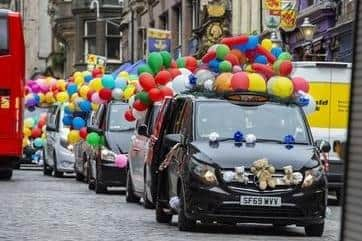
Taxi drivers have had to cancel an annual treat for needy kids, and readers aren’t happy
We all know of the challenges facing Police Scotland following many years of underfunding by the SNP government, and the number of police officers having fallen from 17,496 in April 2013 to 16,553 more recently.
Despite the reduced numbers, much still remains within the chief constable’s control and it is a disgrace that they could not fully support the annual taxi drivers’ ride for children, leading to it being cancelled.
Refusal to support such a good cause helps destroy what little faith many people have in policing. Not in individual officers who work tirelessly, putting themselves at risk of great harm to protect us, but in policing in its wider sense. The police service should feel privileged to be in a position to help such a good cause; I suspect instead they are focused on inappropriate tweets, and non-crime hate incidents.

If the excuse is that it’s following a “national change in policy”, it’s pathetic.
Brian Barbour, Haddington, East Lothian
Sad day
The Edinburgh Taxi Outing for underprivileged kids that has been taking place since 1947 has been cancelled. The move was forced on the outing committee by a policy change from the National Police Chiefs Council, meaning officers can “no longer escort events such as ours through the streets of Edinburgh and East Lothian”, according to secretary Keith J Bell.
It’s a sad society when we take away a day of fun from children with additional support needs, life-limiting conditions and terminal illnesses. Hopefully, something can be done to allow this cancellation to be reversed.
Steven Robertson, Musselburgh, East Lothian
Killjoys
Whoever caused the cancellation are miserable killjoys.
John Spencely, Edinburgh
Courageous words
HumanGayMale is a grassroots organisation advocating for gay men on the basis of biological sex and same-sex attraction. We exist to protect and rebuild the gay male community, and to defend the foundational truth that homosexuality means attraction to the same sex, not to a gender identity. We do not align ourselves with “queer” thinking, or with the forced teaming of same-sex attraction and gender identity through the “LGBTQ+” movement.
Jenny Lindsay’s recent articles in The Scotsman will have resonated not just with women, but also with many lesbians, gay men and bisexual people. Her writing has helped expose attempts to replace material, sex-based reality with a fictional construct of gender ideology.
Women’s rights and homosexual rights both depend on sex being real, knowable and politically speakable. If “woman” is redefined by gender identity, women’s spaces, services and protections are lost. If “gay” and “lesbian” are detached from biological sex, same-sex attraction itself is obscured, and the boundaries of homosexuality are lost.
Too many know the cost of stating this truth plainly. They can find themselves, at best, branded unkind and, at worst, labelled bigots, cancelled, or ostracised simply for defending the very basis on which their rights were secured.
Jenny Lindsay has given public voice to what many in Scotland know and, thanks in part to her, what more people are now prepared to say. For her courage, clarity, persistence and contribution to honest journalism, she deserves our thanks.
James Roberts, Managing Director, HumanGayMale, Dundee
Compassion
Responding to Jenny Lindsay’s column on conversion-ban proposals, Tim Hopkins (Letters, 26 May) says Ms Lindsay’s views on trans-identified people are “well-known”. What should be known is that Ms Lindsay has spoken against hostility towards trans-identified people. I have no doubt she would wish them dignity, compassion, legal protection from abuse and proper care where they are distressed or vulnerable.
What she undoubtedly objects to are demands that “gender identity” must override safeguarding, free speech, clinical caution and the sex-based rights of women and same-sex-attracted people.
Mr Hopkins says a person’s sexual orientation and gender identity “are what they are, and cannot be changed through pressure or coercion”. Few nowadays need convincing on the wrongness of trying to turn homosexual people straight. But it does not follow that gender identity should be dealt with in the same way as sexual orientation, especially where children are concerned.
The Cass Review stressed the need for careful, holistic assessment of young people with gender-related distress, rather than treating a declared identity as the whole answer. It also noted concern about young people who might otherwise have grown up gay or lesbian being drawn into a gender pathway.
That is the danger in badly framed conversion-ban legislation. If ordinary exploration is deterred, clinicians, parents, teachers and counsellors may feel compelled to affirm gender identity while being discouraged from asking whether distress is connected to puberty, autism, mental health, trauma, family pressure or emerging homosexuality.
The law should not make it dangerous to help a gender-nonconforming child understand he or she may simply be gay. Of course, one cannot rule out that, for some proponents of such legislation, making those conversations risky is part of the intention.
Brian Forsyth, Edinburgh
Grammar’s party
How heartening to read Lovina Roe’s letter (25 May). The damage done to Scottish education over the last 40-50 years by “progressive” educationists has left too many Scots unable to function accurately in written communication in their own – often their only – language. For decades, English language teaching in many European countries has been far superior to its practice here.
I recall a student from the former GDR in the early 1990s. She came for a year, her first visit to an English-speaking country. Her first essay was, from the point of view of grammar, punctuation and syntax, almost perfect, there being a few characteristic German usages. Her written English was far superior to that of most of her British classmates. In her second essay, errors crept in, and in her third there were some of the sloppy usages favoured by the natives. It occurred to me that she was becoming more naturally a native English speaker by assimilating local errors.
In a visit to rural Ukraine in 2012 I was impressed by the boards around classroom walls with “good, better, best” and other grammatical aids. Rote learning was a method, not a sin. How can you exercise “skills” if you do not have raw material to work with? How does a pianist or violinist learn to play music without learning by rote scales and arpeggios and practising them repeatedly?
Sloppy usages in written English are now endemic (eg “bias” instead of “biased”) so that the only remedy is probably to import from Scandinavia, Germany, The Netherlands or other countries the English language teachers who produce such accomplished speakers and writers in our language.
Jill Stephenson, Edinburgh
Trains, not roads
Traffic volume on the A9 does not justify dualling it, and encouraging it will increase CO2 emissions. It would be better to improve the ridiculously small rail connection, and use that for freight and as an excellent viewing facility for tourists, tourism now being Scotland’s largest industry by employment.
As an aside, our roads will of course deteriorate since we left the EU, which is keen on roads and would have been repairing and building them here to the sound of a band playing.
Malcolm Parkin, Kinnesswood, Kinross-shire
Disgusting ‘fans’
Like many other Scots I was disgusted by the behaviour of Old Firm “fans” with their pitch invasions and rowdiness both at the recent Old Firm game and again on Saturday after the Celtic v Hearts game, And the term “Ultra” seems to be nothing other than a password for violence and disorderly conduct, including the shocking attacks on the brave police officers sent out to quell the battle. It is truly now a national disgrace and tarnishes the good name of Scottish football worldwide. What makes it worse is the lack of any meaningful statement of condemnation from either Old Firm club and the lack of action by the SFA.
It has long been established that clubs must bear some responsibility for the actions of their fans, and I would suggest tat the SFA must now take immediate action to penalise both clubs, by imposing a retrospective points deduction, plus sizeable fines.
If that results in Hearts now being belatedly awarded the championship that would be good news for Scottish football and would be applauded globally (bar the east end of Glasgow). Only by imposing such penalties will clubs recognise their responsibility and take proactive steps to avoid repeats, and when the fans realise their actions could cost their clubs silverware, it might encourage an improvement among them.
I did e-mail the SFA in similar terms to this letter but received no reply. I now invite them to respond publicly to this letter and make a clear statement on their proposed penalties.
The perception now held by many is that the Old Firm control Scottish football rather than the SFA – this needs to be reversed, and quickly.
Finally, I am not a Hearts supporter, my loyalties lying in a lower division.
R R Brough, Blackhall, Edinburgh
Write to The Scotsman
We welcome your thoughts – NO letters submitted elsewhere, please. Write to [email protected] including name, address and phone number – we won't print full details. Keep letters under 300 words, and in the body of the email – no attachments – and avoid 'Letters to the Editor/Readers’ Letters' or similar in your subject line. If referring to an article, include date, page number and heading. No poems.
Comments
Want to join the conversation? Please or to comment on this article.