
Readers' Letters: Pensions would not suffer in an independent Scotland
Don’t worry about your pension if Scotland ever leaves the UK, says reader
Among other pretty extreme claims, Dr Richard Marsh states that were Scotland to become independent: “The State Pension would have to be paid by Scotland alone and not the UK Government as it is at present” (Letters, 18 October).
As it happens, there are already processes in place for pensions for folk moving to a country other than the UK, but the current position from the UK Government is: “You can claim State Pension abroad if you’ve paid enough UK National Insurance contributions to qualify."
However: at the time of the 2014 Independence Referendum, the (then) Scottish Government position was that: “Future Scottish governments would be responsible for the pensions system in an independent Scotland. Responsibility for paying for state pensions would rest with the Scottish Government and be funded from the Scottish budget. All accrued state and public service pension rights and entitlements would be honoured and protected, and state and public service pensions would continue to be paid on time and in full.”
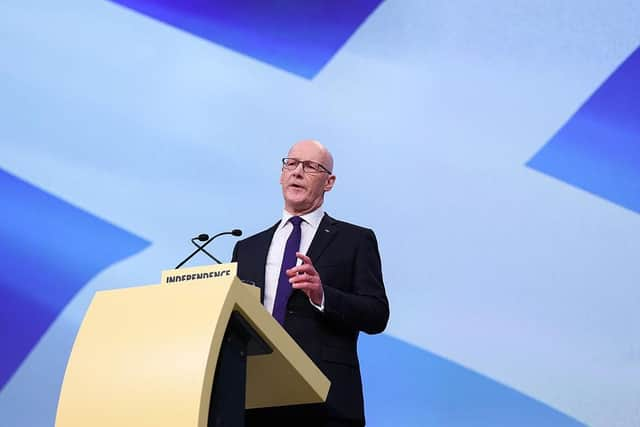

This was a reasonable position to take as, once independent, Scotland would no longer be seeing our National Insurance contributions (and a number of other revenue streams) collected by Westminster and, as we know, successive London governments have failed to build a “pension pot” – instead relying largely on NI payments to fund our UK state pension Ponzi scheme.
Any handover of responsibility for funding and payment would be subject to negotiations between the two governments but, regardless, the UK would remain responsible for funding our state pension to the level earned by each of us by our past NI contributions – unless and until an agreement was made.
There are folk who have spent all of their working lives in Scotland, and others like myself, with 12 years in the Royal Navy and 19 years living and working in London and SE England. Does Dr Marsh really believe that any future Westminster government would renege on pension rights for such folk?
Sorry to disappoint you, Dr Marsh, but your “threat” is little more than scaremongering, unless, of course, future Scottish governments continue to manage our economy as badly as Westminster.
Ian Waugh, Dumfries, Dumfries and Galloway
Tax pain ahead
Rachel Reeves is fighting an economic wildfire on multiple fronts, fuelled by a ready supply of domestic tinder fanned by unrelenting global headwinds. Dowsing the flames urgently needs the anti-incendiary effects of more dynamic growth. But that remains elusive. Meanwhile, fiscal flames climb higher, and firefighting efforts remain constrained by Labour’s manifesto tax pledges, the Chancellor’s fiscal rules and the economic parameters set by the forecasts of the Office for Budget Responsibility (OBR).
Somewhat perversely, the latter has emerged as a source of significant economic heat. How so? Central to the OBR’s forecast is “productivity”. Here OBR forecasts have mainly relied on the pre-2008 trend rate of productivity growth of around 2 per cent per annum. This was believed to be an equilibrium to which the UK economy would naturally return. It hasn’t. In recent times, the OBR has assumed lower productivity growth of 1 per cent per annum, but the trend rate post-2008 has out turned at an even lower 0.5 per cent per annum. A further reduction in the OBR’s assumption is now widely expected.
Unfortunately, for the Chancellor, a downward revision of just 0.1 per cent in productivity growth equates to a multi-billion-pound shortfall in public finances. Leading independent forecasters now warn Ms Reeves faces a deepening fiscal black hole of anything between £20-£50bn – with productivity revisions estimated to account for a hefty £10-£20bn of the shortfall. This self-made fire, born not of the workings of the real economy but of the imperfect science of economic forecasting, will lead to larger than expected tax hikes. More pain beckons for hard-pressed taxpayers.
Ewen Peters, Newton Mearns, Glasgow
Keep speech free
As a technology teacher of 25 years, I am increasingly concerned by the growing use of Strategic Lawsuits Against Public Participation (SLAPPs) by powerful companies — including within the rapidly expanding field of Artificial Intelligence. These legal tactics are designed not to win in court, but to silence critics and watchdogs through the threat of financial ruin. Such behaviour undermines democratic scrutiny just when public oversight of AI ethics, safety and regulation is most urgently needed.
I have written to my MP and MSP urging them to strengthen anti-SLAPP protections in both Westminster and Holyrood. The right to question, investigate and debate new technologies must never depend on the size of one’s legal budget.
If Scotland wishes to lead in ethical and transparent AI development, it should also lead in ensuring researchers, journalists and civil society voices are free from intimidation.
Peter Cairns, Blairgowrie, Perth and Kinross
Police grammar
Susan Dalgety’s latest article mentions Jack McConnell’s understanding the power of education to transform individual lives (Perspective, 19 October). It is unfortunate, therefore, that our educational system – certainly with regard to English – has dropped well below the standards that I was taught in the 1950s.
By way of illustration, while many examples are expounded on the misuse of the apostrophe and of the need to understand plural verbs, we need look no further than a flyer I received through the post last Friday. It proudly displays a footnote, “The countries largest selection of furniture…”. Even my spell checker wants me to change this.
J Lindsay Walls, Edinburgh
Write to The Scotsman
We welcome your thoughts – NO letters submitted elsewhere, please. Write to [email protected] including name, address and phone number – we won't print full details. Keep letters under 300 words, with no attachments, and avoid 'Letters to the Editor/Readers’ Letters' or similar in your subject line – be specific. If referring to an article, include date, page number and heading.
Comments
Want to join the conversation? Please or to comment on this article.