
Readers' Letters: Outdoor blazes aren't always caused by climate changed
Scotland has been burning for a long time, says reader
I don't think anyone would fault the UK government for banning the sale of disposable barbecues.
They must be one of the main causes of fires breaking out all over the UK, in North America and in Europe. The advent of the disposable barbie has allowed people to take them to quite inappropriate places to cook and eat. They are then often abandoned.
What needs to change, however, is the quite misleading name of “wildfires”. Certainly, the fires are caused by man, but not by “climate change”. The fires caused by barbecues, vapes and cigarettes are not “wildfires”. They are simply man-made. A better name should be chosen for them.
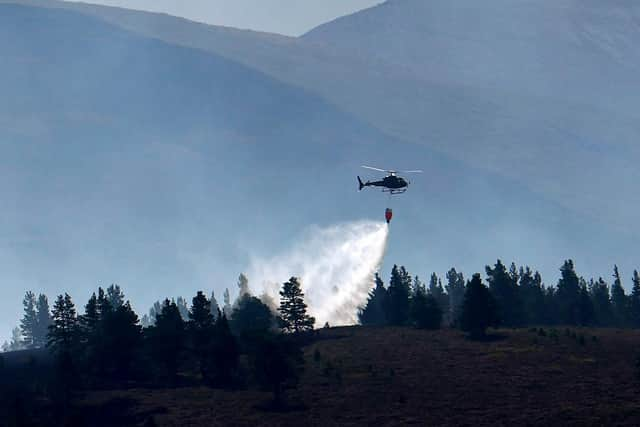

In that regard, for example, consider a fire “raging in Aberdeenshire for almost a week, destroying 50,000 acres of moorland and 700 acres of timber on Deeside”. It extended for ten miles and involved “hundreds of firefighters wearing smoke masks”. Pretty alarming! The cause? It was “kindled by a picnic party”. Sound familiar? Climate change? Well, maybe, but that was in July 1921.
Or, this when “gamekeepers and shepherds had an anxious time preventing the spread” of fires “over miles of moorland” due to “the heatwave and dryness of the grass and heather”. When? In May 1935. The suspects? “Picnic parties are believed to be responsible.”
What goes around comes around. This is quite normal and was common in the 1920s and 1930s.
As Channel 5 showed in a programme last week, it was also typical in 1975 and 1976.
It is people being careless and inconsiderate, not climate change.
Andrew HN Gray, Edinburgh
Oil and gas needed
The Scotsman reports that David Whitehouse of Offshore Energies UK states that “oil and gas provide 75 per cent of the UK's energy” (17 August), and Mr Whitehouse is correct.
You also report that Gillian McKay MSP, the co-leader of the Scottish Greens, describes the development of the Rosebank oil field 80 miles north west of the Shetland Isles as “a climate-wrecking project”, and Ms McKay is wrong.
The UK's energy use has dropped by a quarter since 2010 thanks to the offshoring of our heavy industry and rocketing cost of electricity caused by the so-called "just transition". UK economic growth has stagnated during that period, because less energy use generally means less growth. Modern life depends on the secure supply of oil and gas, not insecure supplies from war-torn countries through the Strait of Hormuz, or shutting down the economy to save a fraction of 1 per cent of the world's man-made CO2.
The climate zealots claim that somehow wildfires spontaneously erupt when the temperature rises into the thirties; I submit that nearly all wildfires are caused by human action. And fighting those fires requires equipment made from the products of oil and gas, and coal to make steel. Diesel fire engines and fire pumps which can run for hours, and fire hoses made from polyester, nylon and polyurethane, and helicopters running on jet fuel or Avgas are needed to fight wildfires. We couldn't fight them without hundreds of products made from hydrocarbons.
The Prime Minister must put Britain first and give the go-ahead for Rosebank and Jackdaw – and reduce the punitive taxation of the industry.
William Loneskie, Oxton, Lauder, Scottish Borders
Release report
Under pressure, the UK government has published a redacted version of a shocking report on climate breakdown, by none other than the joint intelligence committee. Called “Global Biodiversity Loss, Ecosystem Collapse and National Security”, it was supposed to be published in October 2025. But it seems the government wanted to hide the report and the government’s reckless failure to respond.
The report warns that national security, financial property and food security are likely under threat from the climate crisis which will result in collapsing ecosystems that support food production. It discusses “planetary boundaries”, which are safe limits for life on nine Earth systems essential for planetary stability eg climate change, biosphere integrity, oceanic acidity. Six of these are already crossed so “ecosystem degradation” is happening. Unless we stop global warming, we are going towards a planet where there is an “irreversible loss of function beyond repair” – ecosystem collapse. The government knew all this and yet didn’t tell the public or make plans.
Also, unfortunately, the public have failed to connect climate breakdown and fossil fuel emissions from burning coal, oil and gas – with much of the media complicit in not pointing out the connection and ignoring IPCC findings. The UK neoliberal government needs to get real and publicly state this connection and IPCC findings and relate these to the Jackdaw and Rosebank applications.
Andy Burnham’s government must take national security seriously and release the full report without delay, promoting widespread discussion to find credible ways forward in line with climate science, including urgent investment, diverted from military and any new fossil fuel spending.
There needs to be a decentralising of energy infrastructure, making it publicly owned. Countries that transition to renewables are more resilient and will do better economically anyway.
P Yates, Edinburgh
Insane economics
I read with interest the thoughtful and thought-provoking Perspective article by Brian Wilson on GERS (Scotsman, 15 August). I have read other perspectives on the same subject but his was the most balanced and informative by far, alluding as it did to the significant land mass of Scotland which should not be ignored.
It is indeed legitimate to note, “Compared to the rest of the UK, Holyrood gets an extra £2,720 for every man, woman and child”.
We should note also that as part of this lopsided equation every man, woman and child in Scotland gets Holyrood. Already the compensation starts to look significantly less generous.
The SNP administration in Holyrood should be likened to a 19-year-old who cannot tie their shoelaces – under such circumstances it would be idiotic to give them the car keys.
(Dr) Steven William Welsh, Stornoway, Western Isles
Will power
With the people of Scotland continuing to seek self determination, the very personable and proactive Prime Minister Andy Burnham has said he will extend devolution in Scotland, Wales and Northern Ireland.
However, the fact is that devolution is the gift of “others”, while independence is the direct will of the people! There is now record democratic support for self-determination in Holyrood and the Senedd, along with Irish unification, that cannot be ignored.
The insular London ruling class will have to accept this can only be decided by the people of these ancient sovereign Celtic nations.
Grant Frazer, Newtonmore, Highland
Misplaced belief
It must be wonderful to live in the imaginary world of Jill Stephenson (Letters, 17 August) where everything in the “United Kingdom”, including Scotland, is just hunky-dory and there is no apparent need for devolution or the SNP, never mind independence. Unfortunately, in the real world, Ms Stephenson’s criticism of Alex Orr’s words simply reveals the paucity of her own arguments for sustaining a broken union.
If the UK government, with unrestricted financial control, cannot deliver “a foolproof plan for making Scotland more genuinely prosperous”, it does not seem reasonable to expect those who support Scottish independence to produce such a plan based on the highly restricted fiscal arrangements currently confronting the Scottish government.
Stan Grodynski, Longniddry, East Lothian
Complex history
Regarding “The US lawyer bringing slavery museum to Scotland to highlight country's role” (your report, 15 August), there is certainly a good case for greater recognition of the part Scots played in the Atlantic slave trade, as US lawyer Bryan Stevenson argues.
But there is also a good case, which he and too many academics and other commentators ignore completely, for the current rulers in West Africa to acknowledge that without their predecessors’ brutal and profitable part in the supply chain of slaves to the European traders, that disgraceful trade would not have existed at all, or at least not existed to the same extent.
They also tend to ignore the slavery by North Africa’s Barbary Coast raiders for their abduction of an estimated 1.25 million victims from Portugal to Iceland and throughout the Mediterranean.
Finally, it is wrong to state that Edinburgh Council “put in place a permanent interpretive plaque at the Melville Monument in St Andrew Square to explain Henry Dundas’s role in delaying abolition”. The wording makes no attempt to explain or interpret fully his role and reasoning; it is so partial, in both senses, that like many half-truths it is little better than a deliberate falsehood.
It ignores that Dundas and William Wilberforce were good friends sharing the same objective, but as the practical politician Dundas knew well that the 1792 parliament would not accept immediate abolition as advocated by Wilberforce.
So “gradual” abolition of the trade by 1807 was voted through successfully (followed by total emancipation in 1833); not ideal of course, but the alternative might well have been much worse, delaying both by longer.
John Birkett, St Andrews, Fife
Write to The Scotsman
We welcome your thoughts – NO letters submitted elsewhere, please. Write to [email protected] including name, address and phone number – we won't print full details. Keep letters under 300 words, and in the body of the email – no attachments – and avoid 'Letters to the Editor/Readers’ Letters' or similar in your subject line. If referring to an article, include date, page number and heading. No poems.
Comments
Want to join the conversation? Please or to comment on this article.