
Readers’ Letters: Nato is not ready for conflict with Russia
A retired naval officer says the unsentimental reorganisation of the UK armed forces is essential to deter Russia from attacking
The head of Nato has warned that the UK and allies must prepare for war. Putin’s threats cannot be ignored. Si vis pacem, para bellum – we must. Putin preys on the weak and Nato, particularly Europe, is nowhere near ready to deter Russia.
The UK must bring up to standard those ships, aircraft and land forces’ equipments we have today. Action must be taken to improve recruitment and, particularly, the retention of service personnel. Smart use of cyber and development of drones is a priority. Much more investment in new equipment is urgently required.
The Ministry of Defence must be organised more efficiently, both financially and operationally. Defence is now far too expensive for any European nation to do everything. Maritime Britain must be the UK priority (trade, British interests worldwide, protection of home waters and the Eastern Atlantic) while other European nations are better suited to provide most of Nato’s land and air forces.
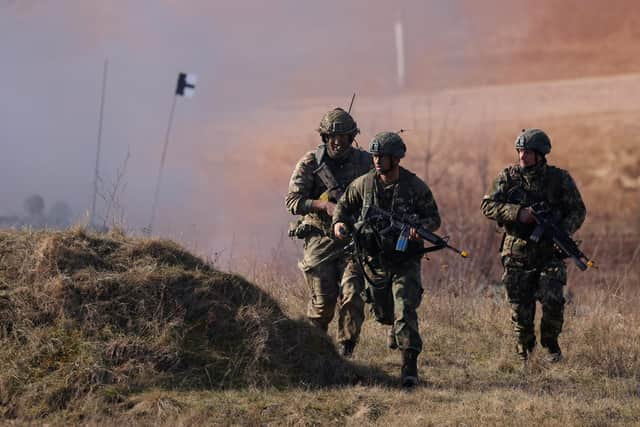

Unsentimental reorganisation of defence is essential. It is fortunate that the present heads of the Army, Royal Navy and Royal Marines have led UK Special Forces, noting that the present Chief of Defence Staff and his Vice Chief are, arguably, Whitehall warriors.
Lester May (Lt Cdr, Royal Navy, retired), London
STEM matters
Our media often report on government comments regarding the importance of STEM subjects in our schools, looking forward to future employment needs in the digital and AI era.
Therefore it was heartening to read of the recognition of one of our primary school teachers (your report, 15 December) being shortlisted for his teaching excellence in STEM subjects and of his engagement with others in promoting best practice in these important subject areas.
Interestingly, if successful, he would use the financial award to address the “financial barriers that often limit access to high quality STEM learning”.
Elsewhere in the paper, Scott Reid reports on Digital Xtra, a charity which provides grants to “support delivery of extra curricular computing and digital tech activities”.
These two articles perhaps indicate how pupils are held back from fulfilling their full potential through lack support, facilities and teachers that aspire to excellence in teaching these subjects.
Increasing teacher numbers in our schools and in higher education is perhaps not the panacea for improving the uptake in these important subjects. More important is the quality of teaching, environment for learning and pupil interest in these subjects.
Obviously the current management of the education system is failing the country, particularly when the emphasis is on the number of pupils with ASN support.
This is not an area that our classroom teachers should spend time on. ASN is a social problem that needs to be addressed and dealt with outside the classroom of pupils who wish to learn without disruption. The sooner our education hierarchy get their act together and address the issue sensibly, the sooner our pupils can start to start to learn.
A Lewis, Coylton, South Ayrshire
Genuine change
Where now for Labour, the party of “change”? From the outset, Keir Starmer made it perfectly clear he was more in tune with the Blairites who had hijacked the party from the last vestiges of true Labour values.
Promoting the discredited values of Blairism was a mistake. Support really started to plummet when Labour started to target pensioners, disability claimants and parents who needed a hand-up in our unequal society.
The first clue for me that Labour was going to be the party of the wrong type of change was when Labour members elected a “Sir” as leader instead of someone who wanted to change the class divide, not embrace it. Meanwhile, levels of riches that beggar belief have been created, while inequality of income and education have risen to unacceptable levels.
Chancellor Reeves says Labour will grow our economy. But, if the benefits of are not shared properly, this could lead to more unemployment, more poverty and more benefit claims. Labour needs to start looking at increasing taxation for some and reducing taxation for others. If change is to be more than just a vacuous promise Labour needs to start looking at a more progressive and fairer form of taxation.
Jack Fraser, Musselburgh, East Lothian
Consequences
Alex Orr (Letters, 15 December), suggests that if we vote for Reform next year it would take Scotland into a very dark and uncomfortable place.
Is that to suggest that the typical Scottish voter doesn’t think about the consequences of his/her vote? If so, is that why we’ve been saddled with declining standards in just about every area for the last 20 years under the SNP?
Bruce Proctor, Stonehaven, Aberdeenshire
Repair bridge
As a hillwalker and a railway enthusiast, I was saddened to hear of the collapse of the Garmouth Viaduct (your report, 15 December). If the bridge is indeed beyond repair and a replacement has to be built, this replacement should as far as possible resemble the original bridge. From the photographs of the collapsed bridge, the bowstring girder part of the bridge appears to be intact, and this is the bridge’s distinguishing feature which should be retained. It is a fine looking bridge and part of Scotland’s railway history.
In Scotland we have many marvellous railway bridges, one of which is the most famous railway bridge in the world, namely the Forth Bridge. Following the Beeching closures of the 1960s many bridges on the closed lines were retained and became part of walkways and the Garmouth Viaduct was one such bridge. But there have been losses. The distinctive looking Creagan Bridge on the former Ballachulish branch line was demolished in the 1990s. Only the piers were retained and used to support a plain-looking road bridge. Everything possible should be done to restore the Garmouth Viaduct to its original form.
Robert Kelly, Dumbarton, West Dunbartonshire
Feminist icon
I have just read the brilliant article “Feminist icon: Sandie Peggie standing up for the women of Scotland” by my favourite columnist, Susan Dalgety (Scotsman, 13 December). She is my voice in the “gender wars”.
How simple it seems for me, 71 years old, to know: there are some men who think they are women. They are not. They are just some men thinking they are women.
As a young university student more than 50 years ago I used to wear men’s clothes, keep my hair very short and wear zero make-up – just comfortable, cheap and simple (although not the best way to get boys’ attention, I admit). This costume didn’t make me a boy, though. Being a woman is so much more than long hair and earrings!
Zofia Neilson, Dunfermline, Fife
Food security
As families across the country sit down to enjoy their Christmas dinner, it is worth reflecting on the people who make that meal possible.
Our farmers, crofters and fishermen do not switch off at Christmas. While others take a well-earned break, they are often working through the cold, the dark and the worst of the winter weather to keep food on our tables.
Food security is not an abstract concept. It begins in our fields, on our hills and out at sea. It depends on people who rise early, work long hours and accept uncertainty as part of daily life.
These are not just jobs; they are livelihoods rooted in tradition, skill and responsibility. Without them, there is no Christmas turkey, no potatoes, no seafood, and no local produce to rely on when supply chains fail.
Recent years have shown how fragile imported food systems can be. Disruption, rising costs and global instability have highlighted the importance of producing food at home.
Yet too often those who provide it are burdened with excessive regulation, rising costs and a lack of meaningful support. That approach is short-sighted and dangerous.
If we are serious about food security, we must be serious about backing the people who deliver it.
That means fair pricing, sensible policy and genuine respect for the work they do. This Christmas, as tables are set and plates are filled, we should remember those who made it possible and ensure they are supported, valued and protected for the future.
Cllr Alastair Redman, Islay, Argyll and Bute
Direction of travel
The EU was set to ban the sale of new petrol and diesel cars from 2035 but of course the UK has to lead the world by banning them from 2030. However, in a blow to Ed Miliband and the green brigade the EU looks set to move the date to 2040.
What will Ed do now? Resign, we all hope. The German chancellor Fried Merz supported the 2040 date, pointing out the “reality is that there will still be millions of combustion engine-based cars around the world in 2035, 2040 and 2050”. There are 1.645 billion vehicles in the world and the UK only has 34 million – or 0.02 per cent – so EVs are just green posturing. Thankfully jobs in the car manufacturing industry will be saved.
All around the world countries are falling out of love with net zero and most did not sign up to it anyway. The UK is responsible for only 1 per cent of global emissions. This does not merit the colossal job losses across all sectors that net zero has and is inflicting.
Clark Cross, Linlithgow. West Lothian
Write to The Scotsman
We welcome your thoughts – NO letters submitted elsewhere, please. Write to [email protected] including name, address and phone number – we won’t print full details. Keep letters under 300 words, with no attachments, and avoid ‘Letters to the Editor/Readers’ Letters’ or similar in your subject line – be specific. If referring to an article, include date, page number and heading.
Comments
Want to join the conversation? Please or to comment on this article.