
Readers Letters: Music cuts to schools would be massive mistake
Withdrawing music lessons from Dumfries and Galloway pupils would be a disaster, says reader
With horror I read the consultation document put forward by Dumfries and Galloway council as they seek to slice money from their outgoings in order to balance the books. At the very top of the list was the proposal to completely cut the young peoples’ music service. No such act of cultural vandalism should be countenanced by the people of Dumfries and Galloway.
Although I live in D&G, I work internationally in the classical music industry as a singer, and I perform at venues in cities such as New York, Paris, Copenhagen and Berlin, as well as in the UK. My start in music included taking council-funded simple violin and trumpet lessons in the store-room of my primary school hall. Although the economic situation was poor at the time, the councillors understood the value of funded music for children, and I was a beneficiary.
Now, with my own children in the D&G educational system, I know from experience that the D&G music service is made up of dedicated people who not only have a passion for the music they teach but also for the great benefits that accrue to the children they tutor. They have worked hard to bring the music service back to a healthy state after a long period of decline. It would be a tragedy if it were to be destroyed now.
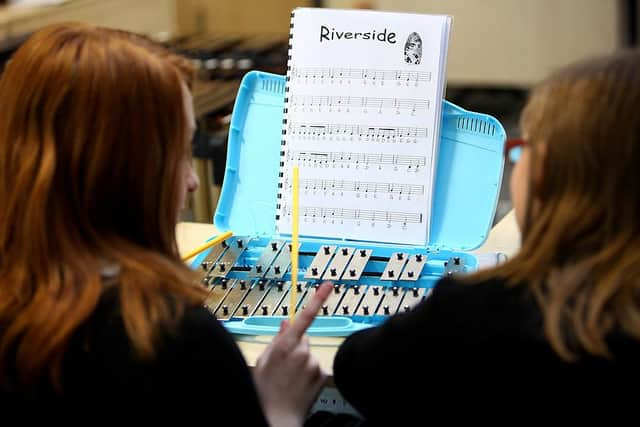

What is further to this madness is the fact that the council receives £305,000 per year from the Scottish Government to pay for instrumental lessons. If the proposal to scrap the music service goes ahead, a possible saving of £300-£550,000 over three years would be eclipsed by the loss of a certain £915,000 over the same three years.
My appeal to the councillors of Dumfries and Galloway is to refuse to cut the school’s music service. Instead, the aim should be to expand it! The benefits of making music are now so well known and go far beyond the cultural aspect of music itself to the building up of school communities, the improvement in children’s academic achievement, the inclusion and encouragement of quieter and less confident children, and a guard against poor mental health as children find an outlet for their creativity and emotion.
The music service in fact pulls more than its own weight in the benefit it gives to the local area and to the costs that are subsequently unspent by the council. All these benefits are quite apart from the bounty that comes to us all. If we cease to teach and train musicians, who will play for our ceilidhs, weddings, funerals, civic services, pop concerts, film soundtracks, Edinburgh Tattoo? It would seem that if this cut is made, few young people from D&G will ever have the opportunity to express their culture in this way.
Joshua Ellicott, Dunscore, Dumfries and Galloway
Blurring terms
Tim Hopkins’s letter (18 November) in response to mine (17 November) illustrates the very muddling of categories whose clarity I argued is essential for protecting same-sex-attracted people.
Mr Hopkins states that “sexual orientation equality is that consenting adult partners should be free to choose each other without any detriment based on what sex they are or are perceived to be”. This is not what “sexual orientation” means under the Equality Act 2010, wherein sexual orientation refers to attraction to people of the same sex, the opposite sex, “sex” here being in biological terms. A perception of being a different sex does not make someone that sex for the purposes of the Act, any more than a perception of disability makes someone disabled.
LGB people were persecuted – and in many contexts still are – because of the reality of their same-sex behaviour. The Act recognises this history and protects LGB people accordingly. As a seasoned gay campaigner, Mr Hopkins will know this; yet as a seasoned trans activist he chooses to deploy linguistic obfuscation to signal solidarity elsewhere.
When Mr Hopkins suggests that “social reactionary campaigns expand from opposing trans equality to opposing LGB equality too,” he overlooks the fact that it is the blurring of sex and gender identity by him and others – including the forced-teaming of “LGB” with “TQ+” – that fuels the very backlash he warns against.
No meaningful equality is served by erasing the sex-based foundations of same-sex orientation. Nor is it served by Mr Hopkins punching down on his own by pretending that biological sex is irrelevant to people’s lives, loves and protections in law.
Brian Forsyth, Edinburgh
Identity politics
Interesting article from Brian Monteith, wondering if John Swinney has just been “lucky” (Perspective, 18 November). Or, is there another explanation for SNP support?
Might not the answer lie in Scottish identity politics, ie, many people vote for them on identity and not on performance? The SNP have persuaded many that if you are “Scottish” you should vote for “Scotland's party” ie the SNP.
However, being “Scottish” does not make you a nationalist!
William Ballantine, Bo'ness, West Lothian
Reform BBC
Context is everything. While much has been written in recent days of deteriorating professional standards at the BBC and of questionable impartiality, little has been written about the reduction in pertinent context over recent years.
The pursuit of populist soundbites to feed a predominantly English audience appears to be the BBC’s primary goal today, not only of news programmes but also of the Laura Kuenssberg, Politics Live and Question Time shows. With a lack of appropriate context, partial framing and pejorative sound-bites, the offerings of GB News and the BBC have become increasingly similar and beg the question, why then should the public continue to fund such a declining supposedly public service.
This question is particularly apt in Scotland where BBC resources, along with those of Sky and ITV, appear to be focused on presenting news stories and political events in a form that exploits shortcomings in Scotland in order to enhance the popularity of news stories presented to English viewers.
A restructured and revitalised BBC Scotland, governed separately and with the authority to truly act independently of London to the full extent of the licence fees raised from the Scottish public, could address professional shortcomings, significantly enhance Scotland’s political discourse and greatly stimulate Scottish creativity, but that would seemingly require the UK Government to devolve control over broadcasting in Scotland.
Regrettably, this will not happen until Westminster values promoting the highest level of professional standards at the BBC along with serving the public in Scotland to a level equivalent to serving the public in England.
Stan Grodynski, Longniddry, East Lothian
Sport injustice
When I was in primary school, I lived where I could hear the Hampden Roar and the cheers from Ibrox. Football touched my life whether I liked it or not, and it taught me early that Scotland’s passions and conscience are one and the same.
As I grew older, I heard the phrase “sports and politics don’t mix” when some teams went to South Africa to play the Springboks. That was when I became aware of apartheid. I have to admit now that the apartheid philosophy made no sense to me; people are people, regardless of colour or creed.
In this light, you might understand my frustration with the sports world’s double standards. South Africa was banned for apartheid. Russia, after its illegal invasion of Ukraine, was swiftly excluded by UEFA and FIFA.
Yet Israel, expelled from the Asian League and now accused of genocide, was welcomed into UEFA and continues to play in European competitions — even competing in FIFA World Cup qualifiers as part of Europe.
This situation is unconscionable. Will we let Scottish football be complicit in genocide?
Judith Campbell, Portree, Highland
Holy silly
Lilliput Church of England Infant School in Dorset has banned the singing of songs from hit Netflix film KPop Demon Hunters because demons are, “opposed to God and goodness".
The girl characters are in a band and fight evil in their spare time. “I’m done with hiding, now I’m shining” they sing. What’s not to like about that? Despite that other parents have defended the “positive messages from the songs”, it seems that in Church of England schools, fun and confidence building in young girls is trumped by religious privilege and fear of the demons.
Neil Barber, Edinburgh Secular Society
Water nonsense
After reading the article “Scots urged to change relationship with water”, (Scotland on Sunday, 16 November) I had to check the date wasn’t 1 April.
For years, as a frequent imbiber of various tipples, being told that Scots have to change our relationship with alcohol, now we are told to address our love of washing, showering and no doubt consuming water for health reasons. Perhaps those dimwits in charge could address their relationship with water.
Fixing leaking pipes would be a great start, and perhaps the most radical option would be to build more reservoirs – something that hasn’t happened for over 30 years.
As is the usual case, it’s blame Joe Public for the errant ways of government and local authority woes.
I would suggest that, given the abundance of my favourite Lager, Loch Katrine isn’t about to run dry any time soon. Thus I will continue to wash, clean and drink to my hearts content. Let the officials in the asylum earn their wages and sort the infrastructure, rather than “educating” the great (un)washed population!
David Millar, Lauder, Scottish Borders
Write to The Scotsman
We welcome your thoughts – NO letters submitted elsewhere, please. Write to [email protected] including name, address and phone number – we won't print full details. Keep letters under 300 words, with no attachments, and avoid 'Letters to the Editor/Readers’ Letters' or similar in your subject line – be specific. If referring to an article, include date, page number and heading.
Comments
Want to join the conversation? Please or to comment on this article.