
Readers' Letters: Mess in Ben Nevis bothy is the height of ignorance
A reader says yobs leaving rubbish behind are showing disrespect to the mountain and civilised climbers
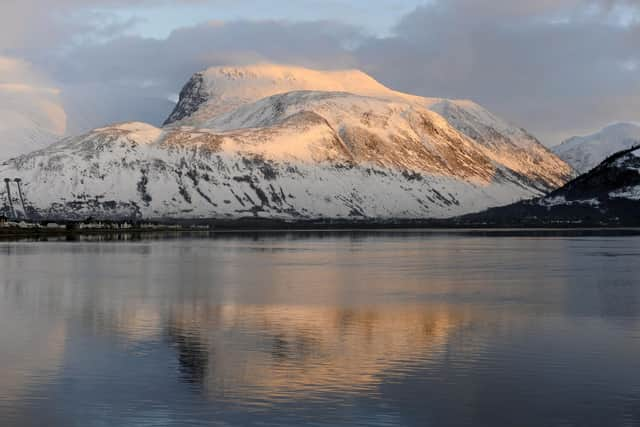
It is desperately sad, not only to those of us who have climbed Ben Nevis (the Mountain of Heaven) several times, to see your picture of its pristine beauty alongside the squalid mess photographed inside the bothy on its summit (your report, 22 September).
My granddaughter and her father climbed it two weekends ago, and were appalled at the plastic bottles and bags forced into the cracks between the stones of the summit cairn, plus fruit peel and other junk scattered over the ground.
It not only disrespects The Ben but all the civilised climbers who follow these utter yobs, particularly those who need to use the bothy for its intended purpose. What goes on in their pinheads, that having carried the stuff up they cannot even carry their remaining packaging down?

I bet that would not occur in Japan, where my son and his wife are now enjoying a holiday in its invariably clean and tidy environments. But then I wonder if Japanese climbers contribute to the detritus left on Everest...? I despair.
John Birkett, St Andrews, Fife
Whisky galore
There seems to be a degree of antagonism arising between the Scottish whisky industry and that in Wales and England (Letters, 22 September). This arises from the different ways in which malts in each are produced. It seems that English producers are not bound by the same exacting rules as those applying to “Scotch”.
I would have thought that our whiskies have the edge because they are more exactingly produced and are single distillery malts, whereas English ones are more general, allowing mashing and fermentation off-site and will not be likely to challenge the individual subtlety of those produced north of the Border.
I would suggest that English whiskies should carry an “appellation contrôlée” indicating that English malts are from general areas – for example, Cumbria, or the East Anglian fens – to differentiate them from the finest Scotch Glenfiddichs, Macallans and Lagavulins.
They should also have a distinct and different name. Clearly, they can’t be “Scotch”. I would suggest that “Englitch” would be a suitable name. It's even more irritating than “Scotch”.
Andrew HN Gray, Edinburgh
Airport cash
An investment of £500 million on Edinburgh airport (your report, 22 September) could be well spent, on enhancing passenger facilities such as lifts, escalators and travelators, or it could be spent on more retail outlets, grotty eateries and crowded gates.
The problem is that the management in charge of the refurbishment has already demonstrated how little it understands what is currently wrong with the entire airport and how little it seems to appreciate the strides that have been made by competitor airports in Europe.
I’d like to think the £500m would achieve genuine improvement in Edinburgh, but ah hae ma doots.
Jill Stephenson, Edinburgh
No means no
Does David Bol really believe that the only way to put an end to the SNP’s hold over Holyrood and the independence question is to have another referendum (Scotsman, 23 September)? The nationalist tendency will never accept any answer other than yes, and will keep agitating for it until they get the answer they desire.
Pauline Carruthers, Edinburgh
EU’s temptations
Andy Burnham seems minded to override the result of the Brexit referendum and take us back into the EU, because he wants to. This surely will make life difficult when John Swinney reminds him that he didn't like the result of the Scottish referendum.
Our First Minister gives the impression of someone who thinks all his failings will vanish overnight after he “rejoins” the EU. Perhaps he could tell the people of Scotland what negotiations the SNP have had with the EU, regarding membership of their club, what joining fee has been agreed, where exactly is he going to borrow that money and what has he got to offer the EU to make our membership a priority for them.
Bruce Proctor, Stonehaven, Aberdeenshire
Union myth
This week we have seen Andy “king-in-the-north-of-the-very-far-south” Burnham displaying more of his disrespect for Scotland as he smiled and chuckled while President Trump said of his country “you call it the United Kingdom, Britain you call it sometimes England… it’s got more names than any other place in the world”, repeating the message that he had previously delivered to Starmer that England, Britain and the so-called “United Kingdom” are all one and the same.
If anyone ever believed the rhetoric that comes from unionist politicians that Scotland is a valued partner rather than a subservient spouse inconveniently wedded to the toxic union, surely they can now see the place that is assigned to our country.
Burnham was elected to an English constituency and appointed to govern as prime minister by an English party that came to power with no need for one single seat or even one single vote for its Scottish subsidiary. Burnham represents his country and is happy to conflate England with the United Kingdom and Britain to the exclusion of Scotland, the true north of this island that we cohabit. He will serve his country first and ours only when our interests coincide with theirs.
Ni Holmes, St Andrews, Fife
United in disdain
“It’s great to be with you today,” simpered Prime Minister Burnham as he met with President Trump on Tuesday. Great? Really? The American non-partisan think tank the Pew Research Centre surveyed public opinion in 36 countries towards the United States and published the results in June. Overwhelmingly, opinion towards the US was unfavourable.
In Canada 66 per cent had an unfavourable view, in France 70 per cent, in Germany 71 per cent and in Sweden 80 per cent disapproved. Even in the UK with its “special relationship”, 58 per cent had an unfavourable view of the United States. There’s no question that this disapproval is directly caused by the actions and antics of President Trump. It's fair to to believe that since the Pew survey was completed that disapproval will have worsened with Trump now threatening to “annihilate” Iran and as the cost of Trump’s war Iran hits ordinary people in their finances.
In particular the cost and indeed the supply of diesel is nearing crisis point. Merchant ships, fishing vessels, agricultural and construction machinery and road haulage need diesel to function. Put up the price of diesel and you put up the price of everything. Inflation will rise, interest rates will rise, and our already heavily indebted economy will stall. Did Mr Burnham therefore tell President Trump to withdraw his forces from the Middle East and re-open the Strait of Hormuz and try to get fuel flowing again? He did not. Why not?
William Loneskie, Lauder, Scottish Borders
Dundas plaque
On a visit to St Andrew Square last Saturday, I was astonished to see that the City of Edinburgh Council has restored the controversial Dundas plaque. For whatever reason, the council has chosen to ignore the opinions of leading academic historians and made the elementary mistake of taking a historical event and creating a narrative that simply is out of step with the historical context.
Those attacking Henry Dundas have to address the question of how a slave-supporting Parliament at that time was ever going to vote for abolition. The motion proposed by William Wilberforce would have faced certain defeat in the House of Lords as well as the opposition of King George III and members of the royal family. A previous attempt in 1792 to pass a motion for abolition had been very heavily defeated. Dundas knew perfectly well that Parliament was packed with members who had strong vested interests in the slave trade. It would take years for the force of the moral argument against the vile trade to have any chance of success.
There were other serious matters for Dundas to contend with. Britain was then at war with Revolutionary France and was faced with the real prospect of invasion. Furthermore, the British establishment was terrified that the success of the French Revolution might inspire similar uprisings in the UK. The country was in turmoil and it fell to Dundas to try to restore order at home and to meet the French threat.
During the debate in 1792 Dundas, determined to keep the issue on the statute book, proposed a gradual path to abolition stating that “My opinion has been always against the slave trade.” Indeed it was Dundas who had taken on the case of the West Indian slave Joseph Knight in 1777 which successfully established that there was no slavery in Scotland. So it is quite wrong to state that Dundas was fighting a rearguard action against abolition and that he alone was responsible for condemning some 420,000 Africans to the horrors of slavery.
It is also wrong to assume that Wilberforce and Dundas were enemies. Dundas advised Wilberforce on how best to take forward his campaign – a campaign that succeeded in 1807.
Eric Melvin, Edinburgh
NEET idea
I wonder what would happen if the government proposed to reintroduce National Service. How many NEETS would suddenly find work?
Alastair Paisley, Edinburgh
Write to The Scotsman
We welcome your thoughts – NO letters submitted elsewhere, please. Write to [email protected] including name, address and phone number – we won’t print full details. Keep letters under 300 words, and in the body of the email – no attachments – and avoid ‘Letters to the Editor/Readers’ Letters’ or similar in your subject line. If referring to an article, include date, page number and heading. No poems.
Comments
Want to join the conversation? Please or to comment on this article.