
Readers' letters: Learn the lessons from previous merger of health boards
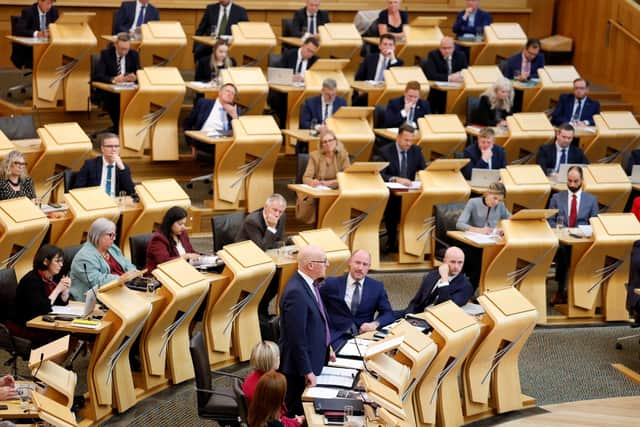
Readers share their concerns about the reduction in the number of health boards announced by the John Swinney in his Programme for Government
So the Scottish government intends to reduce the number of mainland health boards from 11 to two (your report, 2 September). One hopes they have not forgotten the lessons to be learned from the integration of Clyde Health Board with Greater Glasgow Health Board in 2006.
The Vale of Leven Hospital Public Inquiry unearthed a significant amount of material relating to the financial, management and governance implications of that process. On the other hand there was a dearth of documents demonstrating that any consideration had been given to the implications for patient care of such a major reorganisation. This led the Inquiry to include the following among its recommendations to Scottish government in its report:
“In any major structural reorganisation in the NHS in Scotland a due diligence process including risk assessment should be undertaken by the Board or Boards responsible for all patient services before that reorganisation takes place. Subsequent to that reorganisation regular reviews of the process should be conducted to assess its impact upon patient services, up to the point at which the new structure is fully operational.”

There are numerous other lessons to be learned from the Inquiry, and it is to be hoped that those responsible for implementing such radical changes will read the relevant chapters of the Inquiry Report with care so that the errors of the past are not repeated.
Nigel Orr (Solicitor to the Vale of Leven Hospital Inquiry), Linlithgow, West Lothian
Secret plan
Scotland used to be known for its probity. How can the electorate be told of the full story of the deeds of the SNP government two weeks after an election held every five years?
Government employees in the NHS all over the country saw us through a pandemic. They do not deserve to be shocked en masse with the possibility of unemployment or, if lucky, the problem of relocation of their families. These are net contributors at present to our society. They pay taxes and spend money in communities. So many people, usually self-sufficient, unemployed at once and not able to pay mortgages will impact the whole country. Reduce their numbers if need be at a reasonable rate and time but this is cruel and foolhardy. The last thing the public need is an insecure, worried NHS workforce. Who can blame them if they go on strike?
Where are the two health boards to be based? No doubt one will be in Edinburgh, swamping even more a once beautiful city and hinterland. Why was this radical NHS plan not detailed in the manifesto in May? Did the newly elected SNP MSPs know of this plan?
Celia Hobbs, Penicuik, Midlothian
Good on paper
In his Programme for Government, John Swinney’s promise that nobody will be waiting more than 26 weeks for hospital treatment by the end of 2031 rings hollow.
My GP said I would need an MRI scan to determine my needs for an operation but he couldn’t authorise one so referred me to the local hospital. The timeline for that is two years two months and two weeks to speak to a consultant to authorise the MRI, which will take ten months to arrange. Then two months to speak again with the consultant to agree which type of op I will need and that will be scheduled to be done within a year. That’s a total of four years-plus.
How will John Swinney have the staff in place to bring the wait times down to 26 weeks? He won’t, but as usual it is a good soundbite.
Elizabeth Hands, Armadale, West Lothian
Merchant Navy Day
Today is Merchant Navy Day. It is easy to forget about merchant shipping and merchant seafarers but over 90 per cent of our trade, by volume, is by sea – some 75 per cent by value.
There are around 50,000 sea-going ships of all types, of 1,000 tons or more, on the seven seas, with a similar number of smaller ships. Almost two million merchant seafarers, the majority from just five nations – The Philippines, Russian Federation, Indonesia, China and India – keep these ships going.
Maritime choke-points worldwide are always a concern, as is obvious from the 6,000 seafarers on some 500 vessels still stranded due to Iran’s denial of safe passage through the Strait of Hormuz.
For the UK, there is one port call every five minutes, every day of the year. Our nation relies on these shipping movements for its survival and, indeed, our islands have not been food sufficient since the 1750s. Significant energy is imported by sea – shipping is the lifeblood of our economy.
Internationally, the UK remains important a maritime nation, its shipping industry employing some 98,000 people, and it remains the centre for many of the world’s professional maritime service providers. Reflect today on the Merchant Navy – you can’t survive without it.
Lester May (Lt Cmmdr, Royal Navy, retired), Camden Town, London
Hooligans’ rights
Interesting letter from Alastair Paisley (31 August) on using police dogs to combat football hooliganism from bygone days in Germany. In our country, now, to do so would probably be against the hooligans’ human rights.
William Ballantine, Bo’ness, West Lothian
Carnegie’s gift
I read with interest your article on the archive to be created for the birthplace of Andrew Carnegie (Scotsman, 2 September).
On a recent visit to the ‘Dunfermline Glen’ park (donated by Carnegie and adjacent to his birthplace cottage) I was appalled at the dilapidated state of the ornate entrance gates at the south entrance and the main gates on Bridge Street. These gates are so severely rusted that decorative parts will have to be restored.
I contacted the Carnegie Trust regarding the matter only to be advised that the maintenance of the Glen is the responsibility of Fife Council’s parks department. Perhaps some of the £40,000 for the creation of an archive could be redirected to the preservation of Carnegie’s golden gift to Dunfermline. He must be turning in his grave!
Gerald Grieve, Dalgety Bay, Fife
Badenoch blow
The Burnham bounce in Scotland contrasts with the fortunes of Kemi Badenoch. Polling by the Diffley Partnership shows Andy Burnham has the highest leadership rating at plus 9 per cent while Kemi Badenoch commands support of 16 per cent of Scots, the same as Nigel Farage, when asked who would make the best PM. Burnham rated at 45 per cent.
It’s unclear why Badenoch is so unpopular here. The Tories have struggled since Margaret Thatcher wrecked Scotland’s industrial base and imposed the poll tax here first. Badenoch was very different to Keir Starmer and her appointment as Tory leader can be seen in that regard. While she has increased support in England, her high-profile visits to Aberdeen to support oil and gas drilling have failed to spark a recovery in her popularity.
A reshuffle of the Tory shadow cabinet (your report, 1 September) sees the abrasive Tom Tugendhat move to foreign secretary and Andrew Griffith, who was partly responsible for the Liz Truss budget, to chancellor. Whether this will be enough to reignite Tory fortunes remains to be seen but Badenoch will need to change her style to more parliamentary and less personal given Burnham, unlike Starmer, will give as good as he gets. One example in June was calling then Education Secretary Bridget Phillipson a “spiteful class warrior” and Badenoch, according to Phillipson, branding her a “gestapo officer”. Childish remarks are inappropriate for any politician, far less the leader of the opposition. Scots voters will have seen through such personal attacks and praise for Starmer after he stood down. The Tories may need to reshuffle their leader if they want to regain trust here.
Neil Anderson, Edinburgh
Save our industry
The continual push from Chinese manufacturers across the board from clothing to vehicles is relentless to satisfy the UK public’s desire for a bargain and the Chinese government’s aim to become a global player, the dominant force to replace the role currently filled by the United States.
Without doubt, every frock, every imported car and finished steel work sold to UK plc removes vital potentially well paid jobs from our country and forces us down a road that will not be a pretty place.
Of course there are answers, but are the public prepared to face the increased pricing that buying British will inevitably bring? Will our government actually understand that growth will not come merely by wishing it?
There has to be a concerted effort right across the board to bring about a possible salvation of our industry. This will mean understanding who actually owns the manufacturing processes, who benefits from the profits, taxation geared to ensure that earned income is fairly taxed and primarily retained for use within the UK. This must be coupled with government action to ensure government expenditure is reduced and focused on growth
We cannot see this as just another “good to do” item that can be kicked down the road to be tackled some time. This is here and now, a last call that the UK government and buying public should take heed of. Yes there are other areas requiring urgent attention but that’s because the can has been kicked down the road so often we’re running out of road.
You may see this a scaremongering. I suggest that our grandchildren may have a different view in 50 years’ time.
A Lewis, West Linton, Scottish Borders
Write to The Scotsman
We welcome your thoughts – NO letters submitted elsewhere, please. Write to [email protected] including name, address and phone number – we won't print full details. Keep letters under 300 words, and in the body of the email – no attachments – and avoid ‘Letters to the Editor/Readers’ Letters’ or similar in your subject line. If referring to an article, include date, page number and heading. No poems.
Comments
Want to join the conversation? Please or to comment on this article.