
Readers' letters: Labour's push for growth will be stymied by tax hikes
A reader says we need a smaller, leaner state able to take a radical approach to economic policy
Now that tax is the biggest concern of Scotland’s SME businesses for the first time (Scotsman, 29 March) and also increasingly for households, given record council tax hikes, perhaps it’s time to assess how this affects Labour’s push for growth.
We learnt from economics at school that tax is a withdrawal, while consumption, along with investment, help drive growth. By being impacted through national insurance and minimum wage increases, and crucially not receiving the same levels of rates relief as business elsewhere in the UK, our SMEs are not able to invest and grow. As a result of council tax increases, for many households the largest non-discretionary outgoing, consumers are not able spend. Low consumption and investment coupled with higher taxation is a recipe for recession, not growth.
Scotland is enduring a major skills shortage with talent from the rest of the UK being priced out by punitive income tax differentials and a lack of foresight in the education system to train youngsters for the jobs of today, never mind tomorrow. As a result of tax changes Scotland is more poorly placed to benefit from the opportunities from advances in biomedicine, AI and the green economy. Instead our economy is becoming similar to Portugal’s, one of the poorest countries in Europe, dominated by a bloated inefficient public sector and tourism.
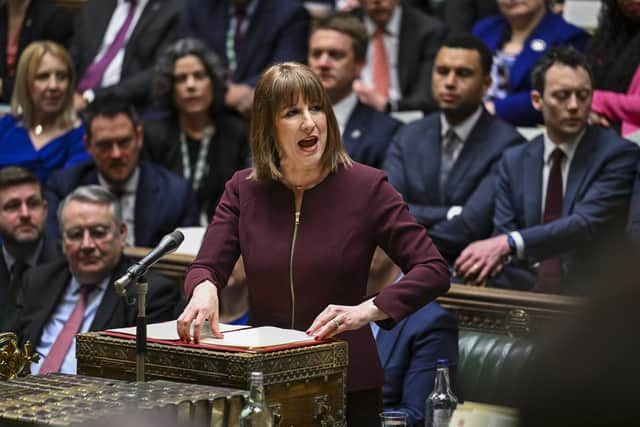

It’s time to rethink economic policy and take a radical approach based on a smaller leaner state that uses tax incentives to encourage talent and innovation. Homegrown SMEs, less prone to the effects of tariffs, are well placed to benefit.
Neil Anderson, Edinburgh
Red lines
The Office for Budget Responsibility (OBR), publishing its economic and fiscal outlook to coincide with the Chancellor’s Spring Statement, noted a continuing weak growth in trade volumes over the coming years. Figures indicate that exports fell 2.2 per cent in 2024, and imports rose by 1.6 per cent.
It notes that this weak growth in imports and exports over the medium term “partly reflects the continuing impact of Brexit”. This is expected to reduce the overall trade intensity of the UK economy by 15 per cent in the long term.
With a Labour government scratching around for levers that will boost economic growth, clearly it may want to re-examine its “red lines” of the UK not rejoining the EU single market or even the customs union.
Alex Orr, Edinburgh
Saving money
Rachel Reeves has stalled the economy with her rise in national insurance, so to plug the hole in Government finances she is hitting welfare. There are better ways of reducing borrowing:
1. Abolish the Household Cavalry and redirect money saved to the defence budget;
2. Reduce by half attendance money for the House of Lords, an unelected and unrepresentative body’
3. Halve spending on quangos. What good do they do?
4. Scrap HS2, a vanity project with no economic case;
5. Tax multinational companies on their turnover, instead of their declared profits, which by transfer pricing they shift to low-tax countries like Luxemburg and Ireland, thereby reducing our GNP.
Colin McAllister, St Andrews, Fife
Willing to work
There is growing concern that a substantial section of the population seems unwilling to work. But is the issue more one of willingness to work or of willingness to hire? It would hardly be surprising if enthusiasm for seeking work flagged among those who come to believe that they won’t be offered a job and wouldn’t be able to hold onto it even if they were.
With the minimum wage progressing towards a living wage, there is a trend for more work roles requiring only relatively easily acquired skills to be paid at this rate or marginally above it. The rate set by the government becomes the norm for workers with these more basic skills and drives the price level that can be charged for the goods and services they generate.
Even for these simpler tasks, there will be a spread of levels of efficiency with which a range of individuals can perform them. Most workers will be within a normal distribution of efficiency and it will be viable to pay them at or above the minimum wage. There will, however, be other potential workers who may be quite capable of doing the job, only at their own perhaps slower pace or with a higher likelihood of errors. If their pay rate could be adjusted downwards accordingly, then it might be economically viable to employ them. But the bar on doing this effectively renders them unemployable.
We have tended to think of the minimum wage as benefiting those whose pay rate is driven up by it. But, arguably, the greater advantage is to those who are exempted and allowed to undercut it, because their competitiveness in job-seeking is increased.
We don’t wish any particular occupational group, such a cleaners, to have their general pay level depressed below a living wage. But if a quota were set (say one in ten) and applied separately to each work role, then this could accommodate many of those for whom the likely alternative is unemployment.
John Riseley, Harrogate, North Yorkshire
Early ecumenism
Doug Clark’s commendation of a primary school ceasing to celebrate Easter (Letters, 27 March) makes no sense to me.
I was raised in a Jewish family and my local state primary school celebrated all religious events without any controversy.
I credit this early ecumenism with making me a more tolerant, curious, and respectful man who supports positive interfaith relations. Don’t ban religious celebrations in schools, instead, use them as teachable moments to promote good will among all pupils.
Professor Joe Goldblatt, Edinburgh
Path to power
Were I a clever, educated, devious, self-centred, megalomaniacal billionaire with the huge political ambition of me, and then my family, ruling in perpetuity my nation; and all with the apparent approval of the population, I could do no better than devise an enabling polity.
To dilute and focus elsewhere any opposition or dissent I would encourage the competition for votes of a multiparty electoral system aided and informed by a media largely owned and supervised discreetly by my notional peers and pals.
Being a good psychologist I would deliberately engineer the occasional outrage, shortage, disaster, scandal or tragedy so the many potential fingers of blame that are always on the look-out for someone or somewhere to point for something would be fully occupied and not suspect me. In fact, me and mine would remain unknown to the public at large. Other faces and persons would be provided to absorb any incipient popular demand for heroes, hate figures or role models.
Benefitting from history, the populace would be provided an updated “bread and circuses” regimen of sports, TV shows, musicians, films, festivals, holidays, religions, criminal outrages, drug abuse, mobile phones and other such pursuits as were needed from time to time to keep my coffers and those of my aforesaid friends filling nicely. Education, health, welfare and commercial/industrial functions would be designed to support and facilitate my ambition,
The occasional enemy, war or natural disaster might be exploited or even added to the mixture where desirable and possible. Indeed, from time to time I might even provoke discontent or even minor wars so that the nation’s factories would keep busy producing the necessary wherewithal for battle, whether on land, sea, air or digitally. All this in the admirable cause of keeping me in power. And given recent behaviour by my autocratic peers I may as well join with them to earn more gold by provoking one or two international threats and several actual incidents.
If such a system requires a name I humbly suggest “democracy”.
Tim Flinn, Edinburgh
Vance v Trump
I didn't think it was possible to be more arrogant than Donald Trump, but now his Vice-President, JD Vance, has convanced me of the opposite. He's also catching up in the loathesome stakes.
Steve Hayes, Leven, Fife
A spent cause
Surely it is more than obvious that the cause of Scottish nationalism has ceased to serve any purpose.
In the early days it had figures such as Gordon Wilson, Alex Salmond, Margaret Ewing, Jim Sillars and Winnie Ewing to the fore but it has now passed its peak and is unlikely to recover. The candidates standing for the SNP at the Holyrood elections in the spring of 2026 will undoubtedly take a complete pasting, as their counterparts did at Westminster in 2024.
The SNP should remember that there would not probably even have been a “Scottish Executive”, or government as they insist on calling it, but for the efforts of a small group of worthies at Glasgow University Union all these years ago – including Donald Dewar, John Smith, Menzies Campbell, Derry Irvine (now Lord Irvine).
The much diminished membership of the SNP, and their few remaining leaders are clutching at straws if they think that the electorate of Scotland is going to support them in the 2026 election.
Robert I G Scott, Ceres, Fife
Write to The Scotsman
We welcome your thoughts – NO letters submitted elsewhere, please. Write to [email protected] including name, address and phone number – we won't print full details. Keep letters under 300 words, with no attachments, and avoid 'Letters to the Editor/Readers’ Letters' or similar in your subject line – be specific. If referring to an article, include date, page number and heading.
Comments
Want to join the conversation? Please or to comment on this article.