
Readers' letters: Labour must think radically to win Holyrood election
A devo-max argument could counter John Swinney’s belief that the ‘limits of devolution’ have been reached, a reader says
Brian Wilson (Perspective, 11 October) is right to suggest that the SNP “make way for fresh ambition” after John Swinney admitted that “we’re reaching or have reached the limits of devolution”. The Scottish Government cannot go any further on policies like eradicating child poverty as it’s being “held back” by Labour’s handling of the economy, Swinney argues. He stepped in to stabilise the SNP after the resignation of the hapless Humza Yousaf. With Kate Forbes not standing at Holyrood next year expect more continuity.
Mr Wilson does not, however, offer any examples of that “fresh ambition” from Labour to suggest it could win at Holyrood. This could be through using existing powers, or as former Labour PM Gordon Brown argued during the 2014 referendum, a devo-max model primarily widening tax-raising powers. The latter, if argued persuasively, could give Labour policy a stimulus in areas like education, more skilled jobs, health, transport and welfare. Some of these areas are fully devolved but all where the SNP government is struggling badly to make improvements, holding back growth
As things stand the only party that is offering to do things radically differently is Reform through US DOGE-style cost-cutting. While addressing inefficient public services is badly needed, a return to austerity is not. Scotland has gone as far as it can with the current devolution model and is staring into a political void. Labour needs to think radically to win at Holyrood next year. A carefully defined devo-max argument would give it a framework to suggest that it could make a tangible difference next year.
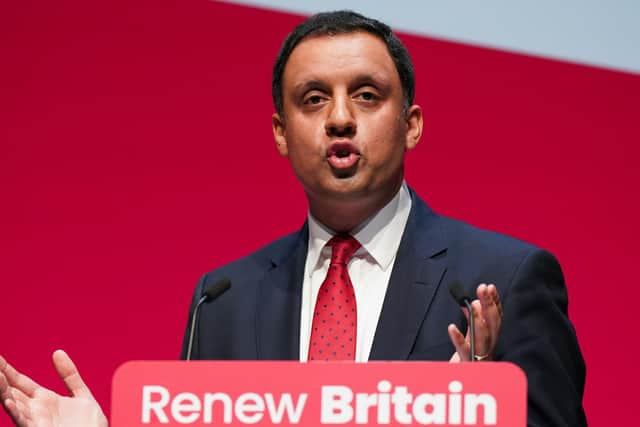

Neil Anderson, Edinburgh
Deluded Swinney
In an extraordinary interview with Martin Geissler on BBC’s The Sunday Show, John Swinney’s only response to the financial realities of a secessionist Scotland was: “Well, that’s the gloomiest of gloomy I’ve ever heard, Martin”. Agreed. The scenario of a separate Scotland using the pound with no control over its monetary policy, and being alone and buffeted by the current international storms, is indeed thoroughly gloomy. Why, then, are there still people prepared to vote for this potential disaster, to be followed by an untried new currency?
We get a clue from E Campbell (Letters, 11 October). He rehearses the tedious old nationalist saw about ’65 countries’ once ruled by the British now being independent. How many of these 65 were ever – as Scotland is – an integral part of the UK?Answer: one, part of the island of Ireland. Former colonies are not comparators with Scotland, which has never been a colony. The comparison is false.
Mr Campbell then gives us the other prong of his case, which is another threadbare nationalist conceit: Scotland has the same ability to be a ‘successful independent country’ as some of the former colonies. So what? That is his opinion, nothing more. He cannot provide a shred of evidence.
As is always the case with Scottish nationalists, he is unable to tell us how Scotland would make a success of secession, outside both the UK and the EU, which position Mr Swinney’s recent ‘fresh start’ paper confirmed it would be. If this is as good as it gets for separatists, no wonder most commentators judge that their cause is lost.
Jill Stephenson, Edinburgh
ECHR facts
Kemi Badenoch’s proclamation that the Conservatives will take the UK out of the European Convention on Human Rights (ECHR) if they win the next election is, they claim, partly due to the ECHR being a serious impediment to deporting foreign national offenders.
However, the oft-quoted cases about the problems caused by the ECHR are misleading, and the data suggest this is a relatively minor issue.
Since 1980, there have been 29 cases involving deportations from the UK heard by the Strasbourg court, and the UK has won 16 of them. None of the 13 defeats has been in the past five years.
If we conclude that something must be done, it does not follow that we must leave the ECHR to resolve this situation. When it comes to interpreting the relevant ECHR articles, our courts consider guidance set out by parliament. The Home Secretary has set out her intention to tighten this guidance.
Instead, the Conservatives have predictably followed Reform in calling for full withdrawal. Such a move complicates the workings of the Good Friday agreement and our post-Brexit deal with the EU. Additionally, by leaving the Council of Europe, we will be in the esteemed company of Russia and Belarus, leaving us even more isolated. The irony is that leaving the ECHR will make it harder to work with other European countries to tackle illegal immigration, the very issue the Tories claim to be seeking to tackle.
Alex Orr, Edinburgh
Not plain sailing
I share the concern about the Glen Sannox that Charles Sinclair expressed (Letters, 11 October). I actually sailed on the vessel from Brodick to Troon on Sunday 5 October, the last sailing before it went out of service again. It was a very smooth sail in fairly rough sea conditions. But from where I was sitting, I noticed that window frames were already rusting. The vessel did not enter service until this year, but of course it is seven years since work on it started so it is not surprising that it is showing signs of wear and tear.
But on a more positive note, I was interested to see the Cal Mac plan to test the Glen Sannox at Kennacraig (your report, 11 October). I have been sailing to and from Arran for more than 40 years and had never thought of using Kennacraig as an alternative mainland port for the Glen Sannox if it was not possible to dock at Troon. This would mean a longer onward journey but would keep the service from Brodick operating. Cal Mac deserve credit for thinking out of the box.
K W McKay, Carrbridge, Highland
Write to The Scotsman
We welcome your thoughts – NO letters submitted elsewhere, please. Write to [email protected] including name, address and phone number – we won't print full details. Keep letters under 300 words, with no attachments, and avoid ‘Letters to the Editor/Readers’ Letters’ or similar in your subject line – be specific. If referring to an article, include date, page number and heading.
Comments
Want to join the conversation? Please or to comment on this article.