
Readers' Letters: Labour must act now to stop small boats bringing in migrants
New Prime Minister must do more to tackle small boats problem, says reader
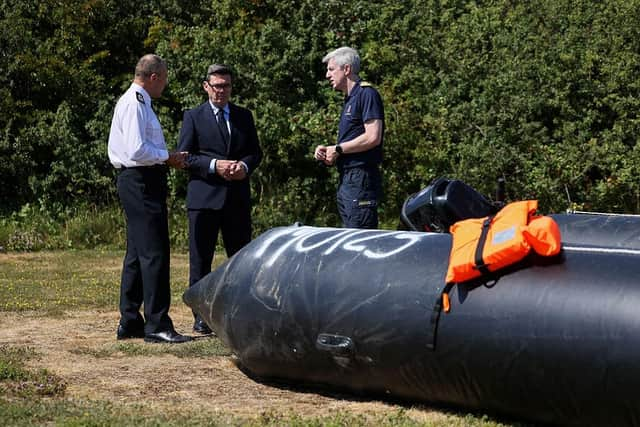
The record for migrants crossing the Channel in now much bigger boats keeps being broken. It was 165 for only a couple of weeks, now it is 230 on one inflatable. This is a recipe for a disaster.
Andy Burnham has desperately tried to avoid this topic but now he can't. Unfortunately, all he has done is criticise those sending the boats. We require action which he appears unwilling to take. This problem is not going away, indeed, it is increasing despite government attempts to spin figures to suggest it is not as bad as it was.
Our society is creaking at the seams, with the latest problem being a shortage of water. How is allowing a steady stream of people to cross our borders illegally helping? We do not need more workers when there are no jobs. Labour must act firmly now and halt this flow completely or let someone else try. Guinness Book of Records entries are not a good look in this situation.

Gerald Edwards, Glasgow
Tram tracking
The adage that if you fail to plan, you're planning to fail, is utterly exemplified by the Edinburgh trams fiasco. For the past 12 years not one single manager, handsomely paid to run the system, even had the competence to wonder what if there is an incident that prevents trams corralled every night at Edinburgh Gateway from getting beyond a blockage.
There were two screamingly obvious options.
Ensure at least two tram sets were parked overnight at the Newhaven end of the line.
Since it's too late for that, transport at least two tram sets via the South Suburban line to the rail underpass at Croall Place on Leith Walk. OK, there are technical problems to overcome: They would need to be shunted, since they could not operate under their own power. They would need to be physically hoisted from the tram system to the heavy-rail system and vice-versa. This could be done by crane overnight.
The transit via the South Sub and to Croall Place would need to be at walking pace – tram/light-rail and heavy-rail use a different rail profile. But done slowly enough, I believe it is entirely feasible.
In the meantime, we have a brain-in-neutral disconnect by highly paid “mis-managers”. As a chartered engineer, I'm not impressed!
Iain Masterton, Kirknewton, West Lothian
SNP, you’re done
From a strictly political point of view the SNP has very limited powers. Following the general election earlier this year it emerged with only eight seats in the Westminster Parliament out of the 57 allocated to Scotland.
The party may well have done better in the local Holyrood elections, but it still emerged with less support than previously. The Scottish Greens gained support, and as newcomers Reform made some headway.
Andy Burnham has made it quite clear he will certainly not grant permission for another independence referendum; and his decision on such a matter would most likely be upheld by the Supreme Court. So, in such circumstances, the whole raison d'etre of the SNP is thwarted by its own extremism.
The political scene in this northerly region needs a fresh start. At the Holyrood elections in May the SNP may have done better than we all expected in spite of the various scandals enveloping its structure, but in time the truth will out, and their decline as a political force will accelerate.
Far too much time has been wasted on the sideshows of the SNP such as marches sporting tons of “tartanalia”, Gaelic signage everywhere and a seemingly endless stream of conferences. But to what avail? The SNP will never recover from the malaise which set in after the downfall of Alec Salmond.
Quite simply, it reached its zenith several years ago, but such is the determination within its ranks that it may well have to be quite litera\lly dragged out of office.
Robert I G Scott, Northfield, Ceres, Fife
Go federal
Ian Waugh’s response to my original letter (8 August) shows once again that the UK and Northern Ireland should be split into a federation, so each area will raise its own income and expenditure with payments to the central government for common expenses, armed forces etc.
The amount of the contribution could be based on a formula similar to that used for payments currently made to the areas. How much each area receives at the moment is a constant thorn in national expenditure debate, perhaps this might help satisfy the many arguments.
Charles Lowson, Fareham, Hants
Route finder
I was interested that Fredrika Klarén used the return journey between St Andrews and Edinburgh as an example of a round trip of 100 miles or so which could be easily undertaken by an electric car rather than one powered by petrol or diesel (Perspective, 7 August).
Some might be surprised that people making that journey would need to use any kind of car; surely a town of the stature of St Andrews has good public transport links, especially with Scotland's capital?
On paper, this may appear to be the case. There are two trains an hour from Edinburgh to the nearest railway station; however, Leuchars is more than five miles away from the Home of Golf. For those not wishing the hassle of changing modes, there is an hourly direct bus service between Edinburgh and St Andrews, but perhaps the journey time of at least two hours is the reason the vast majority of travellers between these places choose to drive. As a result, the A91 into St Andrews is the busiest road in north east Fife, and unfortunately, electric cars cause just as much traffic congestion as do those using fossil fuels.
A publicly funded professional study showed a railway line to St Andrews, enabling travellers to board a train at Waverley and disembark in St Andrews, was the best way to achieve the greatest switch from cars and so reduce traffic issues, including congestion, in and around the Fife town, as well as reducing emissions. However, Transport Scotland simply dismissed these findings, saying all St Andrews needed was "better buses”, though there has been neither hide nor hair of these since.
Which is a somewhat roundabout way of saying the automatic assumption by Ms Klarén that people travelling from Edinburgh to St Andrews would drive demonstrates that the existing public transport options, even the direct bus, simply do not cut it. Something much more attractive, such as a direct train, is required to get as many cars as possible, including electric ones, off the road, such that when somebody wishes to travel from Edinburgh to St Andrews they will not automatically reach for the ignition keys.
Jane Ann Liston, Convenor – StARLink (St Andrews Rail Link) campaign, St Andrews, Fife
Renewed interest
It’s not clear from Ian Moir’s comments what he thinks is the long-term solution for energy (Letters, 10 August). He raises the bogeyman of Dunkelflaute (low light and low wind, which affects Scotland for between 50 and 150 hours per year, according to Wikipedia).
He claims renewable energy generation for the other 8,610 hours of the year is therefore totally unviable on a cost and reliability basis. This assumes the diminishing and finite supplies of fossil fuels do not continue to increase in cost. It also assumes, naively, that technology will not develop and that future battery storage improvements or other technologies (perhaps hydrogen gas plants using hydrogen generated by electrolysis with renewable electricity) will cover the gap in generation during these dunkelflaut periods.
I struggled to understand the unreferenced cost figures he included in his justification. However, the fact remains that while the raw material of fossil fuels can only increase in price, the raw materials for renewables (wind and sun) are infinite and will always be free.
Therefore it is only the costs of generation from raw material to electricity that will be a source of debate on a cost basis. But basically, I contend that Mr Moir is wrong and that Fredrika Klarén is correct in maintaining that energy transition to renewables can be sacrifice-free if managed carefully.
David Morris, Dalkeith, Midlothian
Forked tongue
The recent letters concerning Nicola Sturgeon make me wonder how she is managing in London. Some years ago I attended a business cocktail party in Knightsbridge, and in conversation with a local lady guest was asked where I lived. “Edinburgh,” I replied.
This left the lady looking blank. “It’s the capital city of Scotland,” I added for clarification. “Really,” she replied. “Then I must complement you on your ability to speak such excellent English.”
Malcolm Parkin, Kinnesswood, Kinross-shire
Spotless opinions
Leo Pard aka David Millar (Letters, 8 August) is absolutely correct. My comparison of the SNP government’s shambolic performance over two decades with leopards would have been hurtful.
I apologise unreservedly for the hurt my letter caused to leopards or any other inhabitant of the animal world.
Brian Barbour, Haddington, East Lothian
Write to The Scotsman
We welcome your thoughts – NO letters submitted elsewhere, please. Write to [email protected] including name, address and phone number – we won't print full details. Keep letters under 300 words, and in the body of the email – no attachments – and avoid 'Letters to the Editor/Readers’ Letters' or similar in your subject line. If referring to an article, include date, page number and heading. No poems.
Comments
Want to join the conversation? Please or to comment on this article.