
Readers' Letters: It's a tragedy take-up of measles vaccine has fallen
The measles vaccine is a triumph of medical science and should be taken up by all parents, says reader
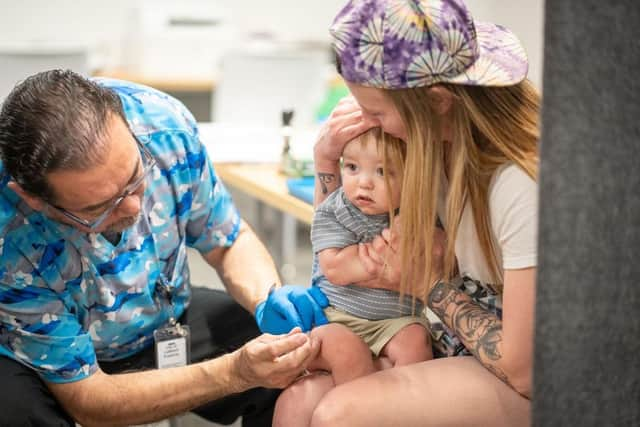
As a virologist I apologise for not being more effective in persuading all parents to get their children vaccinated against measles as a matter of course. In terms of lives saved and safety it is not possible to better the vaccine as a triumph of medical science.
Unfortunately, however, a link with deprivation still exists, not with mortality – in the olden days measles killed 9.2 per cent of children living in single room flats compared to1.5 per cent in those in houses with four or more rooms – but with vaccine uptake, which a century later still shows a similar difference between the most and least deprived areas.
My concern about the recent decline in vaccine uptake is not only fuelled by anger that a superbly effective preventative measure is not being used to the full, but by the personal experience of attending a post-mortem on a teenager who had died from subacute sclerosing panencephalitis, a horrible complication of measles. Fortunately rare, occurring in 1 in 10,000 infections, the sufferer always dies after developing personality changes, seizures, and a terminal paralytic state. Vaccination gives 100 per cent protection against it.

Hugh Pennington, Aberdeen
A wife’s wisdom
Donald Trump not that long ago said to Volodymyr Zelensky that Vladimir Putin would sign an agreement with him and would keep to it “because I know him”. It takes Melania Trump’s words to basically tell the US President, don't believe what Putin is saying as he won't keep his word, which, if you remember the great “show me respect” meeting they had in the Oval office, is exactly what Zelensky told him all those months ago – Putin can't be trusted to keep his word on any agreement.
J Moore, Glasgow
Inflation pain
Double-digit inflation may be over but, largely driven by food prices, annual inflation is up again to 3.6 per cent according to the ONS. Life continues to feel tough for many households. Any hope on the horizon? Not according to the Resolution Foundation. Its new report, “Living Standards Outlook for 2025”, does not make for happy reading. The report finds the mild recovery in real incomes in 2024-25 fails to compensate for a “lost half-decade”. It also confirms the cost-of-living crisis is still very much with us. Food insecurity was twice as high at the start of 2025 as in 2021.
Looking ahead, the real income of a “typical non-pensioner” is expected to rise by just 1 per cent by 2030, giving “zero growth” over the entire decade! “Lower-income” households are projected to be 1 per cent worse off and those on “very low incomes” 8 per cent worse off (that’s poorer by £1,000). By contrast, the real income of a” typical pensioner” is expected to rise by 5 per cent, and that of an “outright homeowner” by 4 per cent. A “typical mortgage holder”, however, is projected to be 1 per cent worse off.
These pressures, if realised, do nothing to alleviate the embarrassment of the UK being ranked ninth most unequal among 38 OECD countries in terms of income. Trade union discontent can be expected to intensify, especially in the public sector, with the Government seemingly powerless to instil stability (taxpayers will surely pick up the tab).
Simultaneously, AI adoption is reducing job opportunities in the private sector, especially for new graduates. Dynamic growth would ease tensions. But the Chancellor knows, that’s still like looking for smoke on some distant horizon – on an increasingly windy day!
Ewen Peters, Newton Mearns, East Renfrewshire
Realism needed
I would suggest that in his article “Why major changes to the ISAs regime are long overdue” (14 July), Adrian Murphy has the diagnosis spot on but the prescription could be better.
Part of the reason people keep money in Cash ISAs and avoid stocks and shares investments is the need to gain access at short notice with the assurance they will not lose money; while possibly not keeping up with inflation they are a better option than keeping cash “under the mattress”. Many, many people must have relatively small amounts to invest and cannot afford to lose it or wait months for favourable conditions to prevail should they need to withdraw it. Sadly, the volatility of stocks and shares is precisely what discourages them from the greater returns possible, with the cash ISA being the least worst alternative.
One only has to see the massive downward effect that events such as Trump tariff announcements, Truss financial statement announcements or Covid had on stock markets and subsequent lengthy recovery periods to see why people will avoid those.
There is another factor, which is the cost burden of investing in those products – these are multi layered so that often the only people making money, or at least too much of it, are the advisers and fund managers, to the detriment of the investor whom the products are supposed to help.
I agree with Mr Murphy that the ISA regime needs to change – not by reducing the amount one can put into a Cash ISA each year but by limiting the total amount held there. If mis‑selling of Lifetime ISAs is happening then that needs to be sorted for sure.
On the fees, there needs to be simplification and proper regulation with limitation on fees charged so that a better proportion of returns goes to the investor, not the institutions.
Neil Robertson, Edinburgh
Useless cabal
He who shouts loudest is not necessarily correct. In reply to Brian Bannatyne-Scott (Letters, 16 July), the app on the NHS England service has been running for years – fact.
Scotland’s is going to be rolled out over two areas serving 70,000 people to see if it works – fact.
This week, visiting Gloucester Royal, the out-of-hours GP said that if I had my prescription with me there was information on it that would have allowed my request for medication much easier. Far from anti-SNP propaganda and based on a false premise, my point was that the NHS should not be devolved in the first place. My reasoning for this is that the SNP are utterly useless, inept and couldn’t organise a chimps’ tea party – there’s your anti-SNP rhetoric! – and fully justified this view is after 18 years of complete incompetence, certainly not a false premise!
Could Mr Bannatyne-Scott fill me in on the successes of the cabal at Holyrood? And please do not omit the great strides made while in cahoots for votes with the ultra left-wing, royal family-hating Greens? I am fairly confident it shouldn’t take up too much time.
D Millar, Lauder, Scottish Borders
Tram trials
It's hard to understand how Edinburgh trams have posted a loss of £10 million in 2024, despite a rise in passenger numbers (your report, 16 July). I wonder who’s footing the bill. Presumably, taxpayers are still paying off the exorbitant bill incurred for their installation.
The trams have been a totally unnecessary luxury, whose construction has caused severe damage, not least to businesses en route. Simply put, it was a vanity project for the council of the time.
The trams, even in their extended route, do little more than replicate what is already covered by our excellent bus system. If further modes of transport were needed, which is questionable, the resurrection of the intra-city rail routes would have been money well spent, taking the burden off our already overcrowded roads. This works perfectly well in Glasgow.
Ian Petrie, Edinburgh
Call for change
M Blair (Letters, 16 July) takes the National Trust for Scotland to task for their telephone response (or lack of it). Sadly, their experience is true of almost every organisation. How often must we wait in a telephone queue being told “due to a high level of calls...” as we wait and wait and wait to speak to a human? If our call really “was important”, as the messages say, these businesses and public bodies would look at their call volume trends and ensure the service was sufficiently staffed to give the public a decent call answer time, combined with the aim of resolving queries first time.
The bad situation is being exacerbated by the increasing use of chatbots, who seem determined to do everything to avoid the customer being passed to a real human being. AI has a long, long way to go in helping to deliver excellent customer service, but it definitely does have a role. In some ways, we are all in part to blame for constantly seeking more for less, but at least we have a choice and can go elsewhere. With public bodies, we have no choice and our job is to allow our pockets to be picked more and more deeply simply to “feed the beast”.
There are exceptions – many financial services companies (such as Standard Life and Chase Bank) do strive to provide excellent service – but I must declare a bias having worked for one and as a customer of the other.
My plea is that every single Executive or Director of a private or public body calls their own organisation at least once a week to experience the service provided to the public. Perhaps then, and only then, will things improve. And no “special service” lines for MPs, MSPs etc. Let them experience what us mere mortals do.
Brian Barbour, Prestonpans, East Lothian
Praise be!
I note Energy Secretary Ed Miliband is considering providing money for solar panels to be installed on religious buildings. No doubt the dwindling congregations in what's left of our churches will celebrate by singing “Nearer My Grid To Thee”.
Robert Menzies, Falkirk
Write to The Scotsman
We welcome your thoughts – NO letters submitted elsewhere, please. Write to [email protected] including name, address and phone number – we won't print full details. Keep letters under 300 words, with no attachments, and avoid 'Letters to the Editor/Readers’ Letters' or similar in your subject line – be specific. If referring to an article, include date, page number and heading.
Comments
Want to join the conversation? Please or to comment on this article.