
Readers Letters: Is Scottish Government guilty of a culture of secrecy?
The Scottish government’s dealings with the Information Commission don’t impress a reader
The SNP is no longer being accused of secrecy only by its political opponents. Scotland’s own independent Information Commissioner has said Ministers appear to have failed to comply with one of his decisions, appear to have tried to conceal that failure, and can no longer be trusted to handle the information unsupervised. That is an extraordinary position for any government to find itself in, and it should concern anyone who cares about standards in public life.
This matters because it goes far beyond a technical disagreement over Freedom of Information procedure. If an independent watchdog says he was forced to take Ministers on trust and now believes that trust was misplaced, then the issue is not administrative tidiness. It is whether Scotland’s government is acting with the honesty and openness the public is entitled to expect.
The first problem is the appearance of non-compliance itself. The second is the allegation this was then concealed through delay, silence and unacceptable explanations where there should have been candour. The third is the wider implication politically sensitive cases may have been treated differently from ordinary cases. That points to a culture in which transparency appears conditional on convenience.
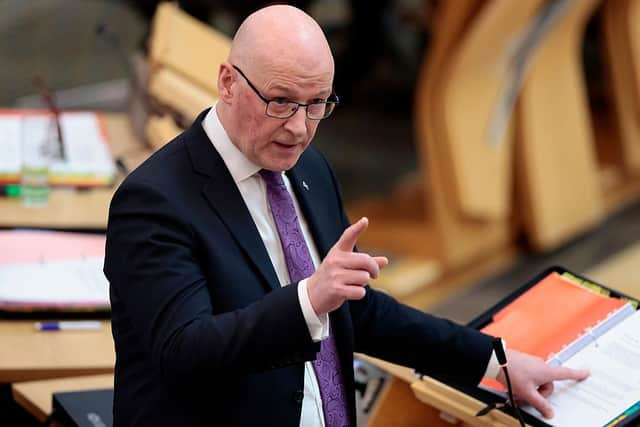

Some will argue this is a dry, procedural matter ordinary voters will struggle to care about. The opposite is true. If ministers cannot be trusted to comply fully and promptly with independent oversight when the subject is sensitive, every later appeal to openness, integrity and accountability is weakened. Public trust does not rest on slogans or carefully managed press lines. It rests on whether those in power tell the truth, follow rules and admit fault when they fall short.
After nearly two decades in office, the SNP increasingly risks looking less like a party of government than a system protecting itself. Scotland deserves better than a culture of delay, evasion and exceptionalism from those who ask to keep governing in its name.
Alastair Majury, Dunblane, Scottish Borders
Time warp Trump
What do you do when a national leader – in this case Donald Trump – appears to be governing from inside a Gordon Gekko time bubble, a leadership style shaped by the power cues, communication habits and cultural assumptions of the 1980s and 1990s? The world has moved on. The public has moved on. Yet his leadership style remains rooted in a different age.
Communication and public expectation have changed dramatically since then. Facts are checked instantly, information is shared globally, and people no longer receive political messages passively. They question, compare and expect clarity rather than theatre. A leadership model built for a slower, more deferential media landscape will inevitably struggle in a world where citizens are not just audiences but participants.
When a leader bolsters himself with what worked 40 years ago, and then shelters inside that belief, a painful awakening is inevitable.
If one person is trapped in a time warp, the harm is limited to those around them. But when a national leader is trapped in that same bubble – unable to see how out of step he has become – the damage spreads far wider. The only solution is unity. It is the one thing that can hold firm against a leader who does not recognise the danger he has created. And here, the danger lies in saying nothing.
Judith Campbell, Portree, Isle of Skye
War record
William Loneskie (Letters, 12 March) reminds us of President Trump’s acid remark that America doesn’t need allies when a war is won.
That is rich indeed coming from the leader of a country that refused to help Britain in the Second World War, when we had done the spadework and were preventing Europe from falling to a madman. It was only the Japanese attack on Pearl Harbor that brought America into the war. Without that, Europe would now be a different place, and of no assistance at all to the USA.
Malcolm Parkin, Kinnesswood, Kinross-shire
Straight talking
In his attempts to be humorous, Dr Andrew Docherty is driven to misrepresent me (Letters, 11 March). I have never used “euphemistic” language about devolution or tried to disguise my feelings about it: it is a crude experiment that has failed Scots. Dr Docherty would be better employed in trying to ascertain why devolution has been such a failure, and why Scotland’s governance and public services are much the worse for it.
As for his denial of antipathy between Alba and the SNP, he really has not been paying attention.
Still, one has to admire his deluded optimism. In a world now a more dangerous place than in 2014, anyone who thinks that breaking up the UK is a sensible idea clearly lacks any sense of realism.
Breaking up the UK is, after all, what the west’s enemies, including Russia, aim for, although the current hostilities in the Middle East seem to have caused the barrage of pro-SNP propaganda coming from Iranian bots to cease.
Jill Stephenson, Edinburgh
Southern wind
It is surprising that the cost of living and the NHS are the main concerns held by voters prior to the May election.
There is not a single reference to the impact of high energy prices based on the use of renewable sources to provide Scottish consumers with electricity – the lifeblood of a 21st-century economy.
The first problem that is never highlighted is the fact that, once the plants at Torness and Peterhead are shut down, there will be no base-load generators in Scotland to keep the lights on when the sun does not shine and the wind fails to blow. Note that in October 2025 there were extended periods when the Torness plant supplied 50 per cent of Scottish demand, Peterhead 40 per cent and renewables only 10 per cent.That implies the SNP plan to rely on English gas turbines to keep the lights on in Scotland. Will such a policy be included In their manifesto for the May election?
Ian Moir, Castle Douglas, Dumfries & Galloway
Indy preview
Stan Grodynski (Letters, 13 March) is a tireless advocate for Scotland leaving the world's sixth largest economy. He writes that “Britain is broken” and devolution is not working.
Notice the similarity between these claims and those of Reform, whose leader Nigel Farage never misses an opportunity to talk Britain down. Britain is not broken. It is still recovering from the effects of the pandemic. It is suffering from high energy costs thanks to the decision to rapidly decarbonise the economy through the ruthless and foolish policy of net zero. It has to meet the challenges of a big rise in immigration caused by hundreds of thousands of people who are desperate to move here because they see the UK as a great place to live. Despite these challenges, I submit that most folk are happy with their lot and do not want to risk the leap into the dark that independence would cause.
Mr Grodynski yet again lists the freebies Scotland has to offer compared with England, such as free nursing and health care, free prescriptions and free hospital parking. What he fails to mention is that these are only possible thanks to the largesse of the Barnett formula. Perhaps the UK government should, as a trial, stop the Barnett formula for two or three years just to give us a taste of what separation from the UK would bring.
William Loneskie, Oxton, Lauder, Berwickshire
Palliative answer
I was shocked to read about the dire shortage of palliative consultants, with three health boards employing none at all (Allan Struthers, Letters, 11 March). Mr Struthers makes a powerful case for palliative care, as opposed to assisted dying, for which there is no clamour, despite the noise.
I write as a customer, not an expert, for we all have to die some time. While I respect the wishes of those who seek assisted dying, and would vote for the bill, personally I would choose palliative care, properly staffed and funded. My concern about assisted dying is the insidious position into which we place doctors, whose calling is to care for life, not to take it away.
I'm a great admirer and supporter of the palliative care offered by Marie Curie. Such care should be open to all.
Ian Petrie, Edinburgh
Look to future
The latest eye-watering additions to the ferry fiascos' total bill being – as always – sent to taxpayers to settle are quite staggering. The level of incompetence at every level necessary to bring this situation about is stratospheric.
I would ask any thinking Scot who is planning to vote SNP at the upcoming election to consider this.
Look at what is happening when they have limited control of our finances. And going a step further, can you even imagine what would happen if the SNP and their allies did manage to break up the UK and they had no-one to bail them out after every certain and self-inflicted catastrophe.
Alexander McKay, Edinburgh
Priorities sunk
I was pleased to learn from The Scotsman of 11 March that though the propellers on the new Glen Rosa are deficient, care has been taken to have the Gaelic version of the vessel’s name prominently displayed on the superstructure so that the handful of people on the islands who don’t understand English and who are still alive by the time the ferry comes into operation will be in no danger of getting on the wrong boat.
S Beck, Edinburgh
Write to The Scotsman
We welcome your thoughts – NO letters submitted elsewhere, please. Write to [email protected] including name, address and phone number – we won't print full details. Keep letters under 300 words, and in the body of the email – no attachments – and avoid 'Letters to the Editor/Readers’ Letters' or similar in your subject line. If referring to an article, include date, page number and heading. No poems.
Comments
Want to join the conversation? Please or to comment on this article.