
Readers Letters: Is Angela Constance having a laugh at donors' expense?
Reader suggests MSP Angela Constance should be booking a venue for August
I suspect Scottish Health Secretary Angela Constance is intending to follow Nicola Sturgeon onto the festival circuit, except in her case it will most likely be the comedy one.
Not only does she suggest that SNP members will happily donate more money to replace that which has gone “missing”, she actually stated that the SNP’s NEC “thoroughly scrutinises and explores the party’s use of resources”. Comedy gold, flying in the face of Peter Murrell having purloined a few hundred thousand from under their noses – presumably also to be replaced by their generous donors?
She seems also to have forgotten that before she can make a career on the stage, she is actually part of a “government” that is supposed to act on behalf of the country. She did let slip that the SNP’s raison d’etre is independence, which they do “day in, day out”. It shows. The welfare of the country and its people come a poor second. We’re not laughing at that.
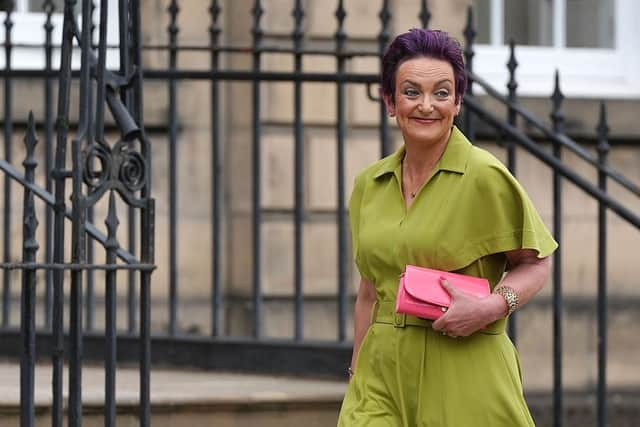

Ken Currie, Edinburgh
A9 improvements
In response to the many letters and articles damning the Scottish government for failure to dual further the A9, I can report that there's an enormous amount of work going on to effect that dualling process at the moment.
I drove up to Inverness and back to Edinburgh last weekend and saw for myself how much work is being done. The Perth to Dunkeld section is complete, there is work north of Dunkeld, more work further up, and major work between Aviemore and Inverness. So to go on and on as if nothing has been happening is nonsense.
There is still much to be done, but the improvements are vast and the journey is being greatly improved. The terrain is extremely difficult to widen, especially north of Dunkeld. Credit where credit is due.
Brian Bannatyne-Scott, Edinburgh
Tough love
It is over 20 years since I was part of an exclusion unit in a school. “Difficult” youngsters were removed from the classroom to the unit, which was staffed by a social worker, a teacher and a community worker and referred youngsters came with a work programme. The unit was able to tailor tuition to the youngster’s needs in a flexible manner that enabled the youngster to interact positively.
When youngsters had “come back up to standard academically” they were invited to go back and negotiate their return to the classroom.
Obviously, such units incur cost but this could be covered by insisting parents had to choose between home education and paying to have their child in the unit.
Consideration could also be given to making parents legally responsible for their children’s actions – either financially, doing community work or, in extreme cases, prison. A move away from the woke society to one of consequences and accountability is long called for if we are to rescue the present generation from chaos exacerbated by social media.
James Watson, Dunbar, East Lothian
Selected history
The Scotsman reminds us of the pioneering work in geology in the 18th century by James Hutton (Perspective, 3 June). Scotland has never been shy of acknowledging its own scientific pioneers, yet one of the most remarkable remains curiously under‑celebrated. As debates about evolution continue in public life, it is worth reminding readers that the first fully articulated theory of natural selection did not come from Charles Darwin in 1859, but from a Perthshire farmer and fruit‑grower, Patrick Matthew, in 1831.
Matthew set out, in the appendix to On Naval Timber and Arboriculture, a clear description of species adapting through competition, environmental pressure, and what he called the “natural process of selection”. Modern scholars recognise that Matthew’s formulation contains the essential mechanism later made famous by Darwin.
For more than a century, the standard narrative has been that Matthew’s ideas were “overlooked”. Yet contemporary research shows that his book was read and cited by several naturalists within Darwin’s own intellectual circle.
Matthew himself publicly asserted his priority in 1860, and Darwin, while denying any direct borrowing, was forced to concede that Matthew had indeed anticipated him.
None of this diminishes Darwin’s achievement in developing and popularising evolutionary theory. But it does mean that Scotland’s contribution deserves far greater recognition than it has received. Patrick Matthew was not an obscure footnote: he was the first to publish the theory of natural selection, and he did so with a clarity that still surprises readers today.
It is time his name stood where it belongs, at the foundation of modern evolutionary thought.
Tim Flinn, Morningside, Edinburgh
Non-binary world
I identify as a gay man, but I infer from Brian Forsyth's latest letter (4 June) that because I have on occasion been attracted to trans men, he would maintain that I am bisexual.
He's welcome! My concern, in a long time campaigning, has not been a universal meaning of those words. It's been to try to make it easier for people to get on with their lives without detriment on the basis of their own, or their partners', gender identity or legal sex or physical sex characteristics.
For most people those three things align and are binary: female or male, with most couples being one of each. But of course not everyone fits that majority model. The three don't always align, and the first and third are not simply binary. It is clear I think that sexual orientation and sex and gender are closely linked concepts. That's partly why the large majority of our community's organisations work for LGBT+ people. And why, for example, YouGov found that 84 per cent of lesbians have a positive view of trans people.
Tim Hopkins, Edinburgh
Soft on Israel?
For years now we have witnessed from afar the unequal conflicts between Israel and neighbouring nations.
Yes, there may be rights and wrongs on different sides, but one thing is clear: Israel operates with the permission and funding of the USA. Even now, within an alleged ceasefire, Israel finds excuses for killing yet more thousands of innocent civilians and grabbing more land illegally, cruelly dispossessing people of their homes and decimating their families and communities.
I believe that UK media has become scared of reporting on their actions in favour of appeasing President Donald Trump and the maverick Benjamin Netanyahu. In the name of justice, is it not time to use every political approach to force Israel to adopt normal means, including diplomacy, to sort issues out rather than tacitly letting Israel continue to follow a path of conflict and destruction.
Andrew Turnbull, Bridge of Earn, Perth and Kinross
Respect the ref
R H Beattie makes some valid points (Letters, 4 June) regarding VAR in Scottish football. The SFA Chief Executive referred, to Ian Maxwell, states that VAR is working. I concur; but it’s working badly.
Mr Maxwell also suggests VAR is getting more decisions right than wrong. How does he know that? What is the baseline to compare against? We’ve not had VAR previously, and I haven’t seen any reports on right or wrong decisions before its introduction. The Chief Executive also states that the stats stack up against everyone in Europe.
Well, for Mr. Maxwell’s benefit, it’s not a competition between Scotland and Europe, but between teams entirely within Scotland, who all want to provide a good and honest footballing product, and at the same time give all those teams a good and honest chance of winning something.
The heart of the matter (no pun intended) is we need, as R H Beattie suggests, accountability and transparency. Also, what’s the point of having a review panel after the fact? That is just adding insult to injury. It does not serve the footballing public well, nor the referees whose chief has to justify decisions (or not) for handball by talking about superimposing tee-shirt lines on bodies.
You cannot referee a football match with a committee (and we all know that bureaucrats love a committee), which to all intents and purposes is what the use of VAR is at the moment. There is only one referee. He, or she, alone is in charge and should make the decisions, and I mean all the decisions. Akin to rugby the referee should ask definitive questions and get straight answers to them, and that should include the possible use of VAR. The referee should not be harangued by someone bellowing in their ear that something has been spotted on their TV monitor. Then that someone spends the next however many minutes scrolling back and forth to justify that position.
Throwing more technology at it is not the answer. Keep it simple. How about having referees participate in some on-field football training, and practice matches, with players to understand the game from their perspective, Also, give absolute control back to the referees, and if they have a doubt, or in their own opinion there is a contentious situation (eg a penalty claim), ask for assistance with a straightforward question that requires a straightforward answer. That way the referees exert their authority and know where they stand. The other required officials know where they stand, and the teams and their supporters know the rules and procedures.
Whether they agree with the outcomes is another matter, but thus was it ever so, VAR or no VAR.
Now that’s a thought. On the other hand why not just scrap VAR altogether?
David J Mackenzie, Inverness
Write to The Scotsman
We welcome your thoughts – NO letters submitted elsewhere, please. Write to [email protected] including name, address and phone number – we won't print full details. Keep letters under 300 words, and in the body of the email – no attachments – and avoid 'Letters to the Editor/Readers’ Letters' or similar in your subject line. If referring to an article, include date, page number and heading. No poems.
Comments
Want to join the conversation? Please or to comment on this article.