
Readers' Letters: Independence would make Scotland much the poorer
Campaigners exaggerate the likely health of Scotland’s finances if Independence arrives, says reader
“Why tell a lie when there are so many ways of telling the truth?” used to be an acclaimed adage in Scotland's financial reporting circles. But now the prizes for skilful (and not-so-skilful) deception go to the politicians, particularly the adepts of the Scottish National Party.
In a nationalist letter to The Scotsman (17 January) Herbert Petrie tells us, “moreover, Scotland runs a trade surplus of £15 billion....”. Similar claims used to be made by SNP Minister Richard Lochhead. But these figures do not reflect the trade deficit with England (which would inevitably exist on independence), nor do they consider the significance of oil sales to exports – the very industry the SNP (and Labour/Greens) want sooner or later to destroy.
The real figures, according to the independent source Statista, is that for just the second quarter of 2025 the value of Scottish exports was £28.2 bn, while imports amounted to £35.4bn –a deficit of £7.1bn. Cutting us off from oil activity, then severing our right to the Barnett formula worth over £45bn in recent years' are the two leading impacts of the independence agenda.
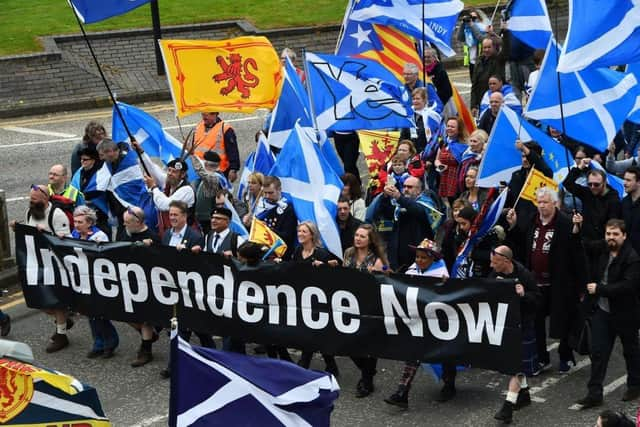

SNP enthusiasts need to be called out about showing the full data and the true implications for Scotland's economic prospects and living standards.
Peter Smaill, Borthwick, Midlothian
Wise heads?
The headline, “Scotland ninth highest in UK for insolvencies”, on Scott Reid's 17 January business report paints a truly grim picture so things must be really bad. But then I read that Scotland accounted for 4 per cent of all UK administrations in 2025 and I thought, this can't be bad, as Scotland accounts for just over 8 per cent of the UK's population. Somewhat puzzled, I looked up all of the figures on law firm Shakespeare Martineau's website. And I found that a more accurate heading for Scott Reid's piece might have been, “Scotland fourth lowest in UK for insolvencies” since the figures compare the nine regions of England and the three devolved nations.
So why did this piece not carry that positive headline instead of the doom-laden headline used?
And the comparison above is of absolute figures that take no account of population. Scotland, with 4.1 per cent of all UK administrations and 8.1 per cent of the UK population, had just 51 per cent of the insolvencies that might be regarded as Scotland's population share. Greater London performed worst on this basis with 184 per cent of the insolvencies that might be expected compared with its population share. Only Wales did better than Scotland in this respect, with just 38 per cent of the insolvencies its population share might expect. So another positive headline for the piece might have been "Scotland second lowest in UK when business insolvencies are compared to population".
It is difficult not to conclude that someone was trying very hard to generate a bad news story out of news that is actually very positive!
Cllr Andrew Parrott, Perth
Volatile times
Donald Trump’s dramatic u-turn after threatening to strike Iran has to be seen in the context of the US national interest. It followed the deaths of over 2,600 protestors (The Scotsman, 16 January,) Trump’s volte face came as he praised the Islamic Republic for stopping mass executions of protestors, although he gave no evidence. The regime admit the killings but blame the US for inciting protests. The rhetoric may have been dialed down but tensions remain.
“Help is on its way,” Trump had said, but what really changed his mind was the spike in oil and gas prices, much of it caused by the Iran unrest. Wholesale natural gas prices have risen by 40 per cent in January while oil prices jumped 10 per cent before falling back as Trump rolled back on strikes. He needs to keep US consumers and big business on side in the run-up to mid-term elections in November and market volatility is not helpful. While his approval rating continues to plummet Trump may focus on domestic policy, so policing the world and acquiring Greenland could be put on ice.
Here, continued unrest on the Middle East, and cold weather across much of Europe, means a potential hike in energy prices in April. Wind power is currently subdued so expensive gas is often the leading source of power to meet higher electricity demand. Trump’s decisions therefore have a direct effect on our bills. Expect volatility!
Neil Anderson, Edinburgh
Prince of Peace
Now Donald Trump is the recipient of not only the prestigious FIFA Peace Prize but the Nobel Peace Prize, courtesy of initial winner Maria Corina Machado, it is fair to say he is truly the Prince of Peace.
Senora Machado, the Venezuelan opposition leader, may be obsequious but is clearly no fool, knowing her chances of becoming leader in her invaded country are totally dependent on wooing President Trump. Getting him onside is not difficult, in the same way a recalcitrant infant can be coaxed into behaving appropriately by giving him something shiny and tactile to play with.
Perhaps if the UK wants a better relationship with the great man it should follow Senora Machado’s example and a special shiny gong could be forged with an impressive title bestowed, such as Grand Archduke Trump of Old Sarum? I’m sure we could even stretch to a brightly coloured uniform with medals. We know Trump never turns down a grovelling gift. In the dizzying, testosterone-fuelled world of international Trumpian politics and diplomacy, it’s a no-brainer.
D Mitchell, Doune, Perthshire
Prize pun
Machado has just reduced the excellence of the latest Nobel Peace prize to zero: Machado About Nothing (which reads better than it sounds, I know).
Steve Hayes, Leven, Fife
Write to The Scotsman
We welcome your thoughts – NO letters submitted elsewhere, please. Write to [email protected] including name, address and phone number – we won't print full details. Keep letters under 300 words, with no attachments, and avoid 'Letters to the Editor/Readers’ Letters' or similar in your subject line – be specific. If referring to an article, include date, page number and heading. And please do ensure any names mentioned are correct.
Comments
Want to join the conversation? Please or to comment on this article.