
Readers’ letters: If we remain silent about Gaza we are complicit in cruelty
History will remember the people who turned their backs on starving children, a reader says
I am writing to you from a comfortable house, far from major suffering. I have enough to eat. I am safe. I can sleep at night without fear – almost.
But that is not the case for thousands around the world. In this instance, I speak of Gaza.
Over 62,000 Palestinians have been killed in less than two years, according to Al Jazeera. The United Nations has declared a famine in Gaza, warning that more than 640,000 people now face starvation-level hunger.
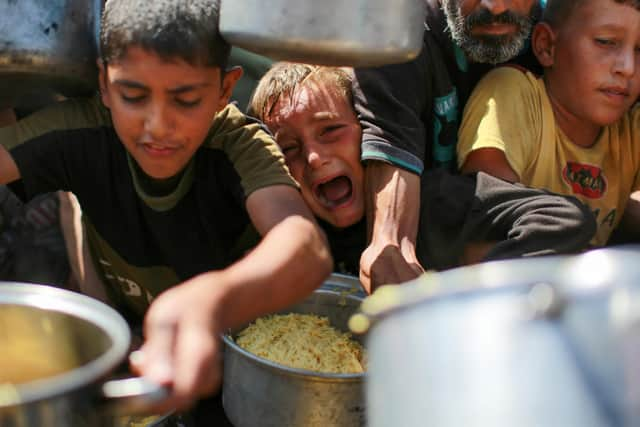

Many of those who will suffer most have done nothing but live their lives, as we do. They are children, mothers, elders. Students, bakers, teachers, nurses, poets. They once had homes, gardens, routines. Now they have rubble, hunger, and grief. They have not bombed, shot, or terrorised anyone.
As Robert Burns wrote:
“Man’s inhumanity to man / Makes countless thousands mourn.”
Today, those thousands are in Gaza. Today they live. Tomorrow… If we remain silent, we become part of that cruelty – and history will remember not only the children who starved, but those who turned away.
Judith Campbell, Portree, Isle of Skye
Forgotten victims
Graham M McLeod (Letters, 28 August) makes a fair, if slightly biased assessment of the current situation in Gaza. Astonishingly, he never mentioned the hostages. He states that the “governments of western democracies” must put a stop to what is happening. That would happen tomorrow if Hamas released the hostages. They seem to be buried and forgotten just like the 7 October attack.
Lewis Finnie, Edinburgh
Into the abyss
Graham M McLeod is right that surviving genocide should not give carte blanche to inflict suffering on another people.
The remnants of mass cruelty, hatred, violence and murder, the train tracks, the ashes in crematoria, the dim lights, and the mountains of human hair, suitcases, spectacles and shoes at Auschwitz still breathe life with lingering memories. The Holocaust was one of the dark chapters in human history. It shows us where antisemitic canards can lead us to.
However, in our troubled world, where conspiracy theories spread like a wildfire, Israel has done a disservice to the memory of the Holocaust. The western world cannot preach “never again” when Gaza continues to be afflicted by genocide, ethnic cleansing and the relentless anguish and famine that are beyond human comprehension. We need to reflect and understand the calamity in Gaza and the contexts that encouraged its perpetuation. Without this, we will continue to sink deep in the abyss of history.
Dr Munjed Farid Al Qutob, London
Trump must act
Pope Leo XIV’s voice is just one of the latest in the chorus of condemnation at the mass starvation of Palestinians in Gaza. Since the war began, over 300 have died, including more than 100 children. This surely is a conservative estimate and just the latest of the host of Israel’s war crimes.
Sadly, and tragically for the Palestinians, the Pope’s plea will be ignored, not least because the Israelis deem Palestinians less than human. That certainly must be the only way that Benjamin Netanyahu and his murderous cohorts can sleep at night.
Only one man can stop this carnage, but his voice is strangely silent. President Trump is just one phone call away from righting this wrong. Trump, whose questionable boast that he has stopped six wars, alone has the leverage, to make Netanyahu think again. Can he make it lucky number seven?
Ian Petrie, Edinburgh
Tariff turmoil
The “uncertainty principle” states while one property of an atom may be known (for example, its position) any other (for example, its momentum) cannot. Aptly, the principle reads across into current US economic and trade policy: forecast to outturn at $2 trillion this year, the high and persistent “public sector deficit” is the known, whilst “tariffs” are the vexing unknown.
Back in June, the US’s special tariff on steel and aluminium was set at 25 per cent for the UK, with the possibility of a further reduction to 0 per cent to help our ailing industry (four out of the six British steel companies are currently propped up by the taxpayer). What’s happened since? Twenty-five per cent tariffs are still in operation and any reductions delayed due to US concerns that some UK steel exports are melted and poured elsewhere. (Applying tariffs is tricky when goods are the product of global value chains, and the country of origin is hard to identify.)
Furthermore, the UK Government has just been blindsided by the US announcement that 25 per cent tariffs are to be applied to more than 400 categories of goods deemed to contain “some” steel or aluminium (such as washing machines, garden furniture, fire extinguishers, children’s highchairs – and cosmetics whose packaging contains some aluminium etc). Trump’s distinction between “reciprocal” and “special” tariffs is now a meaningless blur!
This change is a commercial killer for companies like JCB which exports 30,000 diggers and earth-moving equipment to the US. It’s also a killer for US customs officials and port authorities who have also been caught out. A huge backlog is quickly building up at ports as items are not being released until a clear interpretation emerges on how new rules are to be applied. Good orderly relations are the “sine qua non” of international trade. Instead, all we have is chaos courtesy of Trump’s “uncertainty principle”. Heaven help us!
Ewen Peters, Newton Mearns, East Renfrewshire
No laughing matter
In 1973 the American musician and satirist Tom Lehrer said that political satire died when Henry Kissinger was awarded the Nobel Peace Prize. In Donald Trump’s ridiculous and, as always, totally personal drive towards the same honour, will this signal the death of all types of humour around the world if he is given it?
D Mitchell, Doune, Stirling
Problem solved
Tom Cross KC warns that the current wording of the assisted dying legislation being progressed in Scotland could lead to challenges under the European Convention on Human Rights (Scotsman, 29 August).
Surely the answer would be to word it in the same manner as those EU countries that have introduced such legislation and who are subject to the ECHR. Presumably they had similar arguments put forward when formulating their laws.
C Lowson, Fareham, Hants
Saw point
The news lately has been very disheartening, so I thought I might try to lighten the mood. For some time now I have been puzzled by the enormous public outcry surrounding the felling of the Sycamore Gap tree. As a retired lawyer, I would have loved to have represented the accused. We enjoy defending the indefensible! Four years in the pokey seems rather excessive.
But turning to the case itself, M’Lord, the first point is that the offence claimed of criminal damage seems dubious – so far as I’m aware it was not the subject of a tree preservation order and possibly could be construed as a “res nullius”, belonging to nobody.
Second point, while admittedly a nicely shaped tree, the fact remains it was a sycamore – a non-native species and basically a weed, M’Lord.
Thirdly, M’Lord, it has to be conceded that my clients’ real mistake was to have the felled tree damage Hadrian’s Wall, a much more significant monument, historically, than a 100-year-old weed.
Fourthly, if your Lordship favours a more imaginative sentence, then may I suggest my clients should be ordered to remove the stump so that no more weeds can grow there, repair the damage to Hadrian’s Wall, plant a native species such as an oak and carry out tree planting locally under a community order supervision.
If, however the intention is to impose a custodial sentence, I can assure his Lordship that I shall be contacting my clients before their release and invite them and their chainsaws up to Drumnadrochit so that they can fell any number of sycamores and their numerous offspring that threaten my own and many neighbouring houses
They can be assured there will be absolutely no widespread condemnation or weeping and wailing and gnashing of teeth. Job well done. I rest my case.
Torquil MacLeod, Drumnadrochit, Highland
Saving water
Is our common sense so limited that we really need Scottish Water and SEPA to tell us not to use our dishwashers and washing machines until they are full, not to keep the water running when brushing our teeth, not to fill the kettle full for only one cup of tea, etc (Scotsman, 27 August)?
But I gather that only about one per cent of our rainfall is actually stored in reservoirs and 20 per cent is lost from leaking pipes. When will the relevant bodies rectify such abject failures, and also implement sensible and often-publicised upgrades to building standards?
Moreover, such standards should require all taps to be lever-taps, easily opened and closed using one finger even with soapy hands, to avoid unnecessary water continuing to run. Non-levered circular taps could then be banished.
Taps can also be operated by our feet or knees, as I found in a fish-and-chips bar in Holland (where all water is metered) so water is not wasted while the soap or gel dissolves the grease before rinsing off.
John Birkett, St Andrews, Fife
Write to The Scotsman
We welcome your thoughts – NO letters submitted elsewhere, please. Write to [email protected] including name, address and phone number – we won't print full details. Keep letters under 300 words, with no attachments, and avoid 'Letters to the Editor/Readers’ Letters' or similar in your subject line – be specific. If referring to an article, include date, page number and heading.
Comments
Want to join the conversation? Please or to comment on this article.