
Readers' Letters: If Burnham became PM a general election would be needed
Andy Burnham would have to win the authority to be prime minister, say readers
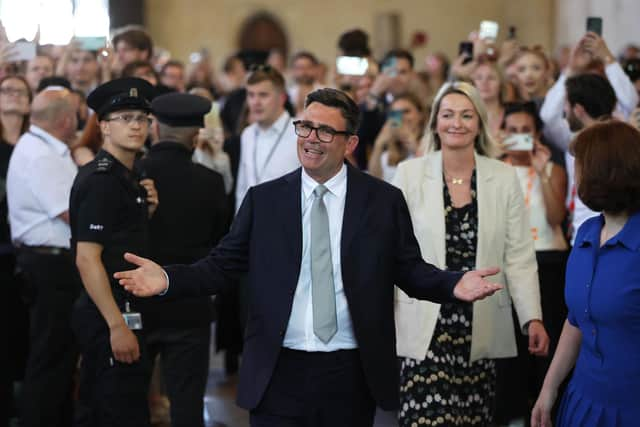
Andy Burnham has indicated that if successful as the uncontested leader of the Labour Party he would change direction of the current government.
This would then result in a new prime minister who was not an MP at the general election and has a different manifesto to the one Labour were voted in on.
If so, this would surely make a general election a democratic necessity.

Paul Lewis, Edinburgh
No mandate
The Messiah of Manchester, aka Andy Burnham, will in all likelihood be our prime minister in a short time. However, this potential prime minister will represent a further shift to the left and indicates he may wish to privatise the utility companies. Interestingly, this is a policy dropped by Sir Keir Starmer.
More importantly, Andy Burnham did not stand in the 2024 general election, meaning he has no democratic mandate from the electorate to impose his policies. As a consequence, and to gain any moral authority and credibility, he must call and win a general election.
Richard Allison, Edinburgh
True patriot?
In his resignation speech yesterday, Keir Starmer said, “Look what we've achieved in two years”.
Yes, let's. Labour is “a party that, once again, stood proudly with, not against, our national flag...” “The biggest improvement in rights for workers and renters in a generation...” “Every decision I’ve taken has been about putting the country I love first...”
Strange how it doesn't look that way, with the North Sea fishing rights handed over to the EU for no material benefit. The defence crisis in which it took a week to send one solitary Royal Navy ship to the east Mediterranean. To have a prime minister who was determined to hand over strategic islands owned by the UK to a nation which is very close to China and to refuse to allow the natives of the Chagos (who wish to remain British) to return to those islands. Relinquishing border controls to Spain in another British Overseas Territory, namely Gibraltar.
That shows how much love Mr Starmer has for our country.
Indeed, his love of country, high taxes and employment rights have destroyed the economy. In my own business sector, up to 1,000 UK recruitment companies have reportedly entered insolvency or voluntary closure over the last 12-18 months. This represents the highest staffing sector failure rate since the 2008 financial crisis. So much for the benefits of his government.
Now we face Andy Burnham, who wants to renationalise extensively and take us back to the Seventies, which I remember well: inflation; stagflation; three-day weeks; power cuts; strikes. With National Debt payments at £125 billion per annum, where will the money come from?
I predict that, under Burnham, in 2026 the UK will be back asking the IMF for a bailout very near the 50th anniversary of the last one.
Andrew HN Gray, Edinburgh
Yes, First Minister
At last I agree with something John Swinney says. Yesterday, on the resignation of Keir Starmer, he uttered “Scotland deserves better”. Perhaps he should follow his example and resign too?
Ken Currie, Edinburgh
Load of Trollope
Did anybody else notice that on the very day the Prime Minister resigned, Radio 4 Extra was broadcasting Episode 10 of the BBC's excellent audio dramatisation of Anthony Trollope's The Pallisers, in which a beleaguered prime minister takes the difficult decision to resign?
Jane Ann Liston, St Andrews, Fife
Work together
Christine Jardine rightly says that all politicians need to listen to the voters (Perspective, 22 June).
I couldn’t agree more. With falling educational standards, crisis in the health services, homelessness and cost of living challenges, it’s time for our politicians to work together on these urgent issues. They can no longer kick these into the long grass or appoint yet another working group to report on the difficulties we all know about already.
Perhaps a history lesson might help focus minds. The Government of National Unity in the 1940s managed to win the war, along with our allies, and set up the groundbreaking National Health Service. I think those politicians would be shaking their heads in despair at our helplessness in 2026.
Fiona Garwood, Edinburgh
Moot point
Today's moot for the masses – the Prime Minister's resignation or the new series of House Of The Dragon: which one will we all care least about before the week is up?
Mark Boyle, Johnstone, Renfrewshire
Failing SNP
Hoping, no doubt, to distract from the woes of the SNP, Stan Grodynski quoted a study stating that Scotland lost “£30 billion per year” than would have been the case had we stayed in the EU (Letters, 20 June). This is, of course, pure speculation. I, for example, would have been a multi-millionaire had it not been for the economic crash in 1990. Prove me wrong.
Mr Grodynski's volume grows in inverse relation to the fortunes of his favourite party, the SNP. He seems blind to the impact they have had, creating a split Scotland through their relentlessly divisive policies to break up the UK. That is indisputable, unlike economic speculation. Scotland has been held back for the entire 21st century by the loudly proclaimed intent of the nationalists to break up the United Kingdom.
The result is that investors are put off Scotland due to the uncertainties about currency, economic stability, security and more in a Europe facing increasing Russian aggression, not to mention the impacts of the Ukraine war which Vladimir Putin instigated and the enormous effects of Covid. Forget Brexit. Any loss of £30 billion per year is easily explained by these factors alone. Separation would be more Scotland's problem than England's. Scots who work in Scotland are already moving to live in England and thereby avoid high SNP taxes . Mr Grodynski blusters about how independence “will” cause a ‘Scottish pound’ to spring, full-formed from thin air. Pure fantasy, as he knows. The dramatic sinking of the SNP vote at the recent Scottish election and the loss of a safe Aberdeen seat on Thursday illustrate the gradual demise of the SNP – and not before time.
Peter Hopkins, Edinburgh
Back to front
Community Councils across Scotland have joined together to issue a unified statement calling for the Scottish government to halt all new renewables developments in because of the “unjust and unnecessary industrialisation of the countryside” and to initiate a planning inquiry to look at the total cumulative impact of wind and solar development on communities and the land.
I don't think our politicians realise the full effect of renewables on the landscape. From the north of Scotland to the south, the countryside has been totally changed for the worse by renewables. Up north, for example, driving past the Crask Inn on the A836 single track road in the direction of Altnaharra through spectacular upland scenery with the huge bulk of Ben Klibreck on your right you are suddenly confronted with the 20 huge towers of Beinn na Ghlas wind farm. How on Earth was planning permission granted for this, miles from where its power output is required?
Down south, on the poorly surfaced A697 five miles from Coldstream on the English border just past the Leitholm road-end, you drive past the huge Matrix Renewables battery storage yard, which occupies a huge site on your left, but five more developments are ongoing in the vicinity, including some 150 shipping container-sized units full of Chinese batteries. Batteries which can only last out four hours max. But dunkelflautes may last for days.
Meanwhile, permission is denied for new drilling in the North Sea while Norway continues to develop new fields and re-open old ones. Not only that, but while oil production – on which modern civilisation depends – is heavily taxed, renewables are heavily subsidised. Something is very, very wrong with our energy policies.
William Loneskie, Oxton, Lauder, Berwickshire
Brazil notes
When Scotland takes to the field against five-time world champions Brazil in Miami tomorrow, the influence of our nation’s role in developing the game in that country should not be underestimated.
It is a Scot, Charles Miller, who is widely recognised as the “father of Brazilian football”.
After returning with a set of playing rules and footballs from his time at school in the UK, he organised a famous match in 1895 between the Sao Paolo Railway Company and the Gas Company. Miller was also a founder of the football league, Liga Paulista.
The year prior to this match, Thomas Donohoe, a textile worker from Busby, arrived in Rio de Janeiro. It is understood that he organised the first-ever football match in Brazilian history, a five-a-side game that took place before Miller’s match and was previously recorded as the first in Brazil.
Donohoe was also involved in founding the Bagu Athletic Club in Rio, which was important as it was the first to allow black Brazilian footballers to join.
Bagu has erected a statue of Donohoe in honour of his contribution to football in Brazil, and there is also a statue of him in Busby.
It was also a Scot, Archie McLean from Paisley, who is credited with developing the passing game in the South American nation, a move away from the earlier “kick-and-rush” style.
Scots played a crucial role in the development of football in many countries around the world, and teaching the Brazilians how to play with flair is yet another example.
Alex Orr, Edinburgh
Write to The Scotsman
We welcome your thoughts – NO letters submitted elsewhere, please. Write to [email protected] including name, address and phone number – we won't print full details. Keep letters under 300 words, and in the body of the email – no attachments – and avoid 'Letters to the Editor/Readers’ Letters' or similar in your subject line. If referring to an article, include date, page number and heading. No poems.
Comments
Want to join the conversation? Please or to comment on this article.