
Readers' Letters: Holyrood's list system needs fundamental reform
The Scottish Parliament fails as a representative democracy because it was designed by politicians for politicians, a reader says
When Tam Dalyell coined the West Lothian question in 1977 he asked a legitimate question about devolved parliaments. He viewed it as unacceptable that as an MP representing Blackburn in West Lothian he could comment on health matters in Blackburn in Lancashire whilst the MP there could not comment on health matters in West Lothian.
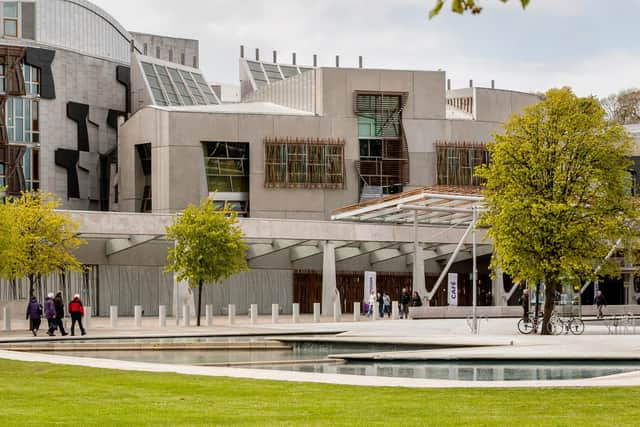
Donald Dewar’s response was to come up with an even more perverse solution for the new Scottish Parliament, namely the regional list system, whereby an MSP nobody voted for can not only comment on health matters but can legislate on them.
Indeed there is nothing in the Scotland Act to prevent unionist parties from putting sitting English MPs at the top of their regional list irrespective of the fact they live outside of Scotland and have never gained a single vote here. In a system designed to prevent any party from having a majority that would effectively give MPs in England the deciding say in any Scottish legislation.

You may well argue that such a scenario already exists with Section 35 of the Scotland Act. This gives Westminster the power to overrule Holyrood, but it’s restricted to certain circumstances where legal conflict may arise.
A fundamental reform of the list system is required with a key requirement being that all candidates must stand in the constituency vote so that voters can pass judgement on them. A party’s regional representatives would then be based on who amongst them got the most public votes rather than the most private ones.
Holyrood fails as a representative democracy because it was designed by politicians for politicians. It’s a parliament of the parties rather than a parliament of the people, with the recurring inability to achieve consensus emphasising this. We’re being held hostage within their parliament rather than being represented in ours.
Robert Menzies, Falkirk
Political hubris
In decades to come, the history of Reform UK and its predecessors will be a textbook example of the price of terminal political hubris.
By any past pointers of British electoral politics, an insurgent party allowed to succeed too fast, too soon would have seen itself overwhelmed with the consequences of largely novice councillors taking control of areas in already acute distress; and the main parties would have learned lessons to restructure their pitch and performances accordingly. Cases in point: the yo-yo histories of the SNP and Democratic Unionists, the crash and burns of the BNP and SDP.
But what’s happened is beyond belief. The local government chaos occurred, especially in the likes of Kent, but the hubris of the established parties which brought the current state of affairs to bear grew exponentially worse: doubling down in a chorus of “let them eat fruitcake!”.
One beholds their discombobulation today as the “swinish multitudes” indeed asked for second helpings: with it Labour’s irrecoverable doom and a decade in the wilderness for the Tories as Reform appears the only defence against Green parties hijacked yet again (this time by a bizarre Islamo-Trotskyite axis of convenience) by forces of fanatical malevolence.
Yet First Minister Swinney thinks telling his Holyrood besties they're not allowed to play with the wicked Baron Offord’s retinue will make Reform UK all just go away – the same tactic Labour tried with the SNP. We all know what happened next.
Mark Boyle, Johnstone, Renfrewshire
Electoral suicide
Clearly, there will need to be an examination of John Swinney's state of mind, if he should be returned to running Scotland’s government. He describes Reform UK – a party which stood for seats throughout the UK, as it is committed to the continuation of our country – as “a threat to devolution”. Such a statement is quite unhinged. Is he actually unaware that his own party seeks not only the end of devolution, but the end of the United Kingdom? That means no more Barnett Formula (running at £2,800 per person per annum in Scotland) and a hard border between Scotland and England. That is the biggest threat to the security and welfare of people on both sides of the border since the Second World War.
Mr Swinney, in line with an alarming proportion of SNP politicians at Holyrood and Westminster, has lived in a nationalist echo chamber his whole life and knows no better. Scotland deserves better, however.
I would suggest that a major concern of any party with MSPs elected to Holyrood is having anything to do with a party whose leader seeks an alliance with Sinn Fein. That will be a millstone around John Swinney’s neck for the next parliament. Mr Swinney says that “the SNP will not engage with Reform politicians if they are re-elected to office”. To be quite frank, I don't know who else would work with such a party as Sinn Fein, with its controversial history. The SNP will struggle to find any upstanding party who would voluntarily join them in doing so. It would be electoral suicide.
Andrew HN Gray, Edinburgh
Brexit’s example
So many Reform voters are those who voted for Brexit. Hopefully this will not result in the same mess as we now have at airports etc because of Brexit. Time will tell!
Mhairi Blair, Greenock, Inverclyde
Antisemitism
I was so concerned by Graham McLeod’s assertion that attacks on Jews would decrease if Israel ceased its aggressive actions (Letters, 8 May), that I am compelled to write. It is time to speak up.
I make it absolutely clear, since this is at the heart of the problem, that I do not support Israel’s aggressive actions.
Antisemitism is as old as the Jewish race, it’s always there and although it goes underground for periods, sometimes decades, you can be sure it will reawaken at the slightest chance.
There was no Gaza and no Israel in 1290 when the Jews were expelled from England.
There was no Gaza and no Israel in the time of the Russian pogroms.
There was no Gaza and no Israel in the 1930s.
Just three examples from a long list.
Many of the vile antisemitic tropes currently trotted out have nothing to do with Israel, they are just anti-Jewish.
The attacks in the UK have been carried out on religious and thus identifiable Jews and Jewish places, not supporters of Benjamin Netanyahu.
I know of no other UK citizens who are wholesale targeted for the actions of a country which shares their faith.
So I wish to politely correct Mr McLeod’s final statement. Jews will always be attacked. Full stop.
Lorna Thorpe, Alyth, Perth and Kinross
Prime time
Thank you for serialising Bertie’s life as described in The Prime of Bertte Pollock before it reaches the public in book form in August. I sincerely hope Irene loses her influence in future editions, though I realise the author needs us to have unchristian thoughts about her!
Martha Dickson, Edinburgh
Turbine trouble
The May election at Holyrood has meant that there has been no discussion over the impact on the price of electricity following the seven-fold increase over the current strike price of £73 per MWhr to £213 per MWhr for the output from floating wind turbines.
In 2020 the strike price was £42 per MWhr with a unit cost of 16p to the Scottish consumer. However, the renewable sector claimed such a subsidy did not cover their costs hence, in 2024, the strike price was increased by a factor of 1.7 to £73 per MWhr. The impact on the price to the consumer? Up by a factor of 1.6 to 26p per unit.
Why was there not a single analysis of a seven-fold increase in the strike price when the SNP energy plan assumes 60 per cent of future ScotWind projects will be based on floating wind turbine technology?
Ian Moir, Castle Douglas, Dumfries and Galloway
NEET solution
Henry McLeish writes that in 1597 “Terrifying legislation was passed saying that poor people who refused to work should be whipped and placed in stocks” (Perspective, 7 May). Now that gives me an idea.
Today there are only 181,890 personnel in the UK armed forces but there are 975,000 young people (aged 16 to 24) not in education, employment, or training (NEETs) in the UK, all receiving welfare benefits funded by taxpayers. These NEETS should be encouraged to join the armed forces and thus help deter those countries who would do us and the free world harm. Those who decline this generous offer should have their benefits taken away.
Clark Cross, Linlithgow, West Lothian
Don’t quote me
An interesting letter from Gordon Wright (6 May), quoting several writers’ sayings on Scottish governance/nationalism, but there others who could be repeated on the same theme.
Josephine Tey, in an unperformed play, a long time ago, had a player say on the subject of Scottish nationalism: “You are rousing hatreds that were sleeping, that would have died in their sleep. You rake up old injustices. You invent new ones. You distort history as you please.
“I love my country just as much as you. But I am not blinded by flag waving or by cheap sentiment. I don’t cheer when some fool tells me that we are the salt of the earth.”
As Mr Wrght says, food for thought!
William Ballantine, Bo’ness, West Lothian
Comments
Want to join the conversation? Please or to comment on this article.