
Readers' Letters: Here's why last month's Scottish election should be re-run
Reader believes the recent Holyrood election should be declared null and void
It is only a few weeks since the Holyrood election but in that very short time, all four wheels of the SNP “van” have come off.
As more revelations are made over the Peter Murrell affair, John Swinney's position is becoming ever more fragile.
Now the Scottish government has been found to be “in contempt” over the Salmond files too. We are still awaiting a positive spin on the next independence referendum and it has gone somewhat quiet on the “affordable shopping basket” front. This all runs a piledriver through the SNP's recent electoral campaign.
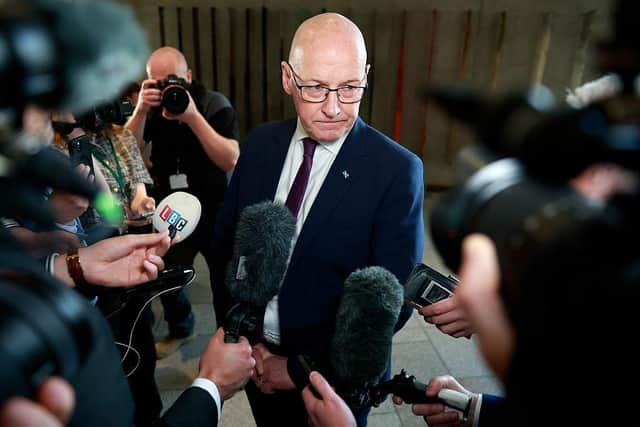

At what point does it impinge upon the veracity of the result? If the public have been misled then surely, as politicians are public servants, some responsibility must be taken and the election re-run?
Mr Swinney has nailed his colours to the mast of “nothing to see here.” There seems to be far more to see here than Mr Swinney would like us to believe.
Gerald Edwards, Glasgow
Senseless?
It occurred to me that a negation of the endlessly repeated railway security announcement might provide an appropriate slogan for our former first minister – don’t see it, don’t say it. Sorted!
John Scarlett, Gorebridge, Midlothian
Scrutiny needed
In Scotland, we are governed (badly) by a regime that is out of control. The current and former first ministers believe that they can escape scrutiny because they are, or were, our rulers. The failure of these people to keep their own house, the SNP, in order, in the Murrell case, is a scandal.
Now we have had the Information Commissioner’s demands that the First Minister release documents relating to the James Hamilton inquiry into whether Nicola Sturgeon broke the ministerial code, in the matter of the Salmond proceedings. The end result is that SNP ministers have been found in contempt by the Court of Session.
And guess who will be expected to pay the Information Commissioner’s expenses and legal fees? You and me, of course.
We need a new system whereby such wilful breaches by overpaid ministers result in some personal penalty for them. They cannot be allowed to avoid scrutiny in the way Swinney demands just because they won an election.
Jill Stephenson, Edinburgh
Most convenient
Nicola Sturgeon said she had plenty of gas in the tank, then one month before her husband was arrested she abruptly resigned as first minister. Was she warned in advance about the train coming down the line?
Then John Swinney was informed by the Lord Advocate of the embezzlement charges Peter Murrell was facing before they were made public, which previous first ministers said was not the norm.
Then the case against Murrell was deferred until just after the elections to the Scottish Parliament.
Once is bad luck, twice is misfortune, but three times…?
Having said that, the police operation against Peter Murrell was an excellent example of a leak-free investigation. Given the political figures involved, officers in Police Scotland, and in particular the lead Assistant Chief Constable, did an excellent job of avoiding leaks to the press and are to be commended for maintaining that leak-free status for several years.
It is just a great pity that the investigation cost more than £2 million in policing at a time when the Police Service has never been under greater pressure. If this inquiry had been at a UK level requiring support from Police Scotland, the SNP would have squealed and squealed until police costs were reimbursed by Westminster. Perhaps Mr Swinney can find it in his heart to send a couple of million to Police Scotland to offset the cost of the investigation.
I won’t hold my breath, but I am an eternal optimist.
Brian Barbour, Haddington, East Lothian
Indyref diversion?
No matter what the outcome of the recent criminal case against former SNP chief executive Peter Murrell for embezzlement of over £400,000 of SNP funds is, First Minister John Swinney's timing must be seen as inappropriate when it comes to his latest proposals for a second independence referendum.
Or is he craftily trying to create a diversion?
If not, then I would venture to suggest that it is hardly a very clever strategic move on his part when the people of Scotland are still reeling from the news that Murrell admitted misappropriating over £400,000 of party funds. One might question what safeguards are in place within the SNP to prevent such criminal activity in its structure. Just how much trust should the members of the electorate have in such a chaotic political organisation?
In any case, I would suggest that Swinney's latest proposals are most unlikely to receive any positive response from the UK government – which by statute is paramount. And, as I am sure Swinney is fully aware, if it should come to a legal challenge by the SNP, such an issue will be referred to the UK Supreme Court, which is paramount.
All such posturing by Swinney is somewhat pathetic; perhaps it just illustrates why in earlier times he was bypassed firstly by Salmond, and then later by Nicola Sturgeon.
He may well be “Honest John”, but his wisdom might well come under scrutiny!
Robert I G Scott, Northfield, Ceres, Fife
Focus on growth
After nearly 30 years working across Dubai, Saudi Arabia and the wider Gulf delivering major infrastructure projects, I recently returned home and voted in Scotland for the first time in decades. It should have felt like a reconnection.
Living overseas often sharpens your Scottish identity rather than weakening it. You follow events from airport lounges and hotel rooms, defend Scotland fiercely abroad and meet Scots in impossible places quietly helping build some of the world’s fastest-growing economies.
So standing in the polling booth should have felt hopeful.
Instead, I walked out feeling strangely deflated – like a man handed a restaurant menu where nothing on offer looks remotely edible, yet everybody insists this is the finest establishment in town.
The SNP has won again, and not without reason. It still speaks the language of national ambition better than its opponents. But after nearly two decades in power, why has genuine economic transformation still not happened?
When I first arrived in Dubai in the late 1990s it was still viewed in Britain as little more than sand, cranes and oversized ambition. Yet over three decades I watched it steadily transform itself into one of the world’s leading logistics, aviation and investment hubs.
And the biggest lesson was not money. It was focus.
Dubai obsessed about connectivity, infrastructure, competitiveness, delivery and growth. Projects were linked to a long-term economic vision. Airports connected to tourism. Tourism connected to real estate. Real estate connected to infrastructure. Infrastructure connected to investment. Everything pointed toward national transformation.
Scotland, by contrast, increasingly feels trapped in short-term political fragmentation, endless consultation and arguments about redistribution rather than wealth creation.
The money has to come from somewhere. Scotland cannot tax itself into prosperity any more than a household can budget itself rich.
What we need now is less constitutional trench warfare and more economic focus: planning reform, housing delivery, infrastructure investment, energy development, productivity growth, skills and technology.
We should be one of Europe’s most competitive small economies. We have the talent, universities, engineering capability and renewable energy resources.
What seems missing is urgency, confidence and a political system capable of thinking beyond the next election cycle.
When will Scotland become a nation again rather than merely a notion?
Kenny Linn, Upper Yetts of Muckhart, Clackmannanshire
Data needed
Whether in Auchtertool, Longformacus or over swathes of other parts of central and south Scotland, the reasons for the current proliferation of proposals for hyperscale data centres need to be urgently reviewed and explained to the public.
Treated by the Scottish government as developments of national importance, yet not specifically referred to in National Planning Framework 4, some of the proposed data centres would be among the world’s largest. They would consume huge quantities of power and need large volumes of water.
Arguments that Scotland provides cheap land in which to site such developments apparently include its currently cool climate compared with the rest of the UK. This needs to be considered in the context of ongoing global warming.
Equally, enhanced employment prospects need to be examined – are they transitory, for example during construction, or long term?
Are we being inexorably driven into a world dominated by AI?
All of these questions need peer review and, in Scotland, organisations such as the Royal Society of Edinburgh need to examine and report on them urgently before Scottish government policies destroy our lives and our environment.
Andrew McMillan, Edinburgh
Write to The Scotsman
We welcome your thoughts – NO letters submitted elsewhere, please. Write to [email protected] including name, address and phone number – we won't print full details. Keep letters under 300 words, and in the body of the email – no attachments – and avoid 'Letters to the Editor/Readers’ Letters' or similar in your subject line. If referring to an article, include date, page number and heading. No poems.
Comments
Want to join the conversation? Please or to comment on this article.