
Readers' letters: Give the Fringe's favourite uncle the freedom of the city
A reader says it’s high time the founder of the Free Fringe got official recognition
On Tuesday on Edinburgh’s Royal Mile, I bumped into, and then had the honour of chatting for half an hour with, the icon that is Peter Buckley Hill. Peter who?
Peter Buckley Hill, the man who in 1995 with just one show, Peter Buckley Hill and Some Comedians, single-handedly created PBH’s Free Fringe, that revolutionary initiative which offers free stages to performers, free shows to punters – theoretically free, but stick in the bucket what you can afford – and an endless stream of customers to hundreds of independent local businesses who otherwise would have lost trade to obscenely priced pop-up bars and food vans.
Millions of people have been entertained by the PBH Free Fringe, many thousands of whom have then been inspired to bring their own productions to Edinburgh. Additionally, those punters have also taken home a memory of both the Fringe and the city which they would not otherwise have had, as will be recalled by everyone who ever attended or performed at one of Peter’s legendary, riotous, chaotic, shambolic, hysterical, joyous and always – always – open and welcoming gigs at the Canons’ Gait pub.
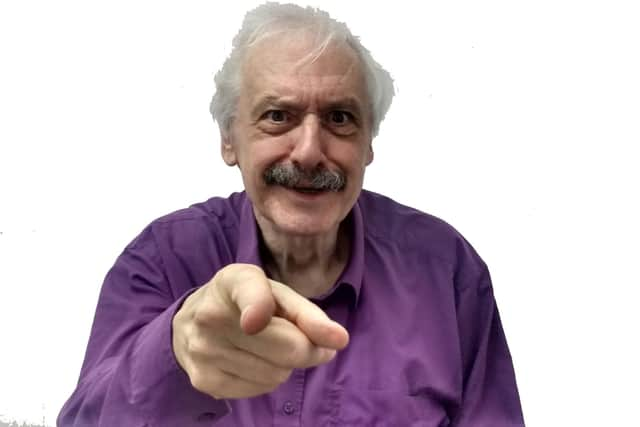

This year alone PBH is responsible for more than 600 free shows in 43 spaces. In an increasingly more corporate, elite and financially challenging environment for performers and punters alike, Peter has, year in year out, delivered the most successful outreach programme across the entire British arts scene. Somewhere out there, the Edinburgh Fringe still has a soul and it is Peter Buckley Hill.
Peter’s getting old. I noticed that, and he acknowledged it. It’s now time to thank – officially – the Fringe’s most beloved, idiosyncratic, visionary, empathetic, iconoclastic, benign old hippy. So, come on Edinburgh City Council, how about giving the Fringe’s favourite uncle the Freedom of the City?
Ross Smith, London
Land tax
Ian Petrie (Letters, 7 August) argues for a local tax based on land values rather than property. A laudable argument, but as a resident of Edinburgh (my home city) he will be aware that it is famous for its tenements.
How would you appraise them? Possibly a share of the building’s imprint. But it would need to be executed in such a way as not to be unfair to those in detached properties.
Something that could fall under the law of unintended consequences.
C Lowson, Fareham, Hants
Energy resilience
According to the message issued by SSEN on 5 August, “Storm Floris has been the most damaging summer storm in recent memory”. It impacted severely on the electricity network throughout the North of Scotland, with supplies to thousands of households being disrupted. Sadly, this has become an all-too-frequent occurrence in recent times and it is very obvious that there is a complete lack of protection and resilience built into our power distribution systems throughout Scotland.
Electricity consumers in Scotland pay approximately 56p every day in standing charges. With more than two million households paying this charge each day the total capital being raised off the backs of bill payers is in the region of £500 million annually. The whole point of the standing charge is to provide capital to repair and maintain the network. It seems that wires on matchsticks do not make for a particularly resilient system in the context of stormy weather. The experience of people living in the North East in recent times tells us that the storms are not only becoming more frequent but they are also growing stronger. Instead of standing charge money being used to fund new pylons to export Scotland’s electricity it is time that the money our bill payers contribute is used to create a resilient distribution network. Cables should be buried; stronger masts constructed when they need to be carried and sound engineering applied to what is a fundamentally simple problem so that Scotland’s citizens don't need to worry about the power going off every single time there is a storm.
Energy is a matter which is reserved to Westminster. As electricity consumers in Scotland have learned in recent months, Westminster is not prepared to act on our behalf if it considers that it may have an adverse impact on consumers in England. The time is now ripe for matters related to the generation and delivery of energy in Scotland to be dealt with at Holyrood by the elected government of Scotland.
Jim Finlayson, Banchory, Aberdeenshire
Renewables banking on wind power is the Achilles heel of our present dash to save our world from calamity.
The cost of scaling up wind power in terms of the impact on our environment is such that our country will be left with little countryside that will not be impacted in a negative way. As an example, here in Scotland – and many hill walkers can testify to this – there are few areas at present whether travelling to or actually walking, the views of pylons and wind turbines do not intrude massively.
It is highly likely that our present leaders have seriously underestimated future energy needs as we move toward the requirements of robotics, data centres, future manufacturing needs and travel, let alone household and office needs.
Imagine how this country would look with the present relatively small number of green power turbines and pylons then scale that up in your mind by at least a factor of four for wind turbines, two for much bigger pylons, ten for battery storage plus the infrastructure to reach housing and offices.
It is the scaling up of energy production to cope with future energy needs that should be driving where we look to source energy. At present, nuclear is only proposed as a base load back up to wind when the scale-up factor of nuclear should be screaming loud and clear “choose me”.
The obvious win for nuclear is that small generators can be located closer to the customer, reducing energy transport infrastructure such as pylons with the other benefit of not requiring back-up infrastructure in case of failure.
Present-day nuclear generation has the ability to reuse waste, which reduces the waste element considerably to the extent that our present nuclear waste, as I understand it, has become an asset rather than liability. What’s not to like?
A Lewis, Coylton, South Ayrshire
Lose-lose strategy
Both SNP and Labour have retained their presumption that there will be no new oil and gas developments in Scotland or in the rest of the UK. Ed Miliband, the minister mostly responsible for these decisions, has a very obvious and strong antagonism towards fossil fuels; many, with reason, feel he is an eco-zealot.
These two parties are in the main responsible for the loss of 13,000 oil and gas jobs in the past year alone. Their attitude surely will leave the country almost totally reliant on intermittent and unreliable and environmentally questionable wind as well as expensive foreign oil and gas imports while also shedding highly skilled jobs at an alarming rate.
In the meantime, Norway is cashing in and filling the gap left by the SNP-Labour's dangerously premature abandonment of our precious energy resources, decades too early and sadly for no other reason than posturing.
Alexander McKay, Edinburgh
No surprise
It should come as little surprise that one of the more intelligent members of the SNP, Kate Forbes, has decided to stand down from the Scottish Parliament.
She has clearly recognised the inability of the First Minister to deliver basic public services for the people of Scotland as she did during the SNP leadership election in 2023 when she was openly critical of the track record of Humza Yousaf. It was also during that leadership election process that she endured some poisonous rhetoric from within her party relating to her views on abortion and gay marriage.
One might fairly come to the conclusion that her decision to step down from the discredited Scottish Parliament has much to do with her faith as well as her intelligence in abandoning a sinking ship.
Richard Allison, Edinburgh
Bright light dims
Yet another bright light in Holyrood goes dimmer, as the Deputy First Minister has announced her intention to stand down from politics in 2026.
Kate Forbes MSP certainly lit up the Chamber back in 2020 as the first female to deliver a Scottish Budget (at short notice) and she brought ability and commitment to her new-found position.
To be an MSP in such a rural and geographically taxing constituency (Skye, Lochaber & Badenoch) would be difficult for anyone, but for a mother with a young child it presents a scenario which raises questions. Should the boundary commission be considering geographically halving the constituency to make it manageable, should parliament be looking for future possibilities for such a geographically spread constituency?
After all, the make-up of constituencies should not be solely dependent on achieving the number of voters, it should be manageable in the interest of constituents and representatives.
Catriona C Clark, Banknock, Falkirk
Vocabulary lesson
I would like to thank Mark Boyle (Letters, 6 August) for introducing me to a wonderful word I have never heard in all my 83 years – snollygoster: an unprincipled person, especially a politician.
Rosemary Shaw, Edinburgh
Write to The Scotsman
We welcome your thoughts – NO letters submitted elsewhere, please. Write to [email protected] including name, address and phone number – we won't print full details. Keep letters under 300 words, with no attachments, and avoid 'Letters to the Editor/Readers’ Letters' or similar in your subject line – be specific. If referring to an article, include date, page number and heading.
Comments
Want to join the conversation? Please or to comment on this article.