
Readers' Letters: Gilruth's rebuke to Burnham reveals nationalist mentality
Deputy First Minister failed to impress reader with her comments on Andy Burnham and an imagined Indyref 2
Jenny Gilruth's comment that Andy Burnham “would lose” another referendum on breaking up the UK tells us exactly why another referendum must remain off limits.
For the separatists of the SNP it has never been about making Scotland better, their record in government shows that, but about beating the English. The ruling elite of Scotland has lowered itself to the mentality of the Tartan Army. I expect Ms Gilruth to announce free parking cones for statues very soon.
(Dr) SJ Clark, Edinburgh

Sign of times
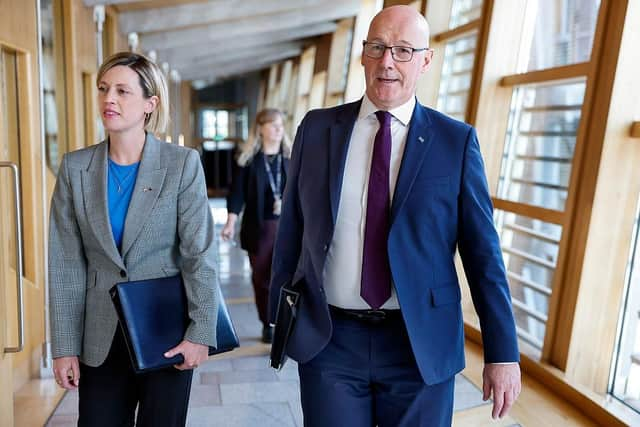
On July 9, 2026, UK Prime Minister Andy Burnham left room for the second Scottish independence referendum if public opinion shows demand for one. The 2026 Scottish Parliament election revealed that such demand really exists – in May the people of Scotland elected more pro-independence MSPs than at any point in the Parliament’s history.
We can’t miss our window, it’s time to act. Scotland’s First Minister John Swinney has already written to the Prime Minister pressing for talks over how a legal mechanism for a second independence referendum could be agreed.
It was a well-timed strategic move to prevent this issue from taking a back seat. Now the Scots have to do their part. It’s time to launch a campaign for signature collection to show the UK government that for all these years Scotland has never changed its stance and kept moving towards independence.
Iain Brocklebank, Glasgow
Pensions are safe
NI Holmes mentions a number of factors that depressed the Yes vote in 2014 – including “lies and false promises”, among which he, correctly, included “the threat of loss of jobs or pensions” (Letters, 11 September).
I've been retired for some years and am in receipt of two pensions – my UK State Pension, and another from my previous employer. In both cases, my pension income is based on my previous contributions and, with independence for Scotland, I can see no reason that wouldn't continue unchanged.
My company pension is the responsibility of fund managers, and is not at the whim of my previous employer – regardless of where their headquarters might be.
Regarding my UK State Pension, there's no shortage of folk who have left the UK and settled abroad and are happily receiving it and related additional benefits. Just as they would had they remained in England, Scotland, Wales or Northern Ireland.
Should I choose to move to Cork in Ireland, Benidorm in Spain, or any number of other countries both pensions will still be paid.
When I tell folk I spent 12 years in the Royal Navy, and lived and worked for 19 years in London and South East England, some reply, “well, it'll be different for you, of course”.
But no, it wouldn't. My contributions that earned both pensions were exactly the same as they would have been had I never left Scotland.
Either existing pensioners will continue to be paid from the Westminster pensions authority wherever they have settled, or the two governments will reach an agreement whereby a lump sum is paid to Holyrood and Scotland assumes responsibility.
In no circumstances is there any legitimate reason why pensions should not continue to be paid.
Ian Waugh, Dumfries, Dumfries and Galloway
Wrong lessons?
The reaction to Scotland’s latest PISA results risks obscuring what the figures actually tell us.
Scotland’s performance is certainly not where we want it to be, and our schools face serious challenges. But the latest scores were broadly stable and sit around, or above, international averages in a world where many countries have experienced declining performance.
Nor do the results provide compelling evidence that Scotland should simply copy England. England performs strongly, but its recent scores are also broadly static. Other successful education systems, including Ireland and Canada, have taken very different approaches.
Scotland should therefore resist the temptation to import policies simply because they come from south of the Border.
Instead, we need to learn from the evidence, tackle teacher shortages, properly resource additional support needs and focus on what works for Scotland’s children.
There are lessons to learn from PISA, but it is far too lazy to say, “be more like England”.
Alex Orr, Edinburgh
New lessons
As SNP continues to fail the late John Knox’s efforts to place Scottish education in worldly poll position, may I offer some suggestions?
Keep schooling comprehensive, but stream secondary classes so as to offer appropriate education for all. This may require special and/or remedial classes run by teachers with appropriate training and incentive payments. It will help classroom teachers to teach rather than control.
Introduce a Scottish 11+ to be sat by all pupils (other than the obviously unable) so appropriate setting may occur in secondary first year. The traditional 3Rs are especially vital still.
Minimise chalk-and-talk in favour of individualised learning so all may learn at their own pace. Skilled teachers should be invited to share in the development of a wide range of suitable materials for use in every school and in all subjects, replacing commercial one-size-fits-all texts.
Compulsory school age to be 7-14, the latter on condition of regular attendance of a worthwhile apprenticeship, with the option to return to schooling.
Abolish school holidays. Individualised learning enables parents and staff to arrange their own breaks. Imagine if hospitals or prisons ran on the current school year!
Tim Flinn, Edinburgh
Write to The Scotsman
We welcome your thoughts – NO letters submitted elsewhere, please. Write to [email protected] including name, address and phone number – we won't print full details. Keep letters under 300 words, and in the body of the email – no attachments – and avoid 'Letters to the Editor/Readers’ Letters' or similar in your subject line. If referring to an article, include date, page number and heading. No poems.
Comments
Want to join the conversation? Please or to comment on this article.