
Readers' letters: Follow Canada's example and build bridges with the EU
Canada is showing the UK the way with its moves to become an associate member of the EU, a reader says
Canada’s opportunity to become the EU’s first associate member clearly opens the door for the UK to do the same.
The EU’s proposal should be a wake-up call for Westminster, and Andy Burnham should pick up the phone and call European Commission President Ursula von der Leyen.
Whatever people’s views on Brexit or full EU membership, there is a strong case for exploring a pragmatic new relationship that brings the UK closer to its largest neighbouring market.
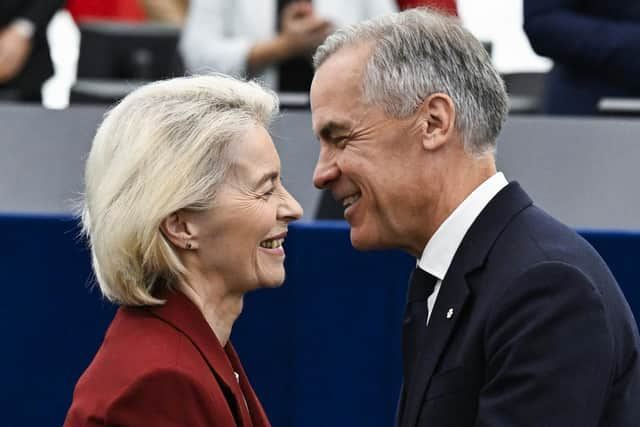

Canada and the EU are looking at deeper cooperation across trade, technology, defence, energy, critical minerals and economic security. The UK should be asking what a similar relationship could deliver for us.
Associate membership is not yet an established EU status, and the details still need to be developed. That is precisely why the UK should engage now rather than watch from the sidelines.
Canada is looking to build bridges with Europe. The UK should do the same.
Alex Orr, Edinburgh
Finite fuel
Clark Cross (Letters, 16 September) has once again thanked a Scotsman writer for an article supporting fossil fuel extraction rather than renewables. “Outstanding” maybe, except experts label the North Sea basin as “mature” with less than 10 per cent of oil reserves left and increasingly expensive to extract. No wonder BP is leaving to “direct capital to our highest value opportunities”.
According to Greg Jackson, of Octopus Energy, Scotland generates three times the electricity it uses. Given that’s mostly through renewables, and with even less gas left in the North Sea than oil, where is the economic case for more fossil fuel extraction beyond the development of Rosebank and Jackdaw? Scotland has no need and already exports much of the energy it produces.
So where is all the wealth Mr Cross refers to “below our feet”? Those companies that are left after BP leaves the North Sea are based overseas and drill to export to international markets, not for domestic generation into the grid. No wonder critics like Uplift have labelled the Offshore Energy UK report a “fantasy”.
This week the new Energy Minister pledged to reduce bills through renewable investment and agreed to meet money expert Martin Lewis in one year to prove she will be successful. She and Andy Burnham have been in post just a few months. Why then extract more finite, dirty and expensive fossil fuels now?
Neil Anderson, Edinburgh
Not so bloated
David Bol’s report (“‘Bloated’ civil service grows under Swinney”, 16 September) illustrates a persistent and unhelpful conflation between the civil service and the wider public sector.
The figure quoted of 553,600 covers the whole devolved public sector, including the NHS, local government and public corporations. Scotland’s civil service makes up 29,000 of that number. However, the article then draws a direct comparison to the UK civil service workforce of 557,000, which does not include the NHS or local government workforce in England.
This comparison is unhelpful – the civil service and wider public sector should not be treated as interchangeable.
Nor should public debate begin from the assumption that a smaller civil service is necessarily a better or more efficient one. It is for ministers to determine its size, but that decision should reflect the work they require civil servants to undertake, and the skills and capacity needed to deliver it.
Reducing staff numbers without reducing or redesigning the workload does not make the work disappear. It risks delays, poorer public services and greater pressure on those who remain.
If ministers believe further reductions are necessary, they should be candid about which functions will cease, reduce or change, and about the consequences for delivery. Serious reform requires a credible workforce plan, not simply numerical targets or labels such as “bloated”.
Civil servants should not be used as a proxy for the entire public sector, nor blamed for workforce decisions made by government.
Allan Sampson, FDA National Officer for Scotland, Edinburgh
Sinn Fein links
On the 25th anniversary of the 9/11 terrorist attacks, John Swinney gave a very effusive and respectful tribute to the victims, families, friends and first responders. He concluded his statement by saying: “Scotland will always reject terrorism and extremist violence.”
Earlier this year, on 30 August in County Mayo, his new best friend, Michelle O'Neill, the Sinn Fein First Minister of Northern Ireland, gave an even more effusive and respectful tribute to a very different group of people.
She was the keynote speaker at the 45th annual commemoration of the 1981 republican hunger strikers. For any avoidance of doubt, these ten individuals (seven IRA, three INLA) were all convicted of serious terrorist offences. Collectively they were sentenced to over 200 years. Sinn Fein however, would have you believe they were “victims” imprisoned for their “political” beliefs. And, needless to say, Ms O'Neill made no mention of their actions or their victims in her address.
In May this year Mr Swinney tried to justify his pact with Sinn Fein by saying that we should “move on” from Sinn Fein’s historic links to republican terrorism. Well Mr Swinney, Sinn Fein definitely haven’t “moved on”. It seems that they will take every opportunity to eulogise and praise republican terrorists.
By allying himself to Sinn Fein, Mr Swinney has shown he will do anything to try to get his way.
To justify his statement that “Scotland will always reject terrorism and extremist violence”, will Mr Swinney now pay tribute to all the victims of terrorism in Northern Ireland and the rest of the UK during the Troubles? Or doesn’t he want to offend his new best pals?
James McLeod, Glenrothes, Fife
Pension pots
Stan Grodynski (Letters, 16 September) continues to peddle the myth that the rest of the UK would somehow continue to pay the state pension to Scots in the event of independence, because “he has paid his NI contributions”.
Given his belief on how Scotland could not just survive but thrive, what is it that makes those in favour of independence cling to the idea that someone else will pick up the bill for paying Scots the pension?
His NI contributions when paid, were, like mine, immediately used to pay the state pension for retirees at that time. There is no “pot”. NI paid today helps funds pension payments today, not at some stage in the future. He may well be right that he has an entitlement, but as this entitlement is actually a liability for the UK at the moment, in the event of independence, it is almost certain that Scotland’s share of that liability would flow to Scotland and the Scottish taxpayer would have to fund the pension.
It is correct that if a UK citizen moves to Spain for example, the UK (which includes Scottish taxpayers), continues to fund the cost of that pension in the same way that the Spanish government would pay the pension entitlement earned for a Spanish citizen who has moved to the UK. However that was subject to an agreement between the UK and EU countries. There is no such agreement between the rest of the UK and Scotland, and to pretend that the rest of the UK would somehow happily pick up the bill for Scottish pensioners is naive in the extreme.
Brian Barbour, Haddington, East Lothian
Not ‘over it’
Had the “change” promised by the Better Together campaign actually been delivered then I would “get over it”.
Did Douglas Cowe (Letters, 17 September) think those in the independence movement would simply give up?
60 per cent of my household didn't get a say in 2014 so somehow their views should be heard. This is just a basic tenet of democracy.
Change was promised and change should have been delivered – not seen as some excuse to keep things the way they are, with a first-past-the post electoral system, the same House of Lords and no thought given to a federal UK.
Twelve years on, can Mr Cowe tell me what has actually changed and would he admit that “change” really meant more of the same?
Peter Ovenstone, Peterhead, Aberdeenshire
Iran emboldened
On the surface, the blame for the rise in inflation to 3.1 per cent appears to be being placed upon the US/Israeli war on Iran. This is unfair. Iran was close to developing a nuclear weapon. That would have been far more catastrophic than a few pence per litre.
What was also catastrophic was the reaction of Europe and even the UK to this war. By staying well out of it these countries have encouraged Iran to be more bold. This has now resulted in the Houthi attacks on Saudi Arabia which have nothing to do with America or Israel but more to do with power politics in the MIddle East.
Those Western governments that have isolated Donald Trump when he needed their help and have turned upon Israel have simply backed the wrong side. As Iran becomes more empowered by Western “surrender” the oil price will simply go on rising. We could have nipped this in the bud. Instead we have unleashed a whirlwind. Left-leaning Western politicians are so concerned over minority votes that they have not recognised the real problem: Iran. Is it too late now?
Gerald Edwards, Glasgow
Write to The Scotsman
We welcome your thoughts – NO letters submitted elsewhere, please. Write to [email protected] including name, address and phone number – we won’t print full details. Keep letters under 300 words, and in the body of the email – no attachments – and avoid ‘Letters to the Editor/Readers’ Letters’ or similar in your subject line. If referring to an article, include date, page number and heading. No poems.
Comments
Want to join the conversation? Please or to comment on this article.