
Readers' Letters: Flooding in Valencia as predictable as the cries of climate change
We shouldn’t be so quick to attribute the flooding in the Valencia area to climate change, a reader suggests
Predictably, the flooding in the Valencia area is being described as a result of “climate change” and the BBC news wheels out academics to confirm that opinion.
It is interesting to note, however, that despite records only going back a couple of hundred years or so, they show that the area around Valencia is not entirely unfamiliar with this type of event.
For, example, on 10 November 1891, newspapers reported that, “floods to the south of Valencia have now abated and men are employed clearing the streets. Half of the orange crop has been destroyed and other crops totally ruined....the damage done to property of all kinds is incalculable”.
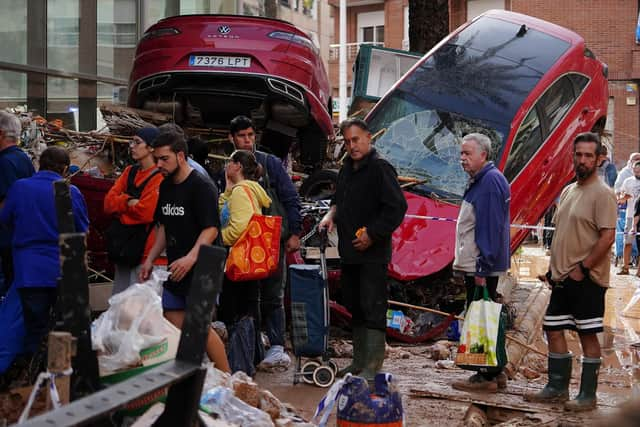

In March 1894, “the crops in the flooded district are completely destroyed” and, in 1909, “a great storm raged on the coast and much damage has been done at Valencia”, and “several quarters of the town are under water”.
In 1919, “as a result of the torrential rains and severe hailstorms, the crops have been destroyed in several communes and part of the town of Valencia has been inundated”.
Of course, there are many other reports from before the 1890s and after 1919, but I quote a small number of examples which do not mention people building houses in dried-out river beds, for example, which has been mentioned in relation to the current flooding.
“Climate change” is the constant fall-back of much of the media and I, like many others are tempted to ask: Climate change? Change from what exactly?
Andrew HN Gray, Edinburgh
Power surge
George Herraghty (Letters, 31 October) asks why we are paying subsidies to install renewable energy sources. The answer is simple – not only to reduce CO2 emissions and thereby slow global warming but because renewables are much, much cheaper.
In the case of both onshore and offshore wind it’s little more than one-third of the cost of a gas turbine power station – £44 per MWh compared to £114 per MWh.
He’s correct to say that when wind speeds are too low then a gap has to be filled, but this is being increasingly done through the development of storage systems – new pumped hydro schemes and massive battery systems as well as new technologies like thermal and gravity storage. Some nuclear power stations will also be needed but these should be as few as possible because of their enormous cost as well as intractable radioactive waste problems.
Barry Hughes, Edinburgh
Toxic attitudes
Carolyn Brown of ScotPAG criticises Chief Medical Officer Prof Gregor Smith for telling the Scottish Parliament that the toxicity of discussion around trans issues is making it harder to fill NHS posts in gender identity healthcare (Letters, 1 November).
Ms Brown writes this criticism, seemingly unconscious of, or unconcerned about, the fact that groups like ScotPAG are particularly contributing to this toxic environment. Her letter claims that gender identity healthcare is a category that “does not exist”, and the ScotGov Challenge page on the ScotPAG website says “the concept that anyone can change sex should be removed from all aspects of our public institutions”.
What could be more toxic towards trans people than proposing that they don't exist, should not be mentioned, and should not be provided appropriate gender healthcare? Thankfully, there are good health professionals who do provide the care trans people need despite such nonsense, although not enough of them at present.
In recent years, groups like ScotPAG have promoted blatant discrimination against trans people. It is disappointing, to say that least, that after many years of improvements in the way LGBT people are treated, such groups are trying to turn the clock back.
I do not think that ultimately they will succeed, and I expect that in the not so distant future we will regard their behaviour with the same incredulity that most of us now feel about the campaigns, decades ago, that tried to stop the decriminalisation and recognition of same-sex relationships.
Tim Hopkins, Edinburgh
Total recall
I’m probably writing this after looking for my glasses while they are on top of my head, but even my shambolic recall eclipses the memory lapse of letter writer James Macintyre (1 November).
He talks of Rachel Reeves’ selective memory when it comes to boom and bust and I almost bust a vital organ with laughter. What Mr Macintyre failed to point out is the giant Lettuce in the room fiscal omnishambles that best describes the Liz Truss budget of 2022. This was the Halloween horror show to end all horror shows.
The Truss/Kwarteng budget resulted in the loss to the United Kingdom of over £30 billion and billions more in repeutational damage, scaring off investors like a two-year-old vampire at your door on Halloween.
We can all do the whataboutery of Punch and Judy politics safe our in own little echo chambers, but some big and scary decisions have to be made by the grown-ups in the room. Now, where are my blinking car keys?
David Cruickshanks, Strathmiglo, Fife
Pension pot
How I wish the media, including The Scotsman, would stop quoting only the new State Pension figures when referring to pensioners’ income.
The vast majority of us retired before 6 April 2016 and will receive £176.45 per week, from next April. This is a far cry from the much-vaunted figure of £230.30 available to younger pensioners.
It also disguises the fact that the United Kingdom State Pension is one of the lowest in Europe. Not to mention the thorny subject of the Winter Fuel Payment withdrawal.
Patricia Macinnes, Glasgow
Go for the burn
Forget recycling. Forget global warming. Personal survival matters. Pensioners are turning to burning their waste paper, cardboard and plastic to keep warm this winter, but, as good citizens, they will still recycle their tins.
Bruce Proctor, Stonehaven, Aberdeenshire
For and against
John Swinney's SNP administration is entirely responsible for winter fuel payments in Scotland from 2025. Yet he has just signed a pledge that condemns the recent restructuring of the payments from a universal to a targeted system.
As he and his administration have accepted the new structuring and will pay the WFP only in that way, it is very difficult to understand why he would choose to make a fanfare of his signing of the pledge. Why not simply adjust his budget and pay the benefit?
It must be assumed that it is the latest manifestation of the SNP being for and against something simultaneously, depending on the audience. What we can say for sure is that is blatant nationalist hypocrisy once more to the fore.
Alexander McKay, Edinburgh
Murray in a hurry
I chanced upon “36 best Chic Murray jokes” (Scotsman, 6 November 2023) and noted that my favourite is not among them. Why I find this so hilarious, I am not sure: “I got up this morning. I like to get up in the morning. It gives me the rest of the day to myself.”
My husband and I met Chic Murray at Heraklion airport in September 1982. He had come to Crete to write a screenplay, but the chauffeur-driven car he had expected to meet him had not turned up so we gave him a lift into town in our little rented Fiat, and he stayed at our hotel. Over dinner, he talked a lot about showbiz people, but I don’t remember any jokes.
In the morning, a weight had been lifted from him: a car had arrived to take him to a secluded location where he could write his screenplay, and have the rest of the time to himself.
Jill Stephenson, Edinburgh
Reasons to cheer
Congratulations to Rosemary Frew on her appointment as Moderator of the General Assembly of the Church of Scotland. She has been called a cheerleader for the Church at a time when, on paper, the Church has very little to cheer about. If we think that, perhaps we should think again.
As a retired Church minister, who is more comfortable to call himself a Christian Humanist these days, I hesitate to think we should cheer the Church, yet maintain that we have a lot to cheer about, not least that we have a female Moderator, who is a cheering parish minister.
The only recorded occasion on which Jesus was cheered was during his ride into Jerusalem on the first Palm Sunday. Far from milking the cheers of the crowd, he shrunk from the temptation of cheap and misguided popularity to choose instead the visible rejection and shame of the cross. That rejection lies at the heart of his way so obviously today.
The Church is having to live with that rejection now, but, through Jesus’s eyes, is challenged see it as his positive victory of life over death, love over hate. The way of Jesus is very much to be cheered today by, not just the Church, but every human being.
Ian Petrie, Edinburgh
Big Ange
I see Mr Postecoglou is again appearing in the Sport pages. I have long been puzzled as to how his name should be pronounced Might it be as referring to an adhesive available to employees of Royal Mail (postie glue) or, perhaps a more modern style of housing for the Inuit people (post igloo)? I should be much obliged for any enlightenment.
S Beck, Edinburgh
Write to The Scotsman
We welcome your thoughts – NO letters submitted elsewhere, please. Write to [email protected] including name, address and phone number – we won't print full details. Keep letters under 300 words, with no attachments, and avoid 'Letters to the Editor/Readers’ Letters' or similar in your subject line – be specific. If referring to an article, include date, page number and heading.
Comments
Want to join the conversation? Please or to comment on this article.