
Readers' letters: Facts will have climate apostles crying green tears
A reader hails a Scotsman writer’s withering attack on the drive for net zero
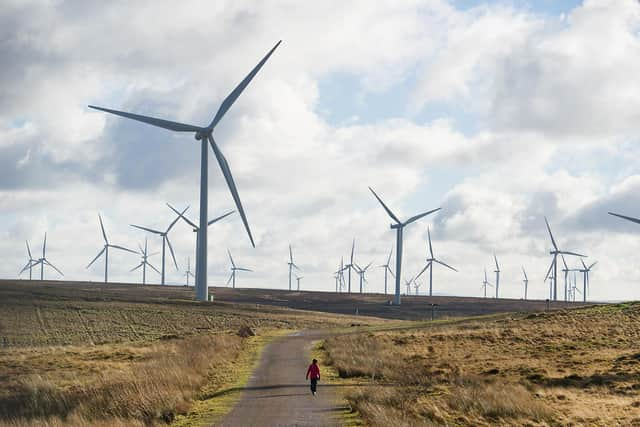
Well done The Scotsman and Paul Wilson for going where angels fear to tread. The article “Wind and solar farms are the great follies of the 21st century” (10 September) will have the climate apostles crying green tears.
The facts quoted destroy the green arguments and are worth repeating. Jobs lost as BP gives up due to uncertainty in respect of the Jackdaw and Rosebank oil and gas fields.
After the wind and solar industry repeatedly telling the public that the electricity generated by wind and solar was cheap and plentiful, the article reveals what we have known for years that “Britain now rejoices in the highest industrial energy prices in the developed world”. One reason, as the article mentions, is constraint payments. Those of a nervous disposition should look away now. The figure is £2.1 billion and counting. Whoever agreed to this must have been green and wet behind the ears. All new contracts, and unfortunately there will be more, should not include constraint payments.

In conclusion Paul Wilson says: “It’s only a matter of time before net zero is consigned to history as a strange and unscientific act of national self-harm.”
This cannot come soon enough.
Clark Cross, Linlithgow, West Lothian
Changeable climate
Things are becoming increasingly daft in the so-called “climate change” debate. The narrative which is the public face of this is that said “climate change” began with the Industrial Revolution, which is arrant nonsense. Any exploration of the rise and fall of civilisations in South America shows how cultures rose and collapsed when severe drought caused the abandonment of cities. The return of tuna (tunnyfish) to British waters illustrates current sea temperatures reverting to those of the 1930s.
An exploration of Ancient Egypt shows that there were times when the Nile ran desperately low. In the time of the Emperor Justinian, a period of several years of cold weather caused poor harvests and starvation, and around 1700 Scots Old Parish Registers show how poor harvests caused starvation across the land. And yet the “hockey stick” portrayal of temperature erases the warm Roman period and the Medieval period to indicate that our current temperature is unparalleled. However, records show that thawing glaciers, warming seas and 40C were commented upon from the 1890s to the 1930s. Greenland was so-called in 1000AD because you could grow crops there and medieval monks grew grapes in Yorkshire.
Climate is always changing.
Andrew HN Gray, Edinburgh
New anthem
As our three children attended Edinburgh University, I regard myself as an honorary Scot entitled to offer the following suggestion.
As the SNP considers its future direction, might it propose adapting the magnificent final theme from Mendelssohn’s Scottish Symphony as Scotland’s national anthem?
Scotland inspired one of the world’s great symphonies. With suitable lyrics, its triumphant theme could become a dignified and unifying anthem, celebrating not an ancient victory over England, but Scotland’s enduring capacity to inspire the world.
Trevor Lyttleton MBE, London
Care crisis
It is no surprise that we have a crisis in caring (your report, 8 September) as it has been predicted for more than 20 years, with dire warnings that to solve the problem most school-leavers would have to become carers or nurses. Obviously a completely unrealistic proposal.
In my early GP career to enter a care facility you had to be mentally competent and able to wash, feed and dress yourself. 35 years later any of those abilities would mean care being provided at home. As a whole cohort of elderly have moved into a state of frailty previous nursing duties are now done by carers while at the same time private care homes and cottage hospitals have closed and carer numbers have been inadequate to provide home care.
At any time around 40 per cent of acute hospital beds (£225,000 each per annum) are now occupied by patients who could be cared for at home or in a care home (£85,000 per annum), making our hospitals the most expensive care homes in the world. 25 years ago I stated that we should be funding more new care homes but was told that people would be looked after at home instead. We now see the inevitable outcome of blocked beds, corridor care and cancelled appointments.
With combined health and social care budgets and management surely now is the time to move staff and funding and redesignate some hospital wards as care facilities until onward discharge. These would be staffed by carers and funded appropriately, releasing around £15 million annually for each district general hospital. This money would provide more beds and care staff in the community and enable hospital nursing and medical staff to move to acute and A&E services.
Dr J Locke (retired), Kirkcudbright, Dumfries and Galloway
Islands strife
Last weekend was my first visit to the Outer Hebrides. I used the opportunity to learn first-hand more of Harris and Lewis and the island economy.
The island population has now dropped below 20,000, largely due to a population ageing more rapidly than the Scottish average. But for those of working age, what keeps the island economy going? Tourism for sure, alongside farming (mostly sheep), some crofting and fishing (commercial and private). And Stornoway, the island capital, acts as an important administrative and service hub for the Hebridean hinterland.
I was especially curious to find out about the health of the Harris Tweed industry. It was a sadness to discover that compared with its zenith in the mid-1960s the industry is now five times smaller: it now supports around 520 jobs across the Scottish economy according to a recent impact assessment. Some 370 of those jobs are located in the Outer Hebrides. And the three remaining mills (Harris Tweed Hebrides, Carloway, and Kenneth McKenzie) are the biggest employers supporting 320 jobs, including contracted home-based weavers.
Exports have been hit hard by the imposition of 10 per cent tariffs by the Trump administration (Japan is now the main export market). In particular, the ending of the $800 tariff-free de minimis rule has hit the rump of small independents and micro-exporters especially hard. These businesses rely on e-commerce to sell into the US market. For example, a £60 Harris Tweed bag once tariff-free now attracts $100-$200 in duty charges plus the 10 per cent ad valorem tariff! Simply not worth the Hebridean candle any more.
Here’s my plea: President Trump, honour your heritage and your mother’s memory (Mary Anne McLeod from Lewis), and, just as you were prepared to do for our whisky industry, please waive these punitive tariffs on Harris Tweed products which so pain your mother’s people! They’re your people too!
Ewen Peters, Newton Mearns, East Renfrewshire
Modern Darien
We live in extraordinary times. We view the failures of government(s) on a daily basis. The fragility of honesty, the deliberate deceits, the cynicism of opportunism and the bare-faced deliberate misrepresentation. It makes The Darien scheme look genuine and honest.
The swamps of failure are to be seen across the country: the infrastructure, the communication system (ferries not least), health, agriculture, fishing and energy.
The saviour, the smoke screen to be launched to cover failure, is an attempt at independence. HS2 in a different format. The South Sea Bubble, indeed even Darien. Precious public money will be spent, time which should be better spent. The incompetence and deceit are breathtaking, What’s worse is that the mediocrities across the political spectrum cannot see this – or it is deliberate?
James Bishop, Gisla, Isle of Lewis
Labour pains
Neil Anderson (Letters, 11 September) has a long list of criticisms of my letter (10 September) that need a reply. Possibly most important is the misnomer of a “two-state solution” beloved of many. Let us be clear here. The Palestinians want a one-state solution, from the river to the sea. There is no room for Israel. Interestingly, many of the workers for Israel on the West Bank are Palestinians so by sanctioning these products, it simply puts more Palestinians out of work. Politicians rarely regard the consequences of a “good headline”.
The timing was awful under any circumstances. It came just before the 9/11 anniversary plus the Jewish High Holy Days. Donald Trump will react, it is only a matter of time. Labour prime ministers seem to like annoying him.
Labour has done far more economic damage than Liz Truss, just look at the interest rates on the bond market. It would do well to drop comparisons. Finally, Andy Burnham has just, possibly accidentally, re-opened the independence debate with his loose tongue, the same tongue that said social issues are as important as defence issues. Mr Burnham is not up to the job. No difference then from Keir Starmer. How long can Burnham last?
Gerald Edwards, Glasgow
‘National’ news
Did anyone notice the extensive coverage and analysis of Andy Burnham’s indyref misstep at PMQs in the BBC and ITN National(sic) News midweek? Nope. Me neither.
John V Lloyd, Inverkeithing, Fife
Write to The Scotsman
We welcome your thoughts – NO letters submitted elsewhere, please. Write to [email protected] including name, address and phone number – we won't print full details. Keep letters under 300 words, and in the body of the email – no attachments – and avoid ‘Letters to the Editor/Readers’ Letters’ or similar in your subject line. If referring to an article, include date, page number and heading. No poems.
Comments
Want to join the conversation? Please or to comment on this article.