
Readers' Letters: Can Swinney really find money for election gifts to voters?
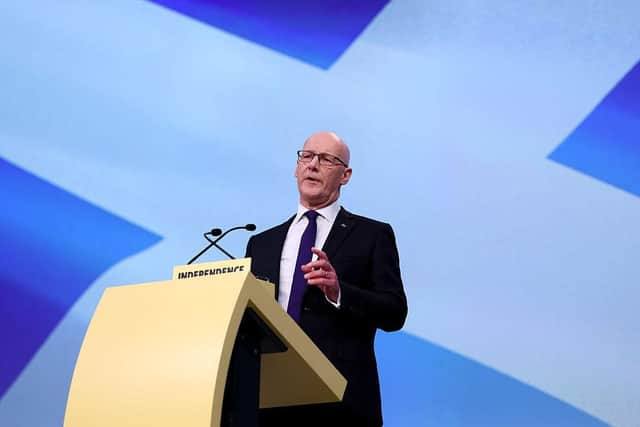
Can John Swinney really find cash to fulfil promises if SNP get a convincing win at upcoming Holyrood poll, asks reader?
To voters awaiting the highest bid from Scottish politicians in this election season, John Swinney’s offer is hard to beat, and no honest opponent would even try.
Mr Swinney will, he claims, spend £500 million to bring Scottish childcare provision up to the standard enjoyed in England. He will give aspiring homeowners “up to” £10,000 each towards a deposit. In addition, Mr Swinney will bring energy sources in Scotland under Holyrood’s control. How will he do all this, and more?
Answer: he will pretend he can spend money that he does not have and cannot raise. Importantly, how much would it cost to bring energy sources under Holyrood’s control? Contrary to Mr Swinney’s mendacious prospectus, Westminster does not control Scottish energy sources: the energy companies who located, extracted, refined and marketed them own them. Not many people seem to know that.

Promising largesse at a time when financial experts in the IFS, Scottish Fiscal Commission, Auditor General’s office and, this week, the Royal Society of Edinburgh warn that Scotland will not, in the next parliamentary term, be able to afford the spending and benefits we currently have, let alone more is the height of dishonesty. We have been here previously. In the last parliamentary term, the SNP administration kept five of its 17 key election pledges.
Why will Mr Swinney not tell the truth? Because, if he did, his support would melt away like snow off a dyke.
Jill Stephenson, Edinburgh
Unconvincing
Grant Frazer makes a very valid comment in his letter (24 March). With the probability of significant support for independence-leaning parties in the forthcoming Scottish Parliamentary elections (including possibly Reform UK) the pro-independence supporters need to get out and make the case. Indeed.
Unfortunately, none of the independence supporters have made a case yet that is relevant, economically sound and workable. Even by throwing taxpayers’ money at a series of papers, the SNP-led Scottish government failed to produce anything viable. In fact, these papers raised more questions than they answered on fundamental issues.
I can’t imagine any convincing case will be crafted over the coming weeks before we go to the polls.
Ross Scott, Edinburgh
Mould danger
Hot on the heels of shut-off rooms dealing with highly medically compromised patients at Glasgow's new flagship Queen Elizabeth Hospital due to risks in the environment comes news that young cancer victims at Edinburgh's equally new Royal Hospital for Children are at risk, too, as mould has been found in their wards.
John Swinney constantly wants to remind us everything is fine in our hospital system, yet the facts are getting in the way. The SNP constantly claims the Scottish NHS is only safe in its hands. Really?
Gerald Edwards, Glasgow
Sinking feeling
Brian Monteith thinks it significant that Reform was the first to announce its manifesto, as if this was a badge of honour (“Scotland should ignore the ‘independent’ IFS if it is ever to prosper again,” 24 March). That’s a bit like saying the Titanic was the first ship to have a heated swimming pool. Very nice, but it hardly made it any more watertight.
Mr Monteith has spent the last few years following Nigel Farage whenever he flipped to yet another far right party. In fact, he’s been in more parties than Andy Warhol. And should any political organisation that reveres Donald Trump so much ever be taken seriously or trusted to pursue the UK’s best interests? Anyone with an ounce of intelligence also knows that Reform’s fiscal plans are geared towards creating a much more favourable regime for the super-rich. Hence the huge donations from offshore billionaires and tax exiles.
With the Institute for Fiscal Studies describing Reform’s back-of-a-fag-packet tax plans “not credible” and “unserious,” I think I know who I trust more. Scotland’s Reform leader, plain old Malcolm from Greenock, needs to get a bigger fag packet, for all the difference it will make.
D Mitchell, Doune, Perthshire
Science friction
It is interesting to see a revival of the Classics in state schools (Ian Petrie, Letters, 24 March). But I hope its resurgence wont turn the brightest and best pupils away from science, as happened in the past. Years ago I supplied cells grown in test tubes to John Mallard for him to use in the early days of his pioneering MRI research. He moved to Aberdeen soon after, but at the time he ran a small physics department at St Thomas's Hospital Medical School, set up to give year-long science courses to new medical students whose scientific knowledge was deficient because they had specialised in Classics at school. The need to train more doctors with speed to save the NHS, and tight funding, make the replication of such courses highly improbable today.
I declare an interest in that I won a scholarship to Cambridge but couldn't take it up because passing O-level Latin was a requirement. I failed and went to St Thomas's instead. No bad thing, in that when doing virological research there I was mentored by June Almeida at the time she was discovering human coronaviruses.
Hugh Pennington, Aberdeen
Choose life
Pope Leo XIV speaks much-needed good sense on the subject of war. Sadly, in a world desperately seeking peace, war is something of a growth industry, in Ukraine, Gaza, Sudan, Iran and Afghanistan, to name but a few.
Pope Leo stresses the sheer damage war is wreaking on our fragile planet. Aeroplanes, he says, should be harbingers of peace, not instruments of war and destruction. He suggests banning all bombing.
Planet Earth, one study suggests, has, quite literally, had its fill of wars, and the irretrievable damage that they are causing to the environment. It's jarring to the ears to hear Donald Trump suggest “we can bomb them just for fun”.
War is, uniquely, a human activity which spreads undeserved havoc to the animal kingdom and inhabitants of the ocean. Humanity has been described as the stewards of the planet. It's time that we treated it and our fellow creatures with respect and, indeed, reverence.
Ian Petrie, Edinburgh
Use resources
Research carried out by pollsters Opinium for Offshore Energies UK revealed that 76 per cent of a sample of 2,000 adults said the UK should “continue producing oil and gas at home rather than relying more on imports” (your report, 23 March).
Just watch the green zealots and far too many politicians rushing to discredit this research by pointing out that Offshore Energies UK is the trade association for the oil and gas industry so the conclusion is questionable.
However, the facts are there are 300 million barrels of oil available for extraction at Rosebank and 120-250 million barrels at Jackdaw, and the Cambo oil field is estimated to contain over 800 million barrels of oil reserves.
The oil and gas industry has 200,000 good skilled jobs across the UK, but due to the dithering by the UK government is shedding 1,000 a month. Despite all the hype, unreliable wind and solar could in the last 12 months only provide 40.9 per cent of UK electricity.
To those who say that fossil fuels create greenhouse gases I would pose the question. How many trillions of tons of greenhouse gases are created every year by wars and Mother Nature?
Clark Cross, Linlithgow, West Lothian
Come together
Mark Openshaw (Letters, 24 March) clearly isn’t a fan of the SNP yet all the supposed “failings” he indicated are witnessed across the whole of the UK and often to a much greater extent. It is not the SNP that has amassed a UK public debt of around £3 trillion, and even in England, which has been slow to adopt a more holistic approach to education, and where selection of schools for testing has been questioned by the OECD, PISA scores are falling.
The fact of the matter is, most people in the UK are being failed by the current constitutional arrangements, democratically, economically and socially. Radical change is no longer desirable but a necessity – the only question is whether that change should be in the form of federalism, confederalism or independence for the nations of these islands.
Of course, if Mr Openshaw is genuinely concerned about instability, he should not procrastinate in arguing constructively for one of these constitutional options, as the longer he waits, the greater the interim risk of devastating turmoil under a Reform UK government that would accelerate Britain’s demise. A win-win outcome for Mr Openshaw would be self-determination for Scotland’s people, as not only would such turmoil be avoided but the influence of the SNP would likely be diminished, if not dissipated altogether, having achieved its raison d'être.
Stan Grodynski, Longniddry, East Lothian
Too stupid?
Steuart Campbell casts doubt on the possibility of intelligent life elsewhere in our galaxy on the grounds that there is no evidence of their trying to contact us (Letters, 23 March).
Could the reason be that they are too intelligent to want to have anything to do with homo sapiens, with our frequent wars and failure to care for our planet?
S Beck, Edinburgh
Write to The Scotsman
We welcome your thoughts – NO letters submitted elsewhere, please. Write to [email protected] including name, address and phone number – we won't print full details. Keep letters under 300 words, and in the body of the email – no attachments – and avoid 'Letters to the Editor/Readers’ Letters' or similar in your subject line. If referring to an article, include date, page number and heading. No poems.
Comments
Want to join the conversation? Please or to comment on this article.