
Readers' letters: Calling Nicola Sturgeon 'divisive' is Orwellian revisionism
A reader takes issue with critics describing the ex-first minister as a ‘divisive’ figure
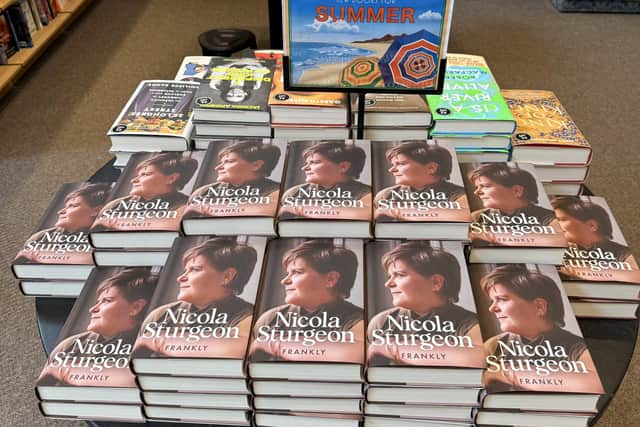
Nicola Sturgeon’s autobiography has her critics claiming that she was a “divisive” leader. But I seem to recall Anas Sarwar demanding a Gaza ceasefire when his boss at Westminster was vehemently opposed to it. That was followed by the disciplining of Labour MPs in Westminster for refusing to obey Keir Starmer’s welfare diktats. Yet I have never heard Kier Starmer’s management style being described as “divisive”.
It was the same with Boris Johnson. Rather than supporting Theresa May he worked behind her back to sabotage her Brexit deal in order to become leader. He then set about expelling those party members who expressed concern about his behaviour. Is that not a more realistic example of being divisive?
It’s perhaps worth pointing out that Nicola Sturgeon became SNP leader after the failed 2014 referendum. Nationalism was subsequently declared “dead in the water” by many of the journalists now claiming she was divisive. Yet within a year she had secured an unprecedented 56 out of 59 Scottish seats at Westminster. On top of that party membership rose to a reputed 125,000 under her stewardship. She succeeded in not only winning over the disaffected within her own party but also persuading voters from other parties to switch allegiance. How is that the hallmark of a “divisive” personality?

Invariably the Holyrood Gender Reform Bill is cited as the prime example of this divisive leadership style. But there was division within nearly all the parties. Some Tories defied their leadership to vote in favour whilst some Labour members followed suit to vote against. That polarisation was there because of the nature of the subject matter rather than a style of government. Despite that Ms Sturgeon persuaded supporters from all parties to unite behind the bill and get it passed. So is this an Orwellian revisionism where unity is now classed as division?
Robert Menzies, Falkirk
Tears of joy
Sobbing on the floor when the police visited, crying in the Holyrood toilets after being bullied by an MSP, teary on delivery of her book, floods of tears during the Covid inquiry: I’ve only read snippets of Nicola Sturgeon’s book but it does seem like one big tear-jerker.
Perhaps its title should have been ‘Merry Christmas’ after that time-honoured Scottish saying: “She’s like a Christmas caird, aye greetin’.”
As female statespersons go, compared to the likes of Angela Merkel, Golda Meir or Madeline Albright it appears Scotland had an incompetent big girl’s blouse as first minister and it’s we Scottish voters who should be shedding tears – of joy – at her very public, self-inflicted demise.
Allan Sutherland, Stonehaven, Aberdeenshire
Freedom at last
A former Scottish Nationalist first minster, in the process of releasing her memoirs, has stated that she wants to live in London and enjoy the freedom of life in the capital city of the UK. Good luck to her.
An added bonus to the freedom she seeks is that her tax bill will be considerably smaller than if she chose to stay in the country she wanted to separate and break off from the UK. She will have a bumper pension, which in itself many find galling as she barely showed her face at Holyrood in the last couple of years, so the tax question is important. In Scotland they tend to hammer “the rich”.
Rank hypocrisy appears to be a prerequisite to being a nationalist first minister.
Alexander McKay, Edinburgh
Shabby capital
I have just enjoyed a two-day stay in Edinburgh, blessed by good weather, great entertainment and charming Scottish staff wherever we went.
However, as a wheelchair user I was shocked by the state of the pavements throughout the centre of town. My partner was exhausted trying to push the chair over broken paving stones, precipitous “dropped kerbs”, holes in the walkways and general dereliction. I was forced to “dismount” regularly to enable us to progress. Fortunately I am able to do that. Others less fortunate must have a terrible time using their wheelchair.
Visiting friends in the New Town we were shocked by the grass and weeds growing out of the pavements. These wonderful streets, which should be the pride and joy of Edinburgh Council, looked rundown and shabby. The magnificent Georgian architecture was diminished by the thickets of grass growing out of the pavements and gutters. I was informed that this was rewilding at work. As a landowner with a passion for regenerative agriculture I regarded this explanation as pathetic. The idea that any meaningful contribution to rewilding was provided by this pathetic growth is risible.
Alun Brooks Moore, Morpeth, Northumberland
Thumbs up
The Festival, Oasis, the Red Arrows and the Tattoo – a great safe weekend for everyone, well managed. Thank you, Edinburgh.
Linda Dooks, Boroughbridge, North Yorkshire
Safe bet
I would like to thank Dr Iona Colfescu who is employed by the University of St Andrews, for her letter about Sunday’s wildfire on Arthur’s seat (13 August).
I won a wager with friends that someone would enter the debate inferring that wildfires were more frequent because of mankind, not a naturally changing climate.
According to the fire service the huge gorse blaze was likely sparked by “human activity”. Experts have said that most wildfires in Scotland are caused by the actions of people, whether malicious or otherwise. BBQs and cigarettes? Dr Rory Hadden, Rushbrook senior lecturer in fire investigation at the University of Edinburgh agreed with this but then had to spoil it all by saying: “More generally we are seeing increases in wildfires in the UK due to climate and land use change.” No word on the obvious – that the areas susceptible to fire should be cut back and the owners of the land are paid to do this on a regular basis. Prevention is better than cure.
Clark Cross, Linlithgow, West Lothian
Fishing expedition
This time of year used to be called the “silly season” because there wasn't any news when Parliament was in recess. Nowadays, that is used for the usual propaganda about climate change. The BBC News at Ten on Monday trotted out Justin Rowlatt as usual to scare us with his latest update. This time, it was on changes to the fish off the coast of Cornwall.
Mr Rowlatt commented of tuna fish: “These huge fish started appearing in the waters of the south-west about a decade ago.” Wrong.
Now, the tuna, or tunny is an old friend returning here after many decades, if they haven’t been around already for quite some time. They were described as “disgracefully overfished” in 2004 and the Brexit agreement was meant to protect our waters, until Labour gave them up recently for nothing. If they have been absent, we can thank fishing for that, not climate change. However, Mr Rowlatt was dramatically reporting on the supposed return of tuna implying that this was as a result of “temperatures (which) have risen gradually over the last 40 years”. However, as in so much of the climate change fear-mongering, a little basic research shows otherwise.
For example, in newspaper reports from the time, there was a “record catch” of “tunny” in the North Sea in 1933 and the “tunny fishing season is with us again” in 1934!
This is on a par with reports about the Arctic melting in the same way. Such articles are oblivious to such newspaper headlines as “The Arctic Seas are getting hot” (1922) and “The Arctic is melting” in 1949.
Andrew HN Gray, Edinburgh
Pray for guidance
Rows over the sales of church buildings begs the fundamental question: are churches there to serve their communities or is it the role of communities to serve their churches?
The Church of Scotland, rather like its sister religious institutions, seems to take the latter view. Perhaps this is one reason for the empty churches.
The Church could do no better now than to pay back its faithful communities for centuries of service by giving them – yes, giving, as in offering – the buildings they need. An impoverished Church might find it easier to enter Heaven.
Rodney Pinder, Kelso, Scottish Borders
Plans combined
John Swinney’s stated route to independence is by securing a second referendum, this granted by Westminster in recognition of a majority of SNP MSPs in the 2026 Holyrood election. But a significant faction of SNP members, represented by 43 branches or more, consider that the path to independence is defined by treating the 2026 election itself as a de-facto referendum; a majority of list votes for pro-independence parties would signal freedom.
Are these plans mutually exclusive? Those wishing independence can vote SNP in the constituency vote; even those independence-seeking voters who have left the SNP, knowing this plan, can hold their nose and vote for them. But all voters wishing independence can vote for other pro-independence parties in the list. If everyone votes for the SNP in the constituency vote, their votes for the SNP in the list will be wasted, but if they go to other pro-independence parties, the pro-independence majority will be increased.
Such a plan, if well-publicised by a widespread campaign by all aligned groups, as in 2014, could easily secure a majority of SNP MSPs, a super-majority of independence-supporting MSPs, and a majority of voters for Yes.
Ken Gow, Banchory, Aberdeenshire
Write to The Scotsman
We welcome your thoughts – NO letters submitted elsewhere, please. Write to [email protected] including name, address and phone number – we won't print full details. Keep letters under 300 words, with no attachments, and avoid 'Letters to the Editor/Readers’ Letters' or similar in your subject line – be specific. If referring to an article, include date, page number and heading.
Comments
Want to join the conversation? Please or to comment on this article.