
Readers' letters: Call SNP's bluff on withdrawal from Westminster
The SNP taking a leaf from Sinn Fein’s playbook presents the UK government with an opportunity, a reader suggests
An SNP MSP called Steven Bonnar has come up with an idea which he hopes will force the government to allow a second independence referendum. This is a classic move by a minority administration to ignore the democratic outcome in May and to attempt to subvert that process. The aim is to emulate the SNP’s friends, Sinn Fein, in not taking their seats at Westminster (your report, 17 September) and it allows the government an opportunity to lance the boil of separatism in its response.
Let’s assume that the SNP does withdraw its MPs from Westminster. The government would then be perfectly within its rights to stop the “short money” given to help them perform their parliamentary duties because they wouldn’t be performing them.
Second, the MPs in question should not be paid anything if they don't do the jobs they have been elected to do.
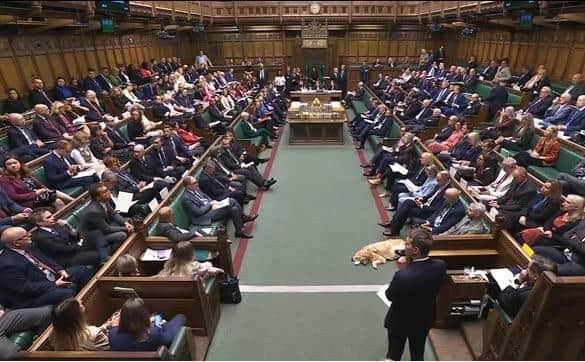

Third, the same procedure which has been used for other errant MPs should be follwed. Constituents of the MPs should be allowed to decide if they want a second vote and if 10 per cent say they do, a by-election should be held. If the SNP candidates are re-elected and still refuse to take their seats, then the constituents who have been thus deprived of their right to parliamentary representation should be allocated an MP in a nearby constituency for any appropriate consultation and representation and that MP should be paid a proportion of the non-sitting MP’s salary, much as GPs are per patient.
By refusing to play the adolescent games the SNP may wish to play, the voters who the SNP would be scorning can get their own back.
Andrew HN Gray, Edinburgh
Trump on Ireland
President Trump’s approval rating of -35 per cent, places him below every other recent White House incumbent at the same stage of tenure – and below his own first-term approval rating.
US voters cite mishandling of the economy, inflation, and the Iran war as the main reasons for their growing concern and disenchantment.
In efforts to regain approval in the run-up to the November mid-term elections, Trump has courted the Jewish vote: understandable as around 7.5 million people in the US claim Jewish heritage either ethically or by way of religious affiliation.
What’s also clear from his recent visit to Ireland is that Trump is making a strong play for the much larger Irish vote: around 31 million US voters claim some Irish heritage.
In this context, raising hackles in 10 Downing Street and at Stormont with controversial remarks on Irish unity will no doubt be seen by President Trump as a small price to pay – and legitimate payback for the UK government’s lack of support at the outset of his war with Iran.
As we’ve witnessed before, President Trump’s level of statesmanship on the world stage is such that he neither forgives nor forgets slights and grievances he takes personally (God save us from such blatant showmanship!).
By way of an aside; as one wag noted, President Trump was the first “Orangeman” ever heard calling for Irish unification – courtesy of his personal make-up artist, of course. Amusing if it wasn't so foolish and potentially damaging.
Ewen Peters, Newton Mearns, East Renfrewshire
BBC blackout
The outstanding BBC comedy series Yes Prime Minister was not only funny, it was educational. It revealed the remarkable skullduggery at the heart of British politics.
Things, clearly, have not changed. This the leaders of three UK Nations met in Cardiff to discuss plans which could eventually see them secede from the UK. It would have got as much coverage had it been on Alpha Centauri. The English media were determined that they were not going to frighten the horses. The BBC News At One covered the threat of AI, donations to Reform, English school lunches, the price of diesel at the pumps, historic abuse at Harrods, young drugs smuggling gangs and then, and only then, after 17 minutes, the Cardiff meeting.
ITN at 6.30pm was similar except they reached it 24 minutes in – after vital news about Oasis tickets.
In 2022 the BBC series Days That Shook The BBC by David Dimbleby came to the conclusion that the BBC has not learned from past mistakes. The truth is the Corporation runs scared of criticising the UK government. Coverage of the Cardiff meeting is just the latest example.
John V Lloyd, Inverkeithing, Fife
Trivia corner
If all the dullards still wishing to obsess over Princess Diana – rather than deal with current, very pressing issues which actually do have a tangible impact to their lives – would like to go off somewhere private and give the rest of the grown-ups peace, that would be just great, thanks.
If you would be good enough to ask to be removed from the electoral register as well that would be an even bigger help.
Mark Boyle, Johnstone, Renfrewshire
Who’s in charge?
Joyce McMillan (Perspective,18 September) says that Westminster cherishes the idea of absolute sovereignty over Scotland. I know from personal experience that Scotland has always had its own independent health service, its own independent education system and its own independent legal system. The last person to attempt absolute sovereignty was Bonnie Prince Charlie in 1745
And to say that support for the SNP and Plaid Cymru is primarily driven by their centre-left positions and not separatism and a wish to leave the UK goes against the stated positions of their party leaders. Remember that it was SNP MP votes which brought down James Callaghan in a 1979 confidence motion which led to the premiership of Margaret Thatcher.
Joyce claims that unionists use “nationalist” as an insult. She uses “Westminster” in the same pejorative way.
Hugh Pennington, Aberdeen
Something rotten
Joyce McMillan tells us that Westminster is insular, self-satisfied and ill-informed, and she has a point. However, has she been listening to Edinburgh and Cardiff lately? The same can be said. UK politics is in a poor way, but the rot does not stop at Berwick!
William Ballantine, Bo’ness, West Lothian
Data centres
It was encouraging to note your report on the need for new rules for data centres (17 September). Before such rules are drawn up it is essential the planning authorities commission infrastructure assessments covering the availability and use of electricity, heat and water by the proposed data centres.
Even if the technical assessments may propose that each data centre has a dedicated stand-alone power plant to service its needs in order not to burden the national grid, there remains the vexed question of the sourcing of substantial additional amounts of cooling water.
In areas of Scotland where there are a number of disused and flooded coal mines it could be worth investigating-whether the water from these might be tapped for data centre use.
The use of the heat given off by data centres is another issue, particularly whether this might be used by some companion industrial process nearby or in some form of district heating scheme for local buildings.
In short, there likely needs to be an independent commission providing expert assessments. These should comprise the engineering designs needed to provide not only the power generation, but also the water and heating infrastructure. Such measures could ensure that any new data centres built are assets and not economic and environmental liabilities to the communities where they are located.
Elizabeth Marshall, Edinburgh
Blind to reality
The SNP’s policy on green energy has been more about keeping the Scottish Greens happy than displaying joined-up thinking. Net zero has dominated SNP policies and blinded it to the reality that nuclear power is the real answer to Scotland’s energy crisis (“UK Minister in demand for SNP nuclear power talks”, Scotsman, 18 September).
Energy costs are rapidly taking centre stage and the SNP’s refusal to accept that nuclear can help is now a millstone around its neck. Holyrood has a surfeit of politicians who cling on to fantasies. We need a dose of realism and this starts with nuclear power and proper usage of oil and gas.
Gerald Edwards, Glasgow
State employees
Allan Sampson (Letters, 18 September) explains what is considered to be the public sector in England and Scotland. An easier public sector definition would simply be those who rely on the state for their pay. That way we find the truth, which is that half the working population has the state as its employer.
This is why we have incompetent Labour governments inflicted on us every so often, when the payroll vote misunderstands the situation.
Malcolm Parkin, Kinnesswood, Kinross-shire
Bridge built
Alex Orr (Letters, 18 Setember) says the UK should explore a closer relationship with the EU like Canada’s associate membership idea. Mr Orr seems to have forgotten that Keir Starmer’s government have already done this, negotiating an EU “reset” agreement last year. This covered security and defence, the Erasmus scheme, trade and trade regulations.
Brian Carson, Edinburgh
Write to The Scotsman
We welcome your thoughts – NO letters submitted elsewhere, please. Write to [email protected] including name, address and phone number – we won’t print full details. Keep letters under 300 words, and in the body of the email – no attachments – and avoid ‘Letters to the Editor/Readers’ Letters’ or similar in your subject line. If referring to an article, include date, page number and heading. No poems.
Comments
Want to join the conversation? Please or to comment on this article.