
Readers’ letters: Bowled over by picture of cricket on beach
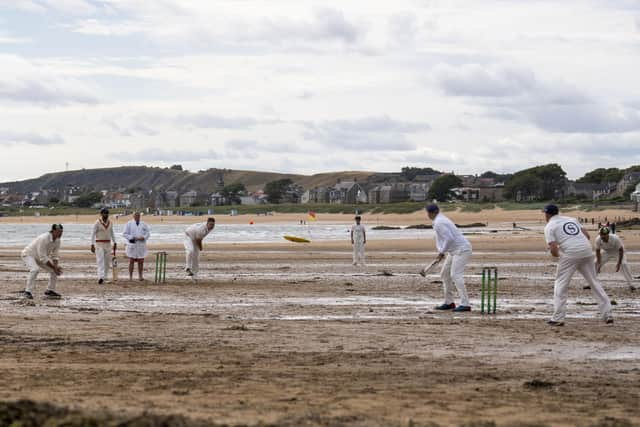
Our picture of beach cricket at Elie brought back memories for a reader
What a wonderful double spread picture on July 29 of cricket being played on Elie beach at low tide. It brought back memories of the very first game played there several decades earlier that was arranged by the former owner of The Ship Inn, Richard Phillip.
Richard was also a leading member of Grange Cricket Club and had invited a team from Edinburgh Academical Cricket Club, of which I was later to become Club President, to play a match in which each player apart from the wicket keeper bowled two overs.
As a prelude, a nine-hole golf competition between the two sides was played in the morning. This was followed by a sumptuous lunch, and at the conclusion of the cricket in the evening there was a barbecue for players and spectators alike in front of the Inn.

Photographs of the match were framed and hung on the walls of the dining rooms and were also immortalised in placemats, all of which sadly faded in time.
What a magnificent day, and one I will always recall, with not a little pride, of having participated in the world’s inaugural pub beach cricket match.
Tony Ostrowski, Edinburgh
Terms of debate
Henry McLeish’s article (Perspective, 30 July) provided an enlightened insight to UK politics without resorting to simplistic derogatory comments about the SNP. While Henry appears still to be convinced of the merits of independence, he at least appears to recognise “the key priority of reforming the British state”. The statement that “our deeply fractured and disunited kingdom cannot move forward until it addresses its politics and governance” may come as a surprise to some but not to most supporters of self-determination.
Henry goes further in stating that “there has been no serious attempt to create a Union of the Nations or a push towards a form of federalism”. Certainly there is much scope for serious debate around this statement and “a well-informed national conversation” in the form of a Citizens’ Convention is long overdue.
Where I would disagree with Henry is on the primary topic of that conversation – instead of discussions on “the UK’s European future” in which, like with Brexit, Scotland’s view would probably be given minimal, if any, consideration, we should be attempting to bridge the constitutional divide by openly and broadly debating Scotland’s future.
Stan Grodynski, Longniddry, East Lothian
Demand for water
We think of Scotland as having unlimited water, but as recent events have shown, Scotland can also have extensive dry periods. And water is not only a valuable and essential resource, but increasingly an expensive one where water has to be collected, piped, cleaned and sewage safely treated and disposed of. Water charges will soon be £1,000 a year for a Band F home. A charge tucked away in our council tax ‘demand’, and already over £300 higher than a similar two-person household might pay just across the border in Northumbria.
You would think that Scottish Water, with its poor track record, would fix leaks instead of seeing beautiful treated, safe water wasted. It could, for example, mandate that meters are fitted in all new homes, and encourage existing homes to install meters by not charging for installation as happens in most areas of England.
Instead, Scottish Water not only charges a premium for meters themselves, plus installation, but has set its tariffs so high for metered water so as to deter meter installation. Meters help reduce demand, and avoid the need to invest in more collection and waste treatment facilities.
Scottish water charges have risen by almost 20 per cent since 2023 and it’s surprising that MSPs are silent on the issues of price, leaks and meters. Perhaps because it’s a public monopoly they stay silent? Some MSP might take an interest as bills continue to rise, but there is little point in complaining to the Scottish government as they simply wash their hands of the matter and refer you back to the quango as if it’s nothing to do with them. Complaints to the Water Industry Commission for Scotland get a similar response.
Maybe both organisations could save water by not washing their hands and actually doing something!
Brian Barbour, Haddington, East Lothian
Reckless burning
I remember an incident at school when some classmates and I accidentally set fire to gorse at Lothianburn. Under the frozen snow covering the gorse, the gorse was tinder-dry. It burst into flame when one of us lit a cigarette. Vegetation can be just as dry under snow as in a dry summer, which is a fact currently being ignored in pursuit of climate change claims. Luckily for us and for Lothianburn, we put it out.
Another factor which has barely been commented upon is the proliferation of disposable barbecues. These have been sold in the UK for 40 years and I would suggest that a sizeable number of “wildfires” are caused by a) cigarettes/matches; and b) abandoned barbies. Having used a disposable barbie at home recently on a log we had kept after our Christmas tree was taken away, I was surprised at how badly singed the log was. Indeed, had the barbie been placed on dry grass, the grass would have burst into flame.
When we consider that a 2007 report stated that “more than 90 per cent of forest fires in Spain and in other European Mediterranean countries are caused by people”, I would suggest that the sale of barbies be restricted until they can be put inside containers which are fire-proof. A further restriction could be the buyers being identified and required by law to return the barbie after use.
Having seen the fires in the Cairngorms and Nethy Bridge a week ago and being aware that Le Monde has confirmed that over 90 per cent of present French so-called wildfires were caused by humans, we should also call them what they are: acts of arson, or, at the least, reckless burning.
Andrew HN Gray, Edinburgh
Five more years
Is the SNP really standing up for Scotland? For years we have witnessed the blight upon our previously ultra scenic landscape with the advent of forests of wind turbines. It is difficult to escape this blot on the horizon.
Now we are witnessing a complete lack of care over the wildfire incidents in the Highlands. The SNP government was not only unprepared for this but managed it badly when it occurred. It is not over yet but the SNP is already moving on to other things.
This is but one area of governance where the SNP is failing. There are so many others. Do we really have to simply put up with nearly five more years of this?
Gerald Edwards, Glasgow
Voting system
John Riseley (Letters, 25 July) asks why in the referendum in 2011 did we vote to reject the proposal to change the UK voting system to the Alternative Vote. Quite simply, because it would not have made the change most voters wanted.
Mr Riseley is correct when he says the Alternative Vote (transferable voting in single-member constituencies) would offer a good chance of single-party government. To win in an AV election a candidate needs 51 per cent of the votes. If the candidates of any one party win in 51 per cent of the constituencies that party will have an absolute majority in Parliament, but with the support of just 26 per cent of those who voted. Mr Riseley is deluded if he thinks such a government “is likely to better reflect the overall spread of opinion”.
In a system of representative democracy, such as we claim for the UK, the first requirement is the fair and proper representation of the voters. Transferable voting has a part to play in achieving that, but only in multi-member constituencies when the overall spread of opinion can be better represented. That is the reform that will make a real difference.
James Gilmour, Edinburgh
Toilet confusion
Lady Poole’s judgement in a recent case involving school toilets stated that it was unlawful to have shared facilities. No mixing of the sexes is allowed, even for hand-washing. Such facilities have to be completely separate. In other words, a five-year-old boy cannot enter a space designed for female use. In that context she was affirming the Supreme Court judgement that any separation of space based on biological sex also applies to spaces for boys and girls (para 174).
However, the Equality and Human Rights Commission appears to take a different view. Its latest guidance was updated after the Supreme Court judgement. And it states in para 13.136 that where there is separate changing accommodation for men and women “A woman is allowed to take her male child under the age of ten into the women’s changing room. This does not undermine the aim, because it is unlikely that young boys pose a threat to women’s safety.” The aim in this instance was to encourage more women to attend a swimming pool who otherwise might not do so because of the male child. We thus have a situation where the judges appear to be saying one thing whilst the official guidance is saying another.
Robert Menzies, Falkirk
Crossing purposes
I travel to Edinburgh regularly. It’s nine years since the Queensferry Crossing opened. Every day work is going on of one sort or another on the Forth Road Bridge.
Does anyone know why and how much it is costing a year to maintain and repair the bridge. It seems a constant task.
Ian Davidson, Glenrothes, Fife
Write to The Scotsman
We welcome your thoughts – NO letters submitted elsewhere, please. Write to [email protected] including name, address and phone number – we won’t print full details. Keep letters under 300 words, and in the body of the email – no attachments – and avoid ‘Letters to the Editor/Readers’ Letters’ or similar in your subject line. If referring to an article, include date, page number and heading. No poems.
Comments
Want to join the conversation? Please or to comment on this article.