
Readers' Letters: Biological men shouldn't be taking part in women's sports
What on earth does ‘versions of women’ mean, wonders reader
As a former PE student I was interested in a members’ debate at Holyrood last Tuesday, led by Tess White MSP, on protecting the female category in sports. So I took a trip to Edinburgh to follow proceedings from the public gallery.
Some might ask why such a debate is necessary at all. Most people will take it for granted that men have a physical advantage over women, especially in strength-based or contact sports such as athletics or rugby. Likewise, many will take it for granted that, for the sake of fairness, female athletes should only compete with other females.
Yet this has become an issue since biologically male athletes, who identify as women, have been allowed to take part in female sport competitions. As a result female athletes have lost out. Such instances have prompted demands to keep the female category in sports single-sex.
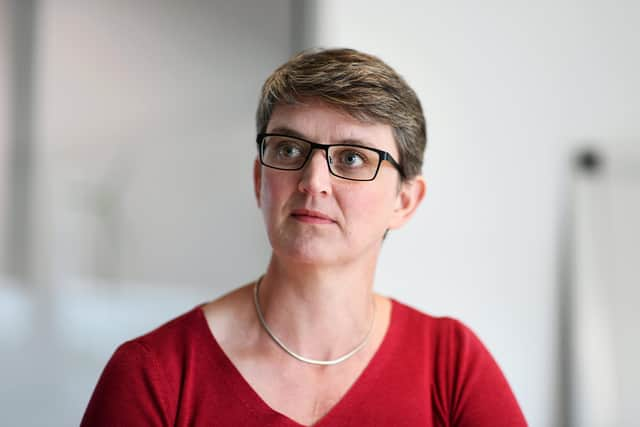

Tess White’s motion made the case for recognising this. While there was well-founded cross-party support for this motion two MSPs, Karen Adam (SNP) and Maggie Chapman (Scottish Greens), fiercely opposed it. They strongly argued for the inclusion of male-born and male-bodied people in women’s sports. Ms Adam’s mention of “versions of women” raised eyebrows. Of course women can be old or young, of different ethnicity or social background. What they all have in common is that they are adult human females. This is the “version” most people would recognise.
Maggie Chapman expressed her objections to this debate and called it “hostile”. In a crafty conflation she insinuated that speaking in favour of defining women and men by their biological sex is akin to transphobia and racism. According to her, she and Ms Adam wanted “this poison to be washed from our politics, our media and our life”. In other words, anyone who disagrees with them is on their blacklist. Tellingly, neither Ms Adam nor Ms Chapman allowed interventions.
Notably, the debate took place with about three quarters of MSPs' seats empty. Visitors were ushered to the section of the public gallery furthest away from the well of the chamber. Security staff kept an eye on us, intercepting occasional clapping with stern looks. There I sat, quietly and well-behaved, feeling grateful to every MSP speaking up for women and girls and hoping common sense will prevail.
Regina Erich, Stonehaven, Aberdeenshire
Not in my name
Israeli Prime Minister Benjamin Netanyahu has made a distinction between Israel “defending itself” and Israel “retaliating”. Most of the world could already see that the daily slaughter of children and babies in Gaza is the latter, having no valid part to play in Israeli self-defence.
It is unfortunate UK Defence Secretary John Healey is not able to make that distinction, as was clear in his statement to ITN that the RAF had been involved with Israel to show "the UK's steadfast support to Israel's right to self-defence". Israel crossed a line by its disproportionate retaliation in Gaza. Their current wars are not of our making and do not need our involvement, and given the criminal actions of Israel, certainly not our “steadfast support”. That was the language of the Sunak government so where is the “change” the Labour Party promised at the last General Election?
If Keir Starmer wants to meddle in the Middle Eastern situation, I have to say to him, do not do it in my name and do not drag my country into your misadventures; I do not consent to your support of Israeli crimes against International Law.
The sooner Scotland is out of this toxic union the sooner our young people will no longer be at risk of involvement in another Middle Eastern conflict that is none of our business. I hope that when Scotland regains its independence we will not only pursue social justice in our own country but also on the international stage, speaking with moral authority rather than jumping into foreign conflicts in support of whoever is friend to the USA or enemy to the enemies of the USA.
Ni Holmes, St Andrews, Fife
Jail fail
Fifty-seven of the 477 criminals freed by the Scottish Government to tackle overcrowding in prisons have been sent back for reoffending (your report, 3 October). Why is no one surprised? What is needed in future is for the Scottish Government to tell the judiciary to impose meaningful jail sentences that will deter even the most hardened criminal. It should be well publicised that the normal jail sentence would be tripled and that there would no longer be remission. That would make criminals think.
Unfortunately the Scottish Government is all talk and no action. A Scottish Prison Service spokesman (spin doctor) waffled on about the “time available to do the important work in supporting people, building relationships, turning lives around, reducing the risk of re-offending and creating a safer Scotland for all”.
He needs to be told his warm, soothing words are not working.
Clark Cross, Linlithgow, West Lothian
Inquiring minds
As the former chair of a Public Inquiry I observe the reasons for their establishment with interest. It could be said that the subjects they investigate reflect not only perceived problems with systems that should protect the public from harm, but reflect the culture of society as a whole.
That is why I find the Scottish nationalist enthusiasm for Ireland as a model to follow hard to accept (Alex Orr, Letters, 3 October). There have been ten Tribunals in the Republic since 1990 (they follow the same rules as UK Public Inquiries). Four of them have investigated corruption on a grand scale involving politicians. None of the 11 Scottish Public Inquiries set up since the 2005 Inquiries Act have had to do this, yet.
But we mustn't be complacent. Four of the Scottish Inquiries have been, or are currently investigating, preventable microbial infections that killed people.
Hugh Pennington, Aberdeen
So print money
In Jackie Baillie’s lambasting of the Scottish administration for a rise in homelessness she doesn’t provide the context for or comparisons with other parts of the UK (Perspective, 2 October).
First, the context. Scotland relies on a shrinking Westminster allowance thanks to UK austerity. Rather than ending austerity as promised, Chancellor Rachel Reeves imagines there’s a £22 billion black hole that needs filling by cutting spending. Her opening salvos were the axing of the winter fuel allowance and refusal to lift the Tory two-child benefit cap, which won’t help Scotland’s pensioners or kids. None of this is necessary since the Treasury owns a central bank it can order to create all the money required to meet people’s needs. And it could tax the wealthy, who are undertaxed by £170bn per year.
Nor does Ms Baillie mention that the 3 per cent homelessness increase (1,088) this year was due to the Home Office’s batching of asylum seekers, allowing 1,300 into Scotland without providing additional funding to house them.
Second, some comparisons. In March 2024 there were 29,652 open homelessness cases in Scotland. In 2006, the last year of the Scottish Labour administration, there were 55,000 cases, nearly double the number. Currently in England 151,630 children are in temporary accommodation, the highest since records began, and on a per capita basis, 58 per cent higher than Scotland. It’s even worse in Labour-run Wales where 34,000 children are in temporary shelters.
English Labour has demonstrated over and over again that it has no solutions to Scotland’s problems. It only worsens them because the UK is addicted to stealing Scotland’s wealth.
The only solution is for Scotland to end its vassal status within the failing union, take back control of its economy and resources and care for its people.
Leah Gunn Barrett, Edinburgh
Interesting times
Assuming the Labour Government recovers from its shambolic three-month honeymoon with a competent, reassuring budget in a few weeks' time, and get real about immigration, energy policy and public service reform, the case for Scottish independence is dead for a generation and all parties can and should settle down to serious debate and policy formulation on how to get the UK back to a common sense, woke-free approach to running the country.
This seems to be the very welcome attitude that new Scottish Tories leader Russell Findlay has projected since his appointment. And if Labour repeat their rout of the SNP in 2026 the Conservatives, Lib Dems and Reform may well wipe out the SNP, in the 48 (out of 129) Highland, North-east and South regions where Labour are not strong.
However, if Labour continue their underwhelming reign and the SNP vote recovers without an overall majority Labour's seeming greater hatred of the Tories than the SNP could sucker them into some kind of support for a minority SNP administration.
Allan Sutherland, Stonehaven, Aberdeenshire
Energy myths
Akshay Kaul, of Ofgem states that a move away from gas to wind and solar renewables will make electricity cleaner, more affordable and secure and bring down bills across the country (“Net Zero means secure, more affordable power”, 30 September).
More affordable? Electricity is already four times the price of gas and rapidly increasing due to nearly £1 billion of constraints payments being gifted to wind farms.
More secure? Why are 11,000 thousand turbines only producing one third of our electricity? Perhaps Mr Kaul can control the wind?
Cleaner? To build and erect these turbines need steel, oil, diesel, transport (and coal furnaces to manufacture the steel. Is Mr Kaul in green denial?
Michael Baird, Bonar Bridge, Highland
Write to The Scotsman
We welcome your thoughts – NO letters submitted elsewhere, please. Write to [email protected] including name, address and phone number – we won't print full details. Keep letters under 300 words, with no attachments, and avoid 'Letters to the Editor/Readers’ Letters' or similar in your subject line – be specific. If referring to an article, include date, page number and heading.
Comments
Want to join the conversation? Please or to comment on this article.