
Readers Letters: BBC should extend apology to lesbians and gays
Donald Trump isn’t the only person BBC should be saying sorry to, says reader
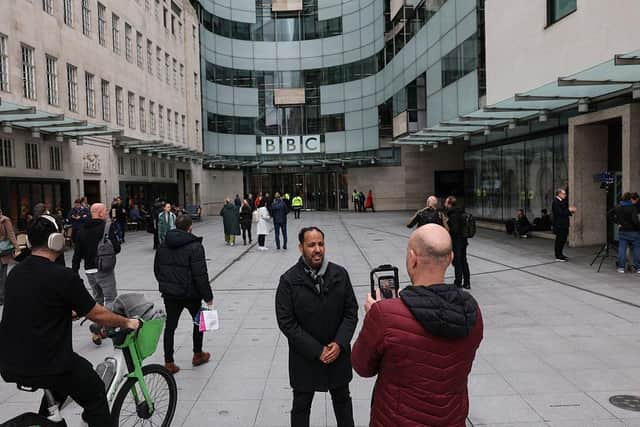
Susan Dalgety addresses the BBC’s failings in its coverage of gender issues (Perspective, 15 November). The BBC does indeed owe an apology to the women it has marginalised, dismissed or treated as troublesome merely for insisting biological sex is real and relevant.
I would suggest any such apology should explicitly acknowledge lesbian and bisexual women, and be extended to gay and bisexual men as well. The rights of these groups are sex-based too, grounded in having an attraction to people of the same sex, not gender identity. When this is blurred or not acknowledged, the protections these groups rely on become equally blurred. The Corporation’s adoption of contested gender identity theory and its conflation of the LGB and TQ+ erases the very basis of same-sex orientation, undermining those protections.
The BBC must listen, reflect and apologise not only to the women who have borne the brunt of its dismissal, but also to the gay and lesbian community whose rights depend on the reality of sex being acknowledged without fear, favour or ideological distortion.

Brian Forsyth, Edinburgh
Biased BBC?
Like a previous correspondent among the 872,000 who completed the BBC survey earlier this year I also found significant Scotland’s low trust in the BBC’s capacity to be independent of government (Letters, 13 November). Thirty-nine per cent suggests that even among Scotland’s Unionist “No” majority the BBC is no longer beyond reproach. The US President threatening to sue the BBC makes the stakes even higher.
Yes voters in 2014 saw in practice what BBC correspondent Allan Little later acknowledged: his metropolitan colleagues assumed a Yes vote would be “foolish”, the arguments in favour were “wrong”. Would Mr Little consider it likely that the BBC can restore the necessary trust before another referendum? The Panorama edit has shown the BBC capable of either unethical, inept, manipulative journalism or extraordinarily casual recklessness about fact-checking.
Remain voters had observed the BBC platforms enjoyed by longtime unelected politician Nigel Farage, featuring among Question Time’s top ten invitees. Rather than reflecting Farage’s electoral support, the BBC, over decades, helped to build it. “Impartial”?
President Trump threatens to sue for reputational damage. Let’s see that one in court. The King submitted to the humiliation of a hastily arranged state visit. Days of footage showed the US President welcomed, fawned over, honoured, flattered and toasted. The display of toadying towards the great panjandrum was breathtaking.
By contrast, there’s talk of $5 billion in “reputational damage” from a 30-second clip on Panorama. Hardly. The BBC’s defence should rest on endless Trump footage with castles, bands, horses, uniforms, dinners and gold plate, and the world’s most famous/notorious family performing their state duty by dancing attendance.
Did the licence fee fund media coverage offering President Trump global PR that the average dictator’s money can’t buy? If it did – and before there’s litigation – licence fee payers should be demanding their money back.
(Dr) Geraldine Prince, North Berwick, East Lothian
Unreliable
Brian Wilson is not afraid to put his head above the parapet (Perspective, 15 November). He points out that this failed Scottish Government thinks renewables is the way to drive our economy by providing “reliable” and “affordable” green electricity from wind and sun.
Reliable? Over the last year wind and sun could produce only 38.3 per cent of our UK electricity so we had to rely on gas (29.9), nuclear (13.3), biomass (7.3 – not green) and Europe (11.2) to keep the lights on.
Affordable? The wind industry gets billions in subsidies every year on top of their strike price. Constraint payments are expected to increase from £1.5bn in 2024 to £2.4bn in 2025. The Contracts for Difference scheme has paid out £10bn and counting. For one year, 2023/2024, the Renewables Obligation subsidy sucked £4.6bn from consumers. The total cost to the electricity consumer of renewable electricity subsidy schemes since 2002 is £220 billion and rocketing.
The UK is now the second most expensive place in the world for electricity – 63 per cent higher than France and 27 per cent higher than Germany. This is the main reason UK unemployment levels are at the highest since 2021.
Clark Cross, Linlithgow, West Lothian
Avoid nuclear
Brian Wilson is right to call for a mix of energy sources but going back to nuclear would be a retrograde step. Sensibly, countries around the world are eschewing this mid-20th-century technology.
Early nuclear power stations are still being decommissioned decades after generating their last kilowatt, such work at Dounreay is expected to cost £8 billion, lasting until the 2070s. Costs for developing Sizewell C rose to £38bn this year, adding £1 a month to energy bills. Like those nuclear modules Mr Wilson backs in Wales, it will be a decade before Sizewell is operational.
Research shows the whole life cost of generating electricity through nuclear is substantially higher than solar and offshore wind.
Perth-based SSE announced £33bn of investment last week, mainly in grid infrastructure, with a substantial proportion in renewables. Markets cheered yet the UK has adopted the marginal cost model whereby wholesale electricity costs are based on the highest priced source, imported gas. Two-thirds of UK gas is imported, mainly from Norway, augmenting its £1.4 trillion sovereign wealth fund.
While the UK transitions to renewables it’s logical to produce more domestic gas, reducing reliance on imported gas for electricity. Bloated bills need to be reduced and VAT removed in the Budget. Scotland, an energy-rich country, should have the lowest bills in Europe not among the highest. Going back to expensive nuclear won’t help.
Neil Anderson, Edinburgh
Write to The Scotsman
We welcome your thoughts – NO letters submitted elsewhere, please. Write to [email protected] including name, address and phone number – we won't print full details. Keep letters under 300 words, with no attachments, and avoid 'Letters to the Editor/Readers’ Letters' or similar in your subject line – be specific. If referring to an article, include date, page number and heading.
Comments
Want to join the conversation? Please or to comment on this article.