
Readers' Letters: Arming Scottish police would make streets more dangerous
Scottish Police Federation wrong to want arms available to more officers, says reader
Calls for Scottish police to be armed are dangerous. It may be that there are safeguards suggested, such as New Zealand police observe, with guns locked in a cabinet in police cars, but that is not a solution. The guns are still there, on the spot.
Up to the mid-1890s, for example, police were not armed in New York. They were permitted to carry their owns guns, but as a rule, constables carried a baton.
A glance at early Edison films from 1897 shows ranks of police in similar uniforms to British bobbies, marching in formation in front of crowds, armed with a baton but no guns.
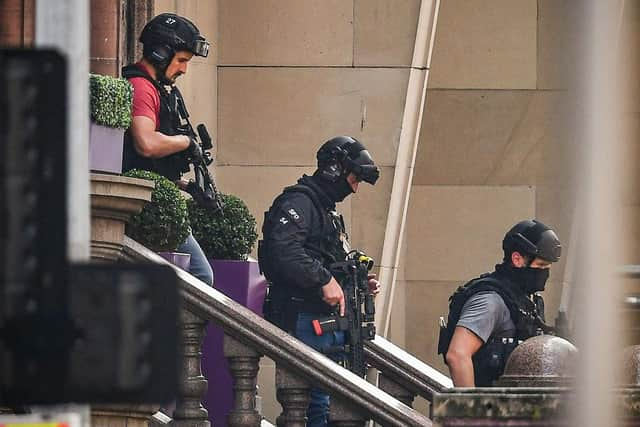

It was only in the previous year that pistols were first ordered for cops by Teddy Roosevelt. This routine arming of police caused a major increase in gun crime, which almost quadrupled between that year and 1928. Deaths in the US from guns are now the equivalent of the casualty rate in a middle-sized war in any given year.
In New York in particular, antipathy between certain national/religious groups exacerbated crime.
This included dislike between police, who were often of German and Irish origin, and Poles, Italians and Jews escaping eastern Europe who formed their own gangs. Once the police were armed, there was only one way to avoid being shot by hostile cops, who would shoot first and ask questions afterwards. That was to be armed yourself.
Do we want criminals in Scotland to arm themselves routinely and to end up with the violent crime and high death-rates which are the norm in the USA?
John Fraser, Glasgow
Too close...
I do not believe that the present Lord Advocate is corrupt but the recent row in the Scottish Parliament raises serious questions about her dual role as head of the Prosecution Service and member of the Scottish government. In any modern democracy, the former post should be completely independent of government to avoid any potential conflict of interest.
This is not the first time that suspicions have been voiced about the Lord Advocate being in cahoots with the government of the day.
During the 1984-85 miners’ strike, questions were raised by myself and other MPs about the cosy relationship between the government and the Prosecution Service. Many striking miners were prosecuted on spurious grounds and there were well-founded suspicions that many of those prosecutions were politically motivated by the government of the day, using every dirty trick in the book in a concerted attempt to defeat the miners and weaken the entire trade union movement.
Forty years later, the Scottish Parliament granted a belated but welcome pardon to most of the miners convicted in Scotland. The powers that be should now take another step forward by making the Prosecution Service completely independent of Government.
Dennis Canavan, Bannockburn, Stirling
Wind up
Stan Grodynski says Ian Moir “is either naive or disingenuous” because he asked “How will the lights stay on in Scotland when the wind fails to blow?” (Letters, 19 February). Many would suggest that it is Mr Grodynski who is muddying the waters.
He says the high price of electricity is due to that nasty UK government. Well, he is correct in a way because of our reliance on wind electricity and the millions of subsidies they are able to claim. Wind electricity is definitely NOT cheap or reliable. UK electricity prices were among the lowest in Europe, but no longer. Only Denmark, Germany and Ireland have more expensive electricity while UK industry pays at least 50 per cent more than most of the rest of Europe.
Why? It’s the cost of the subsidies that Mr Grodynski ignores which are added to our electricity bills for the electricity produced by wind turbines. The Contracts for Difference subsidy has now passed £10 billion and Constraint Payments £2bn. The Renewables Obligations subsidies are about £10 million every year. Add on the cost of the ugly pylons and cable to take “it’s Scotland’s wind” south and you have all the answers.
Clark Cross, Linlithgow, West Lothian
Safe room failure
There is a resounding, albeit reluctant and doleful, chorus of “We told you so” from the beleaguered residents of the Calton area of Glasgow’s east end.
At great expense The Thistle centre for “saving lives” is beginning to immiserate further the lives of the poor relatives and friends of addicted folk who have endured the heartbreaking consequences of intravenous drug dependency for decades.
As predicted, the locality has attracted greater numbers of desperate people from a wide penumbra around the east end and beyond to become denizens of an emerging village whose municipal motto seems to be “You can do a deal with the devil”.
The streets are littered with increasing numbers of discarded needles as never before and every manifestation of antisocial behaviour that results from the lobotomising effects of prescription and non-prescription drugs in hapless and hopeless human beings.
The army of well-intentioned salaried professionals who migrate to these zones are daily presented with the opportunity to finally surrender to the experience of recovering and recovered addicts and admit that they and the nation are powerless to stem the tide of this horrible consequence of spiritual and economic poverty, with naive interventions which divert millions of pounds from areas that could begin to move the needle of drug deaths and consummate misery in the right direction.
Mr John Swinney, with his signature moderating language, has rightly offered his measured support by publicly stating that The Thistle is making a valuable contribution to this national mission to our addicts.
However, it will only be constitutional and economic policy initiatives that stem the inexorable death rate.
Invest locally in jobs, small businesses, vocational employment and a proactive health and social policy freed from managerialism and corporate capture and in relatively short order these deaths of despair would begin to gradually recede in the coming decade.
Listen to the increasing numbers of individuals and families who know the meaning of the words “recovery” and “enabling” as they apply to drug addiction and de facto colonialism.
(Dr) Andrew Docherty, Selkirk, Scottish Borders
Driving school
I agree entirely with T Lewis’s conclusion (Letters, 18 February) that no-one whose vision or cognition is appreciably impaired should be driving.
However, his inference that elderly drivers are especially responsible for major accidents is not borne out by the statistic he quotes – that 23 per cent of fatalities and serious injuries are caused by drivers over 60.
The proportion of the UK population who are over 60 is 24.5 per cent – so older drivers actually cause slightly fewer major accidents than would be expected.
In contrast, drivers between 17 and 24, who comprise 11.5 per cent of the population, cause 18 per cent of the accidents, so are considerably more dangerous than their numbers would predict. What we need is not more eye tests of pensioners but more training of youngsters.
Barry Hughes, Edinburgh
U-turn time
It should make for an interesting couple of months, now that the Chagos “first minister” and supporters have landed on one of the islands saying that they aren’t going to leave. They have underlined their Britishness, saying “God Save the King!”, and stating their intention of staying that way.
Of course, the principle is that the people who belong in our few remaining overseas territories should decide for themselves if they wish to be British or not.
They have. Now, let’s see if the UK government, which is showing indecent haste to give away our strategic islands, try to kick them off those very islands.
Time for another U-turn, Keir!
Andrew HN Gray, Edinburgh
Stand firm
Following the recent reports of a Russian tanker crew being removed by the US in defiance of a Scottish court ruling, and the Green Party’s motion this week on US military use of Scottish airports, it seems to me that we have behaved as if we were still a region, not a devolved country in our own right, for far too long.
At some point we need to grow up. If we want to be recognised and respected, we have to assert our authority as a country. If we’re going to be used by the UK and the US for troop and maritime manoeuvres, it has to be on our terms. This is our land, our waters. We are only undefended if we choose to be. We need to assert what is and is not acceptable to Scotland, the country. We are not an optional extra. It is now time to choose. Are we a bus station or a country?
Judy Campbell, Portree, Isle of Skye
Real problems
With the recent stopping of the Benfica v Real Madrid game because a Real player felt discrimination, one wonders how long the next Old Firm game will last before any religious discrimination manifests itself.
Don’t hold your breath!
Scott Miller, Joppa, Edinburgh
Write to The Scotsman
We welcome your thoughts – NO letters submitted elsewhere, please. Write to [email protected] including name, address and phone number – we won’t print full details. Keep letters under 300 words, and in the body of the email – no attachments – and avoid ’Letters to the Editor/Readers’ Letters’ or similar in your subject line – be specific. If referring to an article, include date, page number and heading. And please do ensure any names mentioned are correct.
Comments
Want to join the conversation? Please or to comment on this article.