
Readers' Letters: Are speed cameras more about a cash grab than safety?
There’s something suspicious about that speed camera, says reader
Readers who regularly drive across the Border might be interested in why I recently “coughed” – as the US police used to say – to exceeding the the 30mph limit by 5 miles per hour while travelling north on the A697 trunk road as it leaves Cornhill-on-Tweed, a village which lies about a mile south of the border bridge at Coldstream. As I exceeded the speed limit by a relatively modest amount I was offered the opportunity to attend a speed awareness course as an alternative to being fined and incurring three points on my licence.
In terms of cost, the options were broadly similar and so I opted to attend the course.
For those motorists who do not know Cornhill, the mobile van containing the camera was positioned at the northern end of the village, just short of the end of the speed limit zone, and located so as to monitor the speed of northbound traffic leaving the village. It’s an area where there is little to see apart from a few bungalows that are well set back from the road.
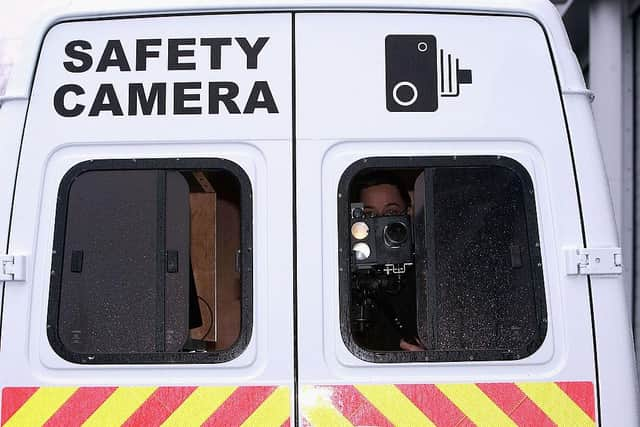

Readers might recall that the Commissioner of the Metropolitan Police recently went on record as claiming that the government’s recent financial review will result in police resources being inadequate in future. Could it be, then, that this location, which carries long distance traffic and therefore drivers in hurry, has been recognised by Northumbria’s Finest as a useful cash cow?
I raise this because while fine income is sent to the Treasury, these course fees are shared between Northumbria Police and the course provider. Last year Northumbria Police “earned” in excess of £1 million (Source FOI request).
While I have no doubt police will claim this money is well spent, their priority should be to live up to their proclaimed aim to protect and serve. As such, surely the residents of places like Cornhill would be offered more protection by monitoring – and therefore reducing – speeds at the entrance to villages and not on what is virtually the open road.
John Rhind, Beadnell, Northumberland
ICE on pitch?
Ian Petrie is right to suggest the Football World Cup should be moved to Canada and Mexico (Letters, 29 January). Can you imagine how Donald Trump’s ICE thugs having, so far, killed murdered Renee Good and Alex Pretti, might cope with the Tartan Army?
Doug Morrison, Tenterden, Kent
Heated words
Well, it’s January 31, and I would suggest we have a contender for “most delusional contribution, 2026” from Stan Grodynski (Letters, 30 January).
As usual, he mentions Brexit, the limited and diminishing powers of devolution available to the Scottish government, he also witters on about federalism and confederalism (I admit I had to look that one up!) only to find we already have it.
As is always the case, the most devolved and legally powerfull nation in Europe fritters away all financial strength it is given on projects which usually never ever come to fruition, on increased benefits, failed ferries and ridiculous virtue signalling rubbish like the GRC, bottle deposit scheme and on and on we go.
Add to this the denial of FOI requests on a daily basis, court cases fought with total disregard to the public purse and we see where the failures are.
Perhaps Mr Grodyski could reply, assassinate my points and I will shrivel up and put my keyboard away – more likely I will charge it up to continue to dismember these deluded adherents to Independence and supporters of the utterly incompetent SNP.
David Millar, Lauder, Scottish Borders
Blessed union
It is mind-blowing that as different corners of Europe and the world are edging together to unite and face possible aggression from a common foe, one exception shines out. The nationalists of Scotland continue to try to divide the people of this island and concentrate energy on frivolous and banal matters – including wanting to eject the very submarines that have kept us safe and free for 80 years – that they believe warrants the break-up of one of the most successful amalgamations of countries in history.
They would prefer, it seems, to continue grievances about coloured emblems on food products or some ancient battle, and disregard the millions of intermarriages and success in every joint endeavour over the centuries we have achieved together, and instead try to separate and divide. And, for the record, my distaste for flag-wavers applies to all who do it.
Alexander McKay, Edinburgh
Dangerous steps
Henry McLeish, in his characteristically powerful article (Perspective, 29 January), comes away with a memorable sentence. “A vote for Reform in the UK would be a step towards Trump’s world.” Exactly! It's nothing much like a compliment,
Reform UK leader Nigel Farage has promised a British version of ICE, whose lethal strongarm tactics have wrought havoc, including killing, in Minneapolis, with a gratifyingly courageous response from its citizens.
Despite his self-serving claims to the contrary, Donald Trump is one of the most unpopular presidents ever, threatening to become a dictator. His starry-eyed follower, Farage, is very likely to do likewise, as the “charismatic' leader of, very much, a one-man party band”.
If the opinion polls are anything to go by, we're set “to take a step into Trump's world”. As Henry McLeish timeously implies, we should be very careful of what we vote for. Trump's America is hardly an enviable blueprint.
Ian Petrie, Edinburgh
Phone fools
It is gut-wrenching to think that Samaritans volunteers helping people in need are having to put up with warped men using the opportunity to speak to a woman for non-consensual phone sex (“Samaritans Scotland volunteers say 'not a shift goes by' without men performing lewd acts over phone”, 28 January).
Sadly, this is not a new phenomenon. About 15 years ago, I remember being appalled when a friend, who was spending her free nights volunteering for the service, told me about her experiences of it.
While the Scottish government continues to navel-gaze and spend its time on fringe issues, it’s surely long overdue for some productive debate around our society and the way we shape the climate in which boys and young men are developing ideas around sex and consent. More thoughtful education should be aimed at developing respect for women and a wider understanding of social responsibilities.
Maybe then, volunteer services such as Samaritans can focus on those in crisis who badly need help without having to deal with these irresponsible and juvenile pests.
Nicola Davies, Kincardine, Fife
Legacy of lies
It seems that telling lies is perfectly acceptable to unionist and federalist politicians if it gets the desired outcome.
In 2014 they lied to both Yes and No voters about change if you voted No, but that is perfectly fine because they kept Scotland within the Union.
In 2016 they lied on the side of a bus and, well, that is perfectly fine as Getting Brexit Done was achieved.
In 2024 lies by the Labour Party, the leader made pledges to their membership to win the leadership, perfectly acceptable as it achieved the aim of getting rid of the Tories.
A politics built on telling lies to the electorate simply to achieve its aims will eventually fall and that seems to be what is happening.
I haven't voted for the Scottish Liberal Democrats since voting for the late Menzies Campbell at the 1992 and 1997 general elections.
I have never voted for either the Scottish Labour Party or Scottish Conservative and Unionist Party at either Scottish Parliament elections or a general election.
So it is the folk who chose to vote for those political parties after promises of “change” who should feel angry. And the folk who chose to vote No on the basis of the promises made to them by the Better Together campaign. I saw these promises for what they actually were, lies to achieve the “correct” outcome for their views.,
Peter Ovenstone, Peterhead, Aberdeenshire
Big deal
This week saw the largest trade deal ever reached between the European Union and India, creating a market of two billion people across the world’s second and fourth-largest economies. It will enable free trade between the bloc of 27 European states and the world's most populous country, which together account for nearly 25 per cent of global gross domestic product.
The deal will include significant tariff cuts across a range of goods and services, eliminating or reducing tariffs on 96.6 per cent of EU goods and liberalising 99.5 per cent of tariff lines for Indian imports. As a result of this deal, EU exports to India are expected to double.
In July 2025, the UK signed a trade deal with India, cutting tariffs on around 90 per cent of UK goods, with 85 per cent becoming tariff-free over the next decade.
Analysis shows that the EU-India trade deal has slashed tariffs more broadly, covering more lines and removing tariffs more extensively than the UK-India trade deal.
By delivering a better deal, the EU's size and negotiating weight once again demonstrate the advantages of being part of the world's largest single market and the obvious folly of Brexit.
Alex Orr, Edinburgh
Write to The Scotsman
We welcome your thoughts – NO letters submitted elsewhere, please. Write to [email protected] including name, address and phone number – we won't print full details. Keep letters under 300 words, with no attachments, and avoid 'Letters to the Editor/Readers’ Letters' or similar in your subject line – be specific. If referring to an article, include date, page number and heading. And please do ensure any names mentioned are correct.
Comments
Want to join the conversation? Please or to comment on this article.