
Readers' Letters: Are Scotland's leaders fit for public life?
Do Scottish ministers live up to the high standards required of public servants, asks reader
Every Scottish government public sector appointment vacancy notice reminds applicants of Nolan's seven principles of public life which they must adhere to. These are: selflessness, integrity, objectivity, accountability, openness, honesty and leadership.
With the current debate over the deaths at Queen Elizabeth University Hospital; the fiasco over ferries; the Information Commissioner taking the Scottish government to court; the Scottish government losing several court cases relating to biological sex; the lack of openness during the Covid inquiry; the refusal to hold an inquiry into the Peter Murrell embezzlement case or to apologise to whistleblowers, can First Minister John Swinney – or indeed, any other Scottish minister – stand up and swear they have followed the Nolan principles of selflessness, integrity, accountability, openness and honesty?
That leaves only the principles of leadership and objectivity. It could be argued these have been adhered to, but it would be a debate and certainly not a foregone conclusion.
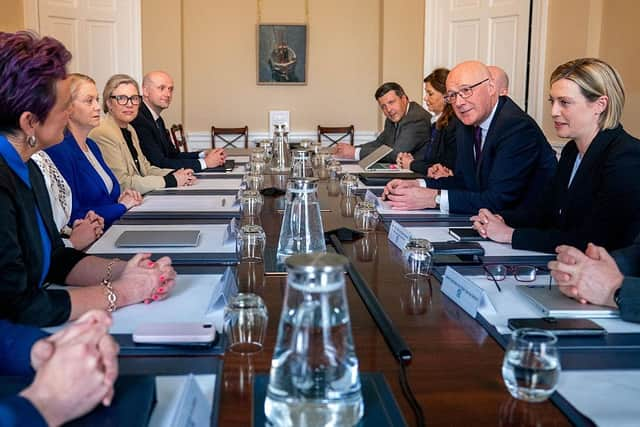

What is almost as bad is that they don’t even have the decency to hang their heads in shame, preferring to bury them in the sand. Perhaps with one’s head in the sand, the sound of whistleblowers remains unheard, and the look of embarrassment remains unseen?
Brian Barbour, Haddington, East London
Empty promises
It did not take long. The Borders “walk-in” GP clinic is closed for a couple of days this week due to “temporary staffing pressures”. What a surprise. This scheme, touted by the SNP as a reason to vote for them only recently, is running into easily foreseen problems. It will get worse as the rollout of many of these walk-in clinics runs into further problems. Only a few are up and running and the projected total number is highly unlikely to be achieved.
Why are there no timely direct consequences regarding promises made by political parties for your vote which then rapidly disappear? This is yet another scandal regarding SNP behaviour.
Gerald Edwards, Glasgow
Defend the UK
One of the major reasons defence of the realm has become a matter of absolute urgency is that the thankfully outgoing Prime Minister has done little or nothing towards increasing the defence budget, preferring to put available funds into welfare.
It turns out Keir Starmer has left behind a £4.7 billion shortfall in defence funding which incoming PM Andy Burnham will have to find. All this confirms what a liability Starmer has been.
I trust Burnham has the smeddum Keir Starmer most certainly did not have and will fully support Dan Jarvis, a former para officer, who must be given the fiscal backing and the time to get into the Defence Secretary’s job.
One of Burnham’s first meetings must be with the Joint Chiefs of Staff, resulting in an urgent and all-encompassing British rearmament programme, costed and funded, which will protect the United Kingdom well into the future. And he must visit President Volodymyr Zelensky, who is defending Ukraine against Russia, in Kyiv. This European war is happening only 1,500 miles from the United Kingdom. Currently Vladimir Putin is very much on the back foot and heading for defeat. When he has little or nothing to lose he will be at his most dangerous.
This does not make the need to get our very professional armed forces properly funded and up to speed any less urgent.
Doug Morrison, Tenterden, Kent
Yes to nuclear
Frances McKie (1 July) suggests “Westminster” is planning to mine for uranium and locate high-level nuclear waste dumps north of the Border, and that it ignores the evidence of continued failures associated with corrosion from radioactive materials and the awful risk to future generations.
Frances should tell us where the potential Scottish mines are going to be located (uranium deposits in the UK are very poor everywhere, only one in Cornwall has ever been good enough to be exploited), what is wrong with Cumbria as the continued location for waste treatment and storage – Sellafield has been doing it without harm for more than half a century – and give us a list of the continuing failures due to corrosion.
I have handled many radioactive materials in my virology research and visited Sellafield and Dounreay and seen no evidence that radioactive waste is corrosive, unlike sulphur dioxide, the waste produced by burning coal, which nearly caused me lethal harm when part of a corroded chimney head blew off and fell very close.
As for Frances' suggestion that hydrogen is far safer than nuclear, the 37 passengers and crew who died when the airship Hindenburg caught fire might disagree.
Hugh Pennington, Aberdeen
Money honeypot
In response to your article “Drop in foreign investment amid global shifts highlights Scotland's challenge” (Business, 26 June), I would like to point out the growing interest we are seeing in the South of Scotland from investors, reflecting a renewed confidence.
South of Scotland Enterprise currently has 78 potential projects from investors interested in coming to the region, with proposals increasing not only in number but in scale and ambition.
This confidence is also being recognised more widely. A recent article in a growth-focused publication described the South of Scotland as “quietly building a new kind of growth engine” and as “emerging as a testbed for how to back ambitious founders early, widen participation and link local programmes into national growth policy”.
Major opportunities such as the former nuclear plant Chapelcross near Annan, the Center Parcs development, Kight’s new battery plant in Dumfries and the Mountain Bike Innovation Centre in Innerleithen illustrate the transformative potential these investments could bring – supporting jobs, strengthening supply chains and benefiting local communities.
This momentum mirrors the national picture set out in the EY UK Attractiveness Survey 2026, confirming Scotland as the top destination for foreign direct investment outside London for the 11th consecutive year.
From our perspective, this reflects the South of Scotland’s growing reputation as a competitive and attractive place to invest – not only because of our assets, skills and infrastructure, but because of the collaborative ecosystem being built here to support enterprise, innovation and responsible growth.
With the right support and continued focus on responsible growth, the region is well placed to convert this interest into long-term economic benefit, ensuring that investment delivers lasting value for both businesses and communities.
Russel Griggs, South of Scotland Enterprise Chair, Dumfries
A good read
As I sit here on 1 July, hunkered down in deepest England, away from the cabal, with my digital copy of The Scotsman to remind me of what I’m missing, today’s copy is forever giving. First we have “Alcohol sales down 20 per cent since 2017” (page 13).
Perhaps a visit to Berwick might explain a few of the percentages missing from sales in Scotland. In any supermarket all you can see are “see you Jimmy” hats and hear are shouts of “och aye the noo”.
Then we move to page 17, with “Reported hate crime up by 17 per cent in 20 years”. Could it be that some of those now sober are finding other things to do?
It felt almost ironic that below was an article stating “Trainspotting returns to Leith festival”. The play is a marvelous example of our woes – drink, drugs, hate crime and violence.
Then in Letters to the Editor, Jill Stephenson explains why we cannot “rejoin” the EU – we were never a member in the first place, a fact sadly lacking in separatist arguments.
And finally, Tim Flinn comments on the linguistics of the “land of Discovery” Dundee – or as it’s known locally, “Dundeh”. It reminded me of a story told to me by a good friend from Kirriemuir 35 years ago involving the shopping centre in “Dundeh”, the Wellgate Centre.
Exiting the building, the following was heard: “Ah wis gannin doon the Wellgate steps, when ah slipped, n meh peh went skeh heh”.
Almost Burns-like in its description!
David Millar, Lauder, Scottish Borders
Finnish line
I agree with Tim Flinn (Letters, 1 July) that it is extremely unlikely Lara Bird MP would develop a local accent at Dundee High School.
However, he mangles the classic shibboleth for detecting that accent. A Dundonian ordering two Forfar bridies, one with and one without onion, would ask for “A plen ane an an ingin ane an a”.
It has been claimed that this sounds like Finnish.
Robert Cairns, Ceres, Cupar, Fife
Write to The Scotsman
We welcome your thoughts – NO letters submitted elsewhere, please. Write to [email protected] including name, address and phone number – we won't print full details. Keep letters under 300 words, and in the body of the email – no attachments – and avoid 'Letters to the Editor/Readers’ Letters' or similar in your subject line. If referring to an article, include date, page number and heading. No poems.
Comments
Want to join the conversation? Please or to comment on this article.