
Readers' Letters: Another year, another case of the Fringe pleading poverty
Correspondent is tired of regular warnings from Fringe about lack of money
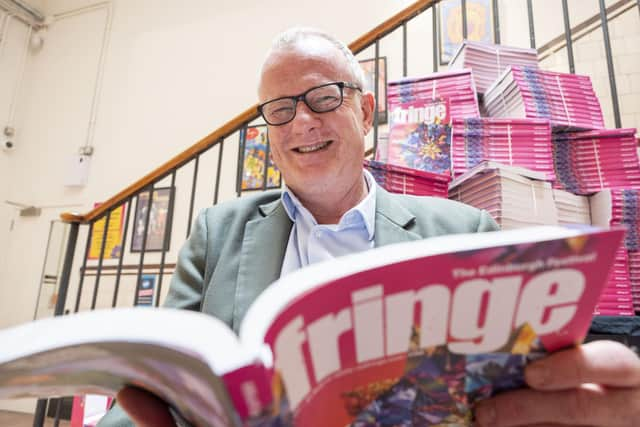
It was with a certain sense of déjà vu that I read The Scotsman’s splash yesterday (“City is killing ‘golden goose’ by failing to fund festivals”, 18 August) and the accompanying lengthy contribution by Fringe Chief Executive Tony Lankester on the need for more funding from council taxpayers for the Festival Fringe.
I must have read the same article every year for at least the last three decades, essentially asking for more money with the threat that if it is not forthcoming the Fringe will go elsewhere. Yet every year the Fringe gets bigger and bigger, the streets get more crowded, the flyers fly thicker and faster.
Accept that the Fringe is an unofficial addition to the official festival, that it is totally voluntary, and that it should be self-supporting. Indeed, it would be no bad thing if the frenzy faded and and we got back to the days when local groups could put on productions without being squeezed out by Underbelly and the like.

Robert Cairns, Ceres, Cupar, Fife
Stream shows
According to the Fringe directory there are at least 1,500 shows I could attend, plus another few hundred main stage productions. Wonderful, except I shan’t be attending any, no matter how attractive, as, although a resident, I dislike crowds and badly behaved audiences.
A solution that would work for me and for which I would pay is to watch the offerings of my choice online at my time and place of choosing. I know this is possible as I already view streamed documentaries, concerts, talks and films in the comfort, convenience, peace and quiet of my own home. Surely the EIF should investigate and instigate this facility for next year? It would open EIF to the world and earn good money.
Tim Flinn, Morningside, Edinburgh
Answers please
In general, the advocates of Scotland becoming an independent state seem somewhat naive when it comes to providing answers as to how the Scottish budget would be funded.
Currently the largest funding source is still the Block Grant, which is a transfer from the UK Exchequer to Holyrood. The grant is calculated by taking into account how much Westminster passed on in the form of a baseline, and then topping up or reducing the level of the grant using the Barnett formula.
In spite of all the propaganda which has emanated from the SNP over the years, we Scots have yet to be informed how the Scottish economy would be funded.
They have been far too busy decrying Westminster rule, misleading people with their propaganda, staging tartan marches and conferences, mounting Gaelic signage on roads everywhere and even on emergency services vehicles.
If ever theSNP cause for independence should be successful it will be a sad day not just for Scotland, but for the whole UK.
Robert I G Scott, Northfield, Ceres, Fife
Selective listening
Catriona Stewart writes that Edinburgh councillors are to consider a report from officers on the Equality and Human Rights Commission’s updated Equality Act Code of Practice (“Council backs Supreme Court ruling”, 14 August). The report sets out the steps the Council is taking to comply with the Code’s provisions on single-sex spaces. Welcoming the move to comply with the law – though one might have expected such compliance to be a given – Susan Smith of For Women Scotland nevertheless urges the Council to stop resisting the law and guidance and end its relationship with publicly funded lobby groups which, she argues, misrepresent the law.
From that perspective, it is notable that the report itself records officer engagement with Stonewall and LGBT and trans organisations that promote contested gender-identity beliefs and associated interpretations of the law, but none with organisations representing those who do not share those beliefs and support the provision of single-sex spaces.
When it comes to equality, failing to engage with interested parties across the spectrum may itself raise questions about the Council’s compliance with the Equality Act and the Public Sector Equality Duty. The impression is given that, even under intense scrutiny, the Council is determined to remain selective about whom it is prepared to hear from on these issues.
Brian Forsyth, Edinburgh
Poor account
The Scottish National Investment Bank seems to be another failure of whatever “legacy” Nicola Sturgeon seems to think she has left the nation. A formal review has advised that SNIB losses will be around £110-120 million and this is money Scotland can ill afford to lose.
However, if you work for the bank you will undoubtedly be pleased with your remuneration. Looking at recent accounts, I was staggered to see the following: One employee earning £200-£250,000. Seven employees earning £150-£200,000. Twenty five employees earning £100-150,000 and 39 employees earning £50-£100,000.
Further, this “gravy train” has a Board containing eight non-executive directors and an Executive Team of six. There are eight Executive Directors and seven in an Investment team.
What on earth are they all doing? In defending the SNIB, Chairman Willie Watt comforts us all in declaring: “We are committed to learning from the review, building on our strengths and continuing to evolve as an institution delivering lasting economic and social impact for Scotland”.
What a “word salad” of nonsense. The SNP needs to close this failed “institution” very quickly and save the people of Scotland from further financial losses.
Richard Allison, Edinburgh
Help women
Why are so many people silent on the appalling plight of women in Afghanistan since the Taliban takeover of the country five years ago? We see daily protests about Palestine, and about the rights of trans women, yet on an issue where woman are suffering brutal repression, there are few, if any, protests and certainly no loud street demonstrations. Just the sound of silence, yet females over the age of 12 are barred from education – a fundamental right in almost every country in the world except Afghanistan.
Their lives are being made a misery: Child marriage is now permitted, and men may legally beat their wives. Yet the protests in this country often centre on whether a trans woman who is a biological man should be allowed into women's changing rooms and prisons, or on support for a (banned) proscribed organisation.
Perhaps we should be think about how much women in Afghanistan suffer and be more grateful for what we have?
Brian Barbour, Haddington, East Lothian
Pygmies or giants?
Joe Fagan seems to a more viable potential leader of Scottish Labour than Monica Lennon, and a down-to-earth combination of him and Michael Marra might shake their party out of its complacent torpor.
I'm particularly interested in his views on reviving North Sea industry, reforming the leaky, expensive Scottish benefits system, back to basics education – and how keen he is on finding a way to consider, support and implement Burnham's good ideas on city provosts and funding and reforming old age care, a policy that will, or should, win the votes and gratitude of OAPs and their younger offspring.
These last two issues and proposals do not fit the current devolution settlement but city devolution would enable Aberdeen City and Shire to rise and expand above the disdain and neglect it suffers from Holyrood, an idea that was welcomed by many local politicians when Andy Burnham described it at a conference I attended in 2019.
Fagan’s support of coalitions is also welcome, especially after Anas Sarwar's idiotic suspension of Aberdeen Labour councillors for joining what was a cordial, workmanlike, potentially successful coalition with the Tories and which contributed to his party's subsequent electoral failures.
But my big fear is, like Burnham, he will be bogged down by the so-called “progressive” luxury belief activists eating away at the soul of his party.
Fagan’s legendary namesake was standing on the shoulders of giants (Bill Shankly and Bob Paisley) when he became Liverpool FC manager. Whoever wins the Scottish Labour leadership will either be standing on the shoulders of pygmies or be one themselves.
Allan Sutherland, Stonehaven, Aberdeenshire
Green warning
In an excellent letter William Loneskie informs readers that fossil fuels are essential and will always be needed (18 August). If I may add more fuel to the fire...
The Green Brigade loves renewables and takes every opportunity to scold those who do not. The Green Brigade try to dictate that we eat less meat, walk, buy electric cars and umpteen other things when the rest of the world is not listening as they harvest and burn fossil fuels to drive their economies. Those Greens of a nervous disposition should turn away now.
The following are made using fossil fuels. Lipstick, deodorants, cosmetics, nail polish, perfume, toothpaste, soap, sanitary products, MRI machines, pacemakers, fertilisers, pharmaceuticals, anaesthetics, cars, electrical goods, insecticides, safety helmets, contact lenses, heart valves, surgeons scrubs, lubricating oil, food preservatives, sports equipment and of course heat pumps, EVs, solar panels and wind turbines.
Will the Green Brigade now promise to shun these items?
Clark Cross, Linlithgow, West Lothian
Write to The Scotsman
We welcome your thoughts – NO letters submitted elsewhere, please. Write to [email protected] including name, address and phone number – we won't print full details. Keep letters under 300 words, and in the body of the email – no attachments – and avoid 'Letters to the Editor/Readers’ Letters' or similar in your subject line. If referring to an article, include date, page number and heading. No poems.
Comments
Want to join the conversation? Please or to comment on this article.