
Readers' Letters: After by-election win Labour needs to sell message of positive change
Labour’s surprise win in the Hamilton, Larkhall and Stonehouse by-election had readers talking
Reform UK’s 26 per cent vote share at the Hamilton, Larkhall and Stonehouse by-election is a warning that the populist party with a toxic ideology can make inroads in next year’s Holyrood election.
Political expert Sir John Curtice estimates Nigel Farage’s party could come third, with 18 seats, based on recent polling (your report, 2 June). He said Reform’s success is “very bad news” for the Tories who polled just 6 per cent at the by-election.
Unfounded remarks by Farage about Scottish Labour leader Anas Sarwar allegedly favouring the Pakistani community were condemned as racist by all major parties in Scotland apart from the Tories, who remain toothless against a party that has overtaken them in the polls and threatens to render them obsolete. The recent resignation of Bellshill-born Reform party chairman Zia Yusuf, after its newest MP suggested the banning of the burka, is a blow to Farage. This follows Reform’s controversial views on banning asylum seekers from Reform-held councils, an unworkable net zero migration policy and the recent comments against Mr Sarwar.
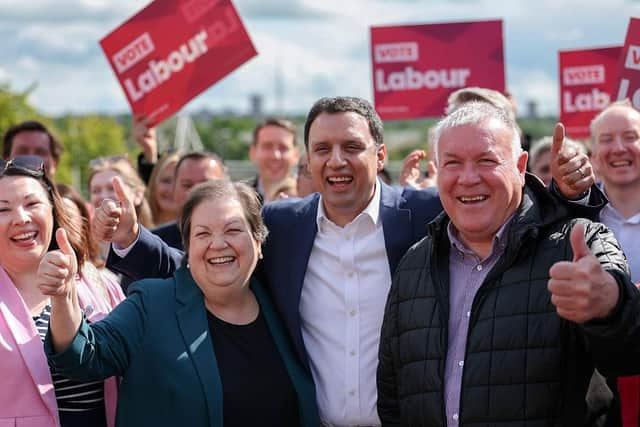

Reform has no place in Scottish democracy as it is difficult to justify any support for a party with outdated views on multiculturalism and climate change. Labour must show that Hamilton was not a blip to defeat two decades of failed SNP policies and the toxic politics of Reform. Voters are more likely to engage if there is tangible hope of positive change.
Neil Anderson, Edinburgh
Counting chickens?
While Labour’s victory in the Hamilton by-election on Thursday seemingly points to the party winning the Scottish Parliament elections next year, if I were Anas Sarwar I wouldn’t be sizing up the curtains of Bute House just yet.
The seat was won comfortably by the SNP in the last Scottish Parliament election in 2021 and is just the sort of seat Labour needs to win if Sarwar is to become Scotland’s next First Minister.
The SNP has made little progress in restoring its fortunes following its heavy defeat in last summer’s Westminster election, with polls suggesting the party’s support across Scotland is still 15 points down on its tally in 2021. In the event, the fall in the party’s support in Hamilton was, at 17 points, just a little higher than that.
However, Labour’s own tally was also down by two points on its vote in 2021, when overall the party came a disappointing third. That drop was very much in line with recent polling, which puts the party at just 19 per cent across Scotland as a whole, while the SNP has around a third of the vote. In addition, Labour is losing somewhere between one in six and one in five of its voters to Reform since last year’s election.
After nearly two decades in the political wilderness, there is little sign that Labour, as it currently stands, is set to regain the reins of power at Holyrood.
Alex Orr, Edinburgh
Real winner
After all the hype by First Minister John Swinney talking up Reform and ignoring Labour it was obviously a tactic by the SNP to try and salvage a win in Hamilton.
Similarly, despite a dreadful campaign by Labour, voting SNP was simply not an option for many on the left. In comes the real winner, Reform UK, with a spectacular vote from a near nil base.
Mr Swinney has unleashed a force that will do real damage in the 2026 Holyrood election. The SNP has proved itself too self-congratulatory too many times. Eighteen years of misrule cannot be rewarded by another term in office. All bets are off as to the make-up of Holyrood in 2026.
The SNP is tired, Labour has yet to prove itself effective, Reform UK has the bit between its teeth and the Tories might yet recover. A year is a long time in politics.
Gerald Edwards, Glasgow
Swinney must go
The loss of the Hamilton by-election to the risibly inept “Scottish” Labour – a party so devoid of ideas it could barely muster a coherent manifesto – is not merely a setback. It is a catastrophe of the SNP’s own making.
This was an entirely avoidable humiliation. Instead of seizing the moment – with independence support now at a formidable 54 per cent in a Norstat poll – John Swinney chose to dither. His response? A pledge to wait until 75 per cent of Scots beg for freedom before lifting a finger. When Keir Starmer declared he would block any independence referendum, Swinney’s silence was deafening. Not a word of defiance, not a hint of resistance to the colonial farce of Section 30. Instead, he opted to align with Labour – a party whose sole distinction from Reform is a marginally more polished veneer of hypocrisy. Both are unionist to the core, united in their mission to siphon Scotland’s wealth southward while offering nothing but condescension in return.
The campaign itself was a masterclass in misdirection. Rather than rallying the independence movement with a bold vision, Swinney fixated on Reform – as if thwarting Nigel Farage’s band of reactionary clowns was the defining struggle of Scottish nationalism. The result? A muddled, defensive mess that left voters uninspired and Labour undeservedly triumphant.
The truth is stark: the SNP has no plan for independence. No strategy beyond grovelling to Westminster for permission to hold a vote – a humiliation masquerading as diplomacy. It is a spectacle so pitiful it verges on self-parody.
Swinney must go. Not with a whimper, but with the swift, decisive exit his failures demand. The independence movement deserves leaders who grasp that freedom is seized, not negotiated – and who possess the courage to act accordingly.
Until then, the SNP’s decline will continue, and Scotland’s potential will remain shackled by the timid and the unimaginative.
Alan Hinnrichs, Dundee
Let teachers teach
As a retired primary teacher who worked for 40 years in primary education, I think there is a simple solution to the “excessive workload”. Stop expecting detailed forward plans, lesson plans and reviews of the same and let teachers teach instead of being overburdened with paperwork for the sake of accountability. The Curriculum for Excellence has a lot to answer for. It was what changed things so drastically and made teaching so much more stressful.
When I began teaching in the 1970s, teachers completed a Record of Work every two weeks. This showed the work that had been completed in all the subjects taught in the primary curriculum in the previous two weeks. From there the progress that was made was clear and any teacher taking over the class (say as sickness cover) knew what was being taught. This was not as detailed as the Forward Plan which replaced it, but it was a clear record, in one slim book, of what had been achieved over the school year. Pupils’ work was marked daily and preparations for next day made daily. The pupils left literate and numerate and, for the most part, behaved responsibly.
Forty years later we were required to make a “Forward Plan” for each subject for the term ahead and then assessed as to how we felt it had been achieved before writing the next Forward Plan! A daily diary of the plan for each day was also required. This was to be written up for the week so any teacher could take over. This was detailed to show subject, aims and objectives. On top of this there was, of course, the marking and noting of any problems and collecting materials for the next day’s work.
In the last year or so of my career we had a school inspection. The HMI “dropped in” to observe one of my lessons and said at the end, “That was an excellent lesson, but I’m afraid I cannot grade you on it as you didn’t have a detailed lesson plan”. My reply was that I had never written a full lesson plan for any lesson since graduating from Callendar Park teacher training college.
If teachers are allowed to teach without all the emphasis on accountability their workload would be greatly reduced and they could enjoy working with their pupils and seeing them love to learn, as I did at the start of my career.
Barbara Wilson, Edinburgh
Cringe no more
I must disagree with Alexander McKay, and by extension, Billy Connolly, on the charge that the Scottish Parliament is “pretendy” (Letters, 6 June). Far from it. Rather, it brings democracy and answerability to our doorstep. If the Scottish Parliament were pretendy, the Westminster Parliament is undoubtedly toxic. Politicians of the calibre of Mhairi Black and Stephen Flynn, disillusioned with Westminster, are seriously thinking of transferring their allegiance. Scotland struggled long and hard to achieve a Scottish Parliament in 1999, with the likes of Donald Dewar, Winnie Ewing, David Steel and Alex Salmond playing leading roles.
Hopefully, Holyrood is here to stay, and grow in stature and personnel, with more and Parliamentarians choosing to be MSPs rather than MPs. Let's hear no more of the infamous “Scottish cringe”.
Ian Petrie, Edinburgh
On the buses
Andrew Clark, who expressed absolute dismay over bus lanes (Letters, 5 June), got the wrong end of the stick. Bus priority lanes are not, in the first instance, about reducing pollution, but about minimising congestion for those who are prepared to travel together.
And to encourage people to do so, buses need to be able to progress reliably, especially on the main arteries. Cars have a vastly disproportionate footprint compared to buses. Bus lanes go some way towards reallocating the communal road space more fairly.
Harald Tobermann, Chair, Edinburgh Bus Users Group
Write to The Scotsman
We welcome your thoughts – no letters submitted elsewhere, please. Write to [email protected] including name, address and phone number – we won't print full details. Keep letters under 300 words, with no attachments, and avoid 'Letters to the Editor/Readers’ Letters' or similar in your subject line – be specific. If referring to an article, include date, page number and heading.
Comments
Want to join the conversation? Please or to comment on this article.