
Readers' Letters: Aberdeen wind farm brings jobs and community benefits
It’s just wrong to claim Aberdeen wind farm isn’t good for local economy, says spokesman
It has been suggested that the Aberdeen wind farm has not created jobs or investment since construction was completed (MJ Salter, Letters, 20 May).
In fact, research from Oxford Brookes estimates spending linked to the operations and maintenance (O&M) of the wind farm is likely to lead to between 40 and 50 full-time equivalent jobs being created each year, through locally based contracts with suppliers and onward spending within the local community.
While it is true that the construction phase of wind farms generates a surge in employment, the long-term impact extends far beyond that. The Aberdeen Offshore Wind Farm supports a range of skilled jobs in operations, maintenance and environmental monitoring – roles that are vital and sustained throughout the life of the project. These are high-quality, future-facing jobs that contribute to the diversification of the regional economy.
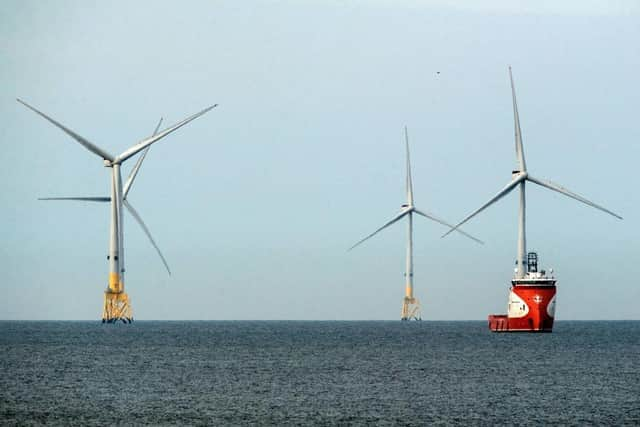

The economic ripple effect of the wind farm is substantial. Local supply chains, ports and service providers benefit directly from the presence of such infrastructure. Aberdeen, long a hub of energy expertise, is now evolving into a centre for renewable innovation – ensuring that the region remains at the forefront of the global energy transition.
Equally important is the community benefit fund associated with the wind farm. This fund has provided over £1 million to local projects, education initiatives and environmental programmes, ensuring that the advantages of renewable energy are shared with the people who live nearby. It is a tangible demonstration of our commitment to inclusive growth and community empowerment.
We welcome continued dialogue and scrutiny, but it is vital that the conversation reflects the full picture.
Claus Wattendrup, UK Country Manager, Vattenfal
Scotland ignored
A rather interesting claim was made by Prime Minister Sir Keir Starmer when he announced the trade deal with the EU: “Britain is back on the world stage!”
Mr Starmer, Scotland never left the world stage, Scotland was dragged out of it. Scotland fully recognised the need to remain in the Single Market and the Customs Union, yet was dragged away from our largest and closest trading partners. So I very much welcome a closer relationship with the EU as it will benefit our export businesses.
What will this new trade deal with the EU bring to Scotland? Well, Scotland and her Government at Holyrood had no prior notice because Scotland was not invited to the EU Trade Deal negotiations, despite the PM on taking office promising to “re-set devolution”. A clear example once again from the Labour Government at Westminster that Scotland is an afterthought and deserves no voice. The Scottish fishing industry is furious with the EU Trade Deal, because the EU will now have unlimited access to Scottish waters for the next 12 years.
The PM and his Labour government, in the last ten days, have shown their total disrespect for our devolved nation and government and her people. They are closing the door to much-needed immigration without any negotiations with our government in Holyrood, and now EU trade deals are agreed, again with no input from Scotland. Scotland’s public and private sector deserve a voice, we deserve to be heard. We simply cannot continue not being seen or heard, while having to endure the damaging impact.
Catriona C Clark, Banknock, Falkirk
Market rules
Two letters caught my attention yesterday, one from Neil Anderson and one from Richard Allison. Both concerned the EU deal. Mr Anderson suggests membership of EFTA would maintain our sovereignty while getting better access to the EU Internal Market.
It was the UK who helped found EFTA in 1960 as a rival to the then EEC. However, a nation of 55 million selling to fellow EFTA member states with a combined population of only 20m made no economic sense, especially as the EEC population was by then close to 200m.
To sell into the EU Internal Market EFTA members have to follow EU rules. These are enforced outwith the EU by the EFTA Court. It follows European Court case law, otherwise you would end up having to choose between two separate case law verdicts to solve the same problem.
And the EU is not a political union. The Maastricht Treaty rejected supranationalism for intergovernmentalism, ie collective decision making. The latter is more cumbersome to operate but protects national rights. However, like any organisation the EU can still take a political stance.
As regards fishing, all EFTA states have signed up to the Common Fisheries Policy allowing mutual access to one another’s waters subject to agreed quotas, so it’s no different from being in the EU.
Mr Allison, meanwhile, suggests that we would fall under the jurisdiction of the European Court of Human Rights as a result of the latest deal. But we are already under its jurisdiction because it is a completely separate entity from the EU. The European Court can intervene in human rights issues only in relation to the operation of the Internal Market such as women being paid less than men for doing the same job. It cannot intervene on issues such as prisoner’s rights.
Robert Menzies, Falkirk
Pot, kettle
It’s frankly hilarious to hear John Swinney having a grievance-stoking whinge about the PM’s EU fisheries giveaway. He moans that “the Scottish Government was not consulted” (your report, 20 May).
Yet this is a First Minister who would take an “independent” Scotland back into Europe and whose government tried to decimate our fishing industry through the Highly Protected Marine Areas legislation, yet another hastily abandoned separatist policy.
As party leader, he boasts that he’s stabilised a divided, scandal-hit SNP. Having the appearance and mannerisms of a boring bank manager undoubtedly helps Mr Swinney project a certain false gravitas which reassures many of his followers.
However, given the ongoing ferries fiasco, repeated use of the phrase “steadying the ship” is perhaps an unfortunate choice of maritime metaphor in praise of this false fisherman’s friend.
Martin O’Gorman, Edinburgh
Wrong move
It must have been difficult for the SNP to make a mess out of the cards they were dealt – with regards to Labour's attempt to reset relations with the EU – but they have succeeded.
Surely, after years of telling everyone that membership of the EU was their one goal in politics, it would have been sensible for the nationalists to claim that Labour's attempts to reset the relationship were a step in the right direction but fell miles short.
But, no, being who they are, they tried to cash in politically and even talked of “surrender” and jumped on the passing bandwagon and aligned themselves directly with Kemi Badenoch's Tories, Nigel Farage and others, using many of the same phrases. With leaders like John Swinney and Stephen Flynn, this was inevitable. Of course, their sheep-like supporters will follow and parrot the same lines. But the party bosses must know they have their votes anyway.
To get within a mile of their Holy Grail they have to convince a great chunk of the thinking centre ground of Scottish politics to change their opinions, something they have never come close to doing. And this latest example only makes that gulf even wider.
Alexander McKay, Edinburgh
Untrue claims
The letter from Peter Hopkins (20 May) contains two startling claims regarding the new UK-EU agreements – both of which are blatantly untrue.
The use of Scottish fishing grounds by EU vessels remains as it was before the new agreement – and will be reviewed every 12 years instead of annually.
There is no discussion of a “Euro Army” currently in Europe, and in any case, the UK has a veto.
Peter Burke, Carnoustie, Angus
Losing ‘friends’
Surely Israel is fast losing its “friends”. One of them, David Lammy, the Foreign Secretary, condemns its recent actions in Gaza as “monstrous, extremist and dangerous” (your report, 21 May). To say the least, that's putting it mildly.
Gaza has been reduced to the status of a ghetto, squeezing its beleaguered citizens ever more tightly into an ever tinier territorial space. Israel's stated aim is to remove them altogether. Upwards of 14,000 babies are at severe risk of dying in the next 48 hours.
Even Donald Trump, described by the egregious Benjamin Netanyahu as “Israel's best friend”, is losing patience, opining, in a masterful understatement, that “a lot of people” have died, adding “we'll have to sort it out”.
Sorting it out is indeed urgent, and as Israel's best friend, Donald Trump, of all people, is the one to do it, with the leverage he has over Benjamin Netanyahu, who is surely, nobody's best friend.
Ian Petrie, Edinburgh
Vile style?
Am I alone in hoping the “fashion students” whose fatuous “creations” adorned The Scotsman front page (21 May) are not receiving grants from taxpayers employed in proper jobs and trade apprenticeships?
As that noted expert Oscar Wilde himself said: “Fashion is a form of ugliness so intolerable we have to change it every six months.”
John Birkett, St Andrews, Fife
Write to The Scotsman
We welcome your thoughts – NO letters submitted elsewhere, please. Write to [email protected] including name, address and phone number – we won't print full details. Keep letters under 300 words, with no attachments, and avoid 'Letters to the Editor/Readers’ Letters' or similar in your subject line – be specific. If referring to an article, include date, page number and heading.
Comments
Want to join the conversation? Please or to comment on this article.