
Readers' letters: A real live dinosaur stalks the pages of The Scotsman
We must take action to tackle climate change, says a reader, whatever ‘serious’ commentators think
John McLellan’s Scotsman column last week (“Labour Will Make Same Mistakes as SNP over net-zero zealotry”, July 30) is the sort of argument which begs the question less, ‘will we survive as a species if man-made climate change is left to rip through our planet unchecked’ than whether we should even bother to try to save it.
Opening with a traditional kicking of the French, he went on to decry the opening ceremony of the Olympics, the torch’s inferiority to that of Atalanta in a previous millennium and then moving on to labour this metaphor to rail against sacrifices on “the altar of climate change; the planet is dying, there is no planet B, and all that guff used…to justify the acceleration of potentially ruinous policies in the pursuit of global one upmanship”,
Now, whilst I am aware that extinct dinosaurs form a large chunk of the crude oil we are using as a fuel source, I have to say I was surprised to learn that one of them was still wielding a pen and writing editorials.
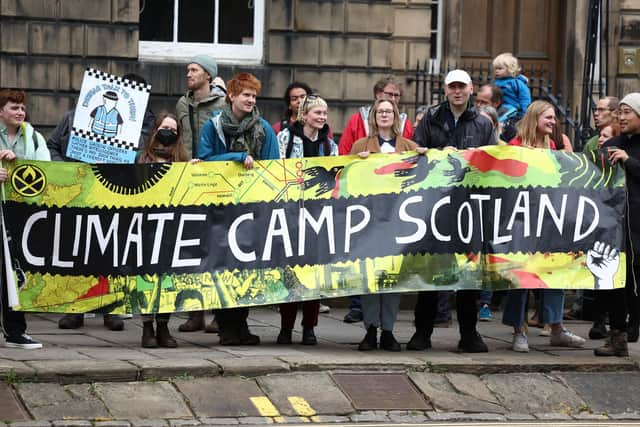

As a former Scottish Green Party candidate at the last election, I will no doubt be classed as part of the tofu-eating wokerati beneath the contempt of “serious”-minded commentators like Mr McLellan. So, I shall leave it to such lefty hippies as the World Bank which cites climate change – alongside inequality – as “the defining issues of the age”.
His piece went on to cite China’s responsibility for 95 per cent of new coal power construction last year. Which is fair. But does rather leave out the $860 billion of investment in clean energy sectors in the same year – that’s almost the same amount of total fossil fuel investment on the entire planet last year and roughly the same value as the GDP of Turkey or Switzerland. That investment also netted the Chinese economy the paltry figure of 11.4tn yuan ($1.6tn) in 2023.
McLellan says “warm words don’t heat homes” and he is correct but nor does lack of investment in sustainable technologies and platforming past-their-sell-by-date concepts and ill-informed Britain-first cliches.
Peter Newman, Tain, Highland
Ticking timebomb
National Records of Scotland (NRS) has recently issued data showing that the number of births registered in Scotland in 2023 is the lowest since records began in 1855 (Scotsman, July 31). I am surprised that there has been little reaction to this.
Life expectancy has increased very significantly over recent generations. A person born at the end of the Second World War on average could expect to live to the age of 64: the equivalent figure for someone born now is 81 years of age. It is stated that, for a population to replace itself, the fertility rate must be 2.1; NRS reports that, in Scotland, it is currently 1.3. Very serious implications arise from the fact that people are living longer while the fertility rate is the lowest ever recorded.
The proportion of the population who are older and who tend to be more reliant on the state for support in areas such as health and social care is increasing; the proportion of economically active people and the tax revenue they generate is reducing. Something has to give.
Yet politicians of all parties seem oblivious to this situation. Policies to extend the range of “free” services and the triple lock on the state pension appeal to the grey vote. Revenue is required to fund these policies but raising tax levels for a reducing number of tax-payers is not sustainable.
It would be good to see debate on this critically important issue. To face up to the situation requires joined-up thinking across a whole range of policies encompassing economic growth, taxation, health and social welfare, employment, immigration and housing. It means politicians moving beyond their comfortable slogans and familiar rhetoric and engaging honestly with the electorate. They should aim to build a consensus towards the difficult decisions which, inevitably, will have to be made.
George Rennie, Inverness, Highland
BBC censorship
The ink had barely dried on the Huw Edwards court paperwork when the BBC took a wrecking ball to their online video archive on iPlayer and YouTube.
The death and state funeral of the Queen. The accession and coronation ceremonies of King Charles. The opening night gala of the 2012 London Olympics. The political downfalls of Johnson and Truss. In fact, just about every major news announcement and important occasion from the past decade which involved Edwards is now being quickly and discreetly removed from BBC streaming platforms.
Even an old episode of Doctor Who, in which his voice was used in a brief news flashback scene, has been chopped. Probably forever. Removing the entire programme instead of merely editing out a few lines of dialogue is akin to using a large sledgehammer to crack a nut.
We can’t ignore our history and we can’t pretend these momentous events didn't happen. It would be a great shame if the announcement we all remember when Huw Edwards broke the news to the nation of the Queen’s passing was never shown again. Future generations deserve the opportunity to see and hear this for themselves. As it happened. As it was reported at the time.
What right does the BBC have to decide what we can and can’t see any more? To take a sweeping decision to remove a decade’s worth of international news coverage because of the actions of one man? Such censorship is reminiscent of Putin's Russia.
No individual is bigger than BBC news, and removing so much important content from the national archive and pretending these events didn’t happen is certainly not the answer.
David Fernandez, Strathaven, South Lanarkshire
Violent rhetoric
It beggars belief that the tragic events of Southport only a week ago have triggered such a spate of violence and hatred on social media and the streets of a growing number of cities. It would be wrong to suggest that Scotland is immune.
James Cleverley, the shadow home secretary, opined in an interview that such actions are not ‘reflective’ of British society. Sadly, sir, increasingly, they are.
All too frequently, in the recent election campaign, anti-immigration venom was spouted by candidates of the far right, in the name of Nigel Farage’s Reform Party and indeed, too many of the right-wing Conservatives. What wasn’t fulfilled in the ballot box is now being played out on the streets.
Thankfully, we have in Keir Starmer a Prime Minister who tones down the rhetoric, and we can only hope that his calm voice is heard and heeded above the rabble’s noise and repulsive actions.
Ian Petrie, Edinburgh
Time for discipline
With regard to the recent criminal violence on our streets; I would suggest consideration of a judicial re-introduction of the clinical applied use of the birch as a first line defence against such criminal violence and thuggery – followed by tagging for two years.
Perhaps we could also introduce camps under the auspices of the army where those found guilty could be placed for two years. During this period they would learn discipline and respect.
When the razor gangs were prevalent in Glasgow some 70 years ago the problem was speedily stamped out by a judge who started doubling the sentence on each additional miscreant brought before him.
James Watson, Dunbar, East Lothian
Science fiction
I refer to your amusing resumé of the Glen Sannox saga (“Do ferry delays arrive by wormhole?”, August 3).
This ferries project was cursed from the day the Scottish Government – aka Nicola Sturgeon – threw £300 million at the Ferguson shipyard, already deeply in debt and way past resuscitation; no prior sue diligence of any kind being evident.
The contracts for the construction of the two ferries were awarded in 2015. Nine years’ on, the ferries are, unbelievably, still at Ferguson’s.
I confess I had to check out what a “wormhole in space-time continuum” is; it sounding more in tune with the Starship Enterprise reaching warp speed.
There was a time the Ferguson yard at Port Glasgow was considered reliable when it specialised in tug boat construction, King George V visiting the yard in 1917. As things stand right now, Para Handy wouldn’t (appropriately) touch the yard with a barge pole.
Doug Morrison, Tenterden, Kent
The right track
The Big Picture of the derelict Shawfield stadium in yesterday’s Scottish Life would seem to offer an ideal solution to the row over the insensitive location of a trotting track at the Bannockburn battle site.
Rodney Pinder, Kelso, Scottish Borders
Decline and fall
When future historians come to write about the decline and fall of the SNP, the Michael Matheson affair and his reluctance to step down will be a major factor. It epitomised all that is wrong with the party and was the tipping point.
There have been other disastrous nationalist ministers, yet the Matheson case hascost them more than any other. In any other party there would have been no wagon-circling and if the erring minister had not jumped, he would have been pushed. That incident accelerated a downfall that had already started and still has some way to go.
But what is beyond dispute is that we are past the “decline” stage and now firmly in the “fall”.
Alexander McKay, Edinburgh
Write to The Scotsman
We welcome your thoughts – NO letters submitted elsewhere, please. Write to [email protected] including name, address and phone number – we won't print full details. Keep letters under 300 words, with no attachments, and avoid 'Letters to the Editor/Readers’ Letters' or similar in your subject line – be specific. If referring to an article, include date, page number and heading.
Comments
Want to join the conversation? Please or to comment on this article.