
Readers' letters: A Margaret Thatcher-style government is what's needed today
Margaret Thatcher’s ethos – based on upward mobility and self-reliance – is sadly lacking today, a reader says
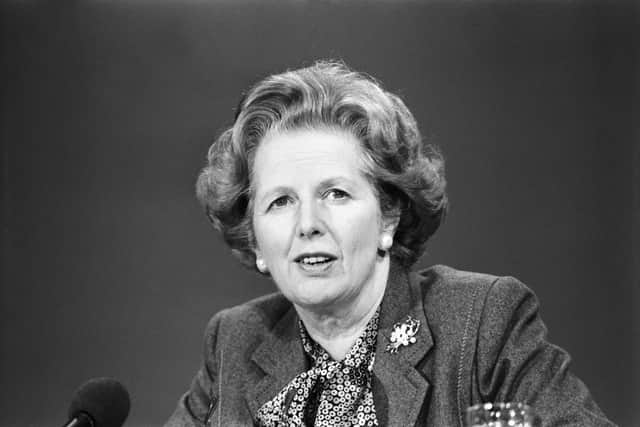
Lord Tebbit died last week, one of the last survivors of Margaret Thatcher’s reforming government of the 1980s.
Probably at the name “Margaret Thatcher” many readers will immediately switch off and mutter “free school milk”, “poll tax” and “miners’ strike”.
History demonstrates that these events did happen and often, as in the miners’ strike resulted in destroying mining communities that had relied upon this employment to sustain them.

Trying to reform local government income to spread the cost among a broader base attracted real anger when trialled in Scotland to the extent that no real attempt to reform local taxation has been attempted since.
However, as we continue to sink into what appears to be a an ever deeper debt hole plus employment malaise, we should remind ourselves that the Thatcher era of Conservative government was underpinned by an ethos which was based on a simple premise that has been lost by government policy: family responsibilities as an example.
In short that ethos was based on the value of upward mobility and self-reliance coupled with a belief in national economic and energy security, all of which have disappeared under the guise of equality and government action apparently keen to punish all those who aspire to be better through a penal tax policy. Not forgetting, of course, the mad dash for green energy that hinders any chance of economic growth by imposing high energy costs on industry and households.
Can we expect any political party to revert to supporting the idea that economic progress can only come from empowerment of all by reducing taxation and energy costs plus removing onerous legislation requirements that hinder rather than support employment?
At present, unfortunately, the answer has to be a resounding no but surely sensible policies will emerge shortly to help us regain a measure of self-respect and responsibilty for our own actions.
A Lewis, Coylton, South Ayrshire
Labour pains
It is hard not to agree with John McLellan (Scotsman, 11 July) that the Labour government may be a lame duck one already. There are ballooning welfare costs, but when the government tries to remedy this, its own backbenchers stop it. It is likely they will be unable to tackle this.
Then there is the threat of strike action by doctors in England, even after a generous pay settlement in the past – is it because doctors see this government as a soft touch? After all, the government has been making many U-turns. Are we about to see the return of union militancy? if so, this could be the end of Labour and, if Kemi Badenoch plays her cards right, the rise of the Tories.
William Ballantine, Bo’ness, West Lothian
Voting age
Thank you, Susan Dalgety (Scotsman. 12 July), for confirming that it’s not only Unicef which defines children as all those under 18 years old, but even the SNP and Holyrood Parliament do so too – under the Children and Young People (Scotland) Act of 2014, and by Holyrood “unanimously incorporating” the United Nations Convention of the Rights of the Child into Scots Law in 2024.
Article One of the Convention defines a child as “every human being under the age of 18”. Thus by these wise decisions, offset by not raising the minimum age for marriage from 16 to 18, the SNP and all Holyrood MSPs have on their own definition legitimised child marriage – presumably without realising it, such is their attention to detail.
Moreover, those SNP and other MSPs who voted (childishly?) to reduce our voting age from 18 to 16 have effectively admitted that they believe children should have the vote.
Both these unwise consequences should be rectified forthwith, by setting 18 as the minimum threshold for both (as my preference of 20 or 21 is no doubt totally off the page).
John Birkett, St Andrews, Fife
Zoned out
Last week UK Energy Secretary, Ed Miliband announced that he would not support the case for zonal pricing of electricity on the basis that “it would be unfair to zones such as the Midlands, Wales and the South of England”. As Scotland was clearly going to be a beneficiary of zonal pricing due to the fact that a huge chunk of the UK’s renewable energy is produced here, then Miliband’s decision could be considered to be based solely on southern interests. Although his decision drew criticism from Scottish MPs of various parties, there was none forthcoming from our Scottish Labour MPs. On that basis can we therefore assume that they are content for Scotland not to have the opportunity to be able to be in the position where it is seen as a more attractive proposition for industries than some parts of our southern neighbours?
Many of us in Scotland who have for decades witnessed Scottish jobs haemorrhaging to England find Scottish Labour’s position inexplicable. Compounding this, however, was the statement by the Under Secretary of State for Energy, Michael Shanks MP, on Radio Scotland (10 July) that the renewable energy generated by Scotlands wind farms isn’t really Scottish renewable energy because, “there isn’t Scottish wind or English wind, there’s GB wind”.
The fact that the turbines that capture the wind to generate the renewable energy and the equipment to then transport it southwards across much of our scenic countryside are located in Scotland seems to have been lost on Mr Shanks. His attitude (and that of the Labour Party as a whole) towards Scotland seems to be that we are here to produce renewable energy and put up with the costs without deriving any benefit. From the1980s onwards we witnessed Scotland's North Sea oil wealth being drained. We now appear to be entering a similar scenario with regard to our renewable energy.
Jim Finlayson, Banchory, Aberdeenshire
Write to The Scotsman
We welcome your thoughts – NO letters submitted elsewhere, please. Write to [email protected] including name, address and phone number – we won't print full details. Keep letters under 300 words, with no attachments, and avoid 'Letters to the Editor/Readers’ Letters' or similar in your subject line – be specific. If referring to an article, include date, page number and heading.