
Why voting against the SNP would be for the party’s own good – as well as everyone else’s

The SNP need some time out of power to formulate a better plan for independence
It’s polling day and the usual rules apply: vote early, vote often and don’t forget to use pens. All bets are off this time. Everyone already knows the outcome will be a landslide Labour victory.
But in Scotland, it’s not just the exhausted Tories who are set to receive a pasting in this general election. The SNP is also likely to suffer significant losses. Today’s vote will bring an end to 14 long years of Conservative rule at Westminster, but voters will not get the opportunity to eject the SNP from government until 2026.
By that point, the nationalists will have been in power for 19 years. Nineteen years! That could almost qualify as an actual generation. Polls predict the SNP will go from having 43 MPs to between 15 and 20. Any fewer than 15 will be catastrophic and any more than 20 might be seen as some sort of achievement.

This is a far cry from the 2015 post-referendum high in the early days of Nicola Sturgeon’s leadership, when the SNP sent 56 of Scotland’s 59 MPs to Westminster. In those days, Sturgeon would say another referendum should be held when there was sustained clear majority support for independence. Over the years, as this has failed to materialise, the bar has been lowered.
Seismic shift in Scottish politics
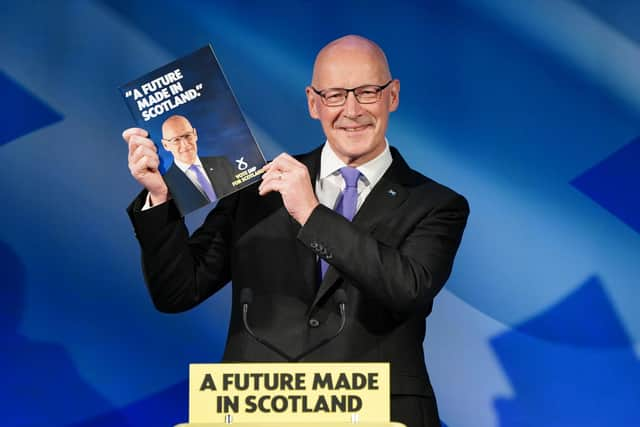
First Minister John Swinney now insists a majority of SNP MPs (or is it more SNP MPs than Scottish Labour MPs?) will constitute a “mandate”. Asked recently about the prospect of falling short of this target, Swinney insisted that he in fact already has a mandate anyway, so there.
He pointed to the Holyrood election of 2021, when the party fell one seat short but teamed up in coalition with the now-dumped Scottish Greens to form a pro-independence majority. In truth, if his party is left without a majority of MPs, this would reflect a seismic change in Scottish politics that should presage a radical shake-up of the nationalist movement.
Confronted with evidence of declining SNP support, party high heidyins invariably point to polling that shows consistently high support for independence. The most recent Savanta poll for The Scotsman put “Yes” at 48 per cent and “No” at 52 per cent, once undecideds were removed. But this only makes it all the more remarkable that SNP support is falling. If almost half the country supports independence, why is the party of independence losing so much ground?
Independence a lesser priority
Swinney and co can point to the emergence of new alternatives for independence supporters. Some of their voters will have ebbed away to Alex Salmond’s Alba, or the Scottish Greens. But this is just a symptom of a deeper malaise. A larger chunk of support appears to be switching to Labour.
Why are significant numbers of voters who purport to favour independence prepared to back a party that says Scotland should stay in the UK? Part of the answer must surely be that these people’s support for independence is more abstract and theoretical than Swinney would like. “Give us independence, but not yet,” they might say.
Polls also show that the issue has been steadily slipping down respondents’ list of priorities in recent years. Voters can see independence is not a realistic prospect for the foreseeable future – Sir Keir Starmer has ruled out any negotiations with Swinney, no matter what “mandate” he claims.
Sure, they might say, independence could be nice some day, but it is not desirable at the moment. Voters are more concerned with keeping body and soul together through the cost-of-living crisis, declining living standards and the inexorable rise of NHS waiting times.
Scotland can’t rejoin EU
Having been in power for 17 years, it is difficult to see SNP solutions to these problems through the party’s lengthy rap sheet. Voters see a failing health service, councils starved of funding, unbuilt ferries, falling standards in schools, and the disastrous “curriculum for excellence”.
And the party’s thin manifesto does very little to entice new support. Swinney clearly remains deeply committed to the party’s central aim of independence in Europe, despite the ever-increasing improbability of this. Scotland cannot “rejoin” the EU. We were never a member any more than Birmingham was, and we would have to play by the same rules as any other independent country seeking to join.
Leaving to one side the fact that the EU of today is a very different proposition from the EU the UK voted to leave in 2016, we would simply not meet the entry criteria. The SNP’s current position is that we would continue to use sterling after independence, rather than create a new currency in order to then adopt the euro.
Our notional deficit now is nowhere near the required 3 per cent of GDP and would be even further off in an economic crisis precipitated by leaving the UK while using what would by then be a foreign currency. And yet Swinney would have us believe that a border running the length of the Tweed between England and the European Union is a realistic prospect?
Time for soul-searching
No one should be under the impression there is even a remote possibility of this happening. “Independence in Europe” is an empty slogan from a party that is out of ideas – or, perhaps more accurately, has only ever really had one idea.
The SNP campervan has stalled and is badly in need of repair. As it approaches 19 years in power, the party needs to undergo a period unburdened by government and under a non-continuity Sturgeon leader, during which members can do some proper soul-searching, talk freely among themselves, and formulate a more credible prospect for independence to put before the people of Scotland.
A vote against the SNP would be in their own best interests – not to mention everyone else’s too.
Comments
Want to join the conversation? Please or to comment on this article.