
Why Starmer’s last PMQs showed what a kinder politics can look like, but also its limits – Alistair Carmichael
Political debate at its finest is a fierce competition of ideas and ideals, writes Alistair Carmichael
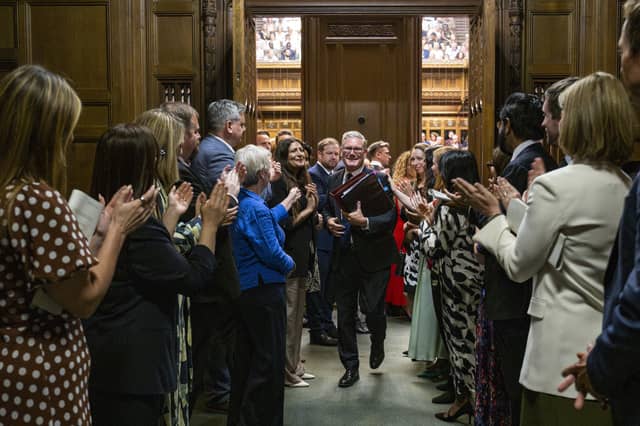

In my time as a Member of Parliament, I have seen my fair share of high-profile departures from office. Indeed as time goes on, the pace of high-profile political departures only seems to intensify.
One feature that most of these defenestrations share is a sudden tonal shift from the usual partisan rancour towards a gentler, more collegiate sort of rhetoric, both inside and outside parliament.
Keir Starmer’s final Prime Minister’s Question Time in the Commons on Wednesday was a classic example of this: gentle humour, conciliation and reflection on the issues that unite us. It showed us just what a kinder politics can look like – but also its limitations.
READ MORE: An important lesson from Keir Starmer and Kemi Badenoch's jokes at Prime Minister's Questions
Sturgeon’s infamous lament
It is no coincidence, after all, that politicians often reach their most reflective, relaxed and conciliatory state at precisely the point when they know their time on the front lines is coming to an end. There is an entire industrial pipeline of former-politicians-turned-jovial-podcasters that can attest to the gentler life which comes after higher ambitions have dropped away.
It’s easier to talk up the need for a kinder politics than it is to live up to that promise when you are tested to that standard day by day.
Nicola Sturgeon, upon leaving office in 2023, belatedly and infamously lamented the division in Scotland’s politics – and even accepted some share of the blame for her part in it. This was still, however, the same person who as First Minister said that she “detested” opposition parties, revelled in the defeats of opponents and made personal attacks on other leaders when they exited frontline politics. For those of us who lived through the 2014 independence campaign and what followed, Sturgeon’s sudden conversion to the ideals of political consensus sat uneasily with what came before.
For sitting politicians, it is also sometimes quite convenient to talk up the rhetoric of collegiality whether or not you intend to live up to it in reality, knowing that your supporters will ignore your hypocrisies while your opponents will fear to call you out, lest they be labelled “negative” in response.
The problem with ‘gentle’ politics
Even now you see incoming (and sometimes longstanding) politicians talk about the need for a new, gentler, more collaborative politics, while colleagues and adversaries nursing the stab wounds of their ambition look on with a raised eyebrow.
I am not entirely convinced that what we should be seeking is a “gentle” sort of politics in of itself. Political debate at its finest is a fierce competition of ideas and ideals. Some of the best laws and policies have come out of bitter political battles – and some of the worst legislation is that which is passed on the nod without scrutiny.
The goal, surely, should be a politics in which we talk about ideas rather than personality-driven attacks – but also a politics in which high-minded rhetoric is fairly measured against the reality of policy outcomes.
There must be a middle-ground between kindness and accountability, between bland platitudes and value-free abuse, in which we can debate ideas rigorously without fear or favour. Until that happens, we will go on discovering our need for a kinder politics precisely at the moment when we are on our way out the door.
Alistair Carmichael is the Scottish Liberal Democrat MP for Orkney and Shetland
Comments
Want to join the conversation? Please or to comment on this article.