
Why silence over Gaza, even in Scotland, risks complicity in war crimes
The extraordinary courage of activists in groups like Standing Together, comprised of Jewish and Palestinian citizens in Israel working jointly for peace and equality, should be an inspiration to us all


The situation in Gaza has never been a distant conflict; it is a humanitarian catastrophe unfolding in real time, and it demands a political response that goes beyond words of concern.
As the death toll rises, the calls for action from my constituents grow louder and more urgent. Every day, I receive messages not only expressing anguish over the suffering of Palestinians, who are being deliberately starved, displaced, and killed while trying to access food and water, but also demanding that their elected representatives act. They are not only grieving; they are writing letters and calling for accountability at every level of government.
As a Muslim MSP, I feel the emotional toll of this crisis both personally and publicly. At Friday prayers, in mosques, at community events and constituency surgeries, I am approached with grief, frustration, and a deep sense of urgency. Many are deeply shaken by what they are witnessing and feel abandoned by institutions they once trusted to stand for justice. People want reassurance that their voices are not being drowned out by political hesitation.

Providing arms and diplomatic cover
Some argue that Gaza should not be a focus for British politicians. However, decisions made in Westminster, regarding arms exports, foreign policy, and trade, have global implications. We provide arms and diplomatic cover; we are not a neutral party. People in Scotland understand this. They expect those in public office to act with transparency and a firm commitment to human rights. Silence, in this context, is not a neutral stance. It risks complicity in war crimes.
The systematic brutality we are witnessing in Gaza and the West Bank is not collateral damage; it is the deliberate dismantling of a people’s right to exist. Entire families are being wiped out in minutes. Hospitals, schools, and places of worship have been bombed. Journalists and aid workers are allegedly being targeted and some have been killed.
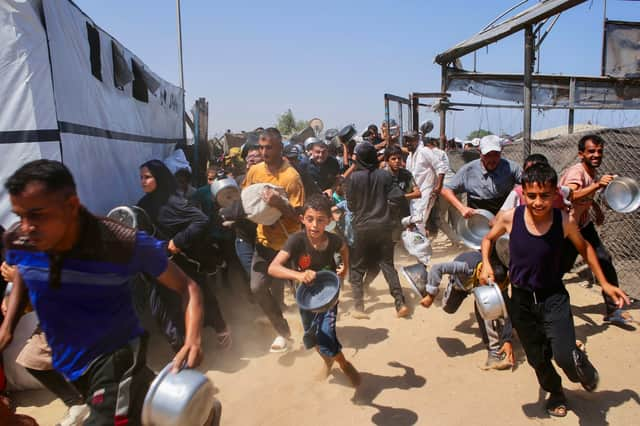
The horror unfolding at humanitarian aid points is especially shocking. Civilians, many of them children, have been killed while queuing for food and water. What should be safe zones for relief have become death traps. These are not isolated incidents. The ongoing violence fits a broader pattern that many human rights observers now warn may amount to ethnic cleansing, or even genocide under international law. Such actions cannot go unanswered. There must be accountability.
British citizens have also been among the victims. Three UK aid workers were killed in an Israeli airstrike on a World Central Kitchen convoy in April 2024. More recently, Israeli tank fire struck the Holy Family Church in Gaza, killing civilians who were sheltering inside.
Condemning but enabling atrocities
That is why I have consistently worked with MPs and fellow MSPs to amplify concerns about Gaza. I welcomed the UK Government’s decision to suspend trade talks with Israel and to impose sanctions on the most extreme members of Prime Minister Netanyahu’s government. These measures are steps in the right direction, but they are far from sufficient.
Last week, the UK joined 27 other countries in condemning Israel’s “inhumane killing” of civilians seeking aid. Yet, despite suspending some export licences in September 2024, the UK has continued to authorise military exports, including munitions, vehicle and aircraft parts, and maintains diplomatic support in international arenas. You cannot claim to condemn atrocities while enabling the means to carry them out.
Here in Scotland, we must also question how our own institutions may be complicit. I recently met with members of Campaign Against Arms Trade Edinburgh, which raised serious concerns about public subsidies being directed through Scottish Enterprise to arms manufacturers, including companies whose components may be used in weapons linked to war crimes.
While not all funding is directly tied to weapons, the ethical implications are undeniable. Taxpayer money should never support, even indirectly, actions that risk violating international law. Public funds must align with Scotland’s commitment to peace, dignity, and justice.

Standing Together
In that same spirit of accountability and solidarity, I’ve also been in conversation with Standing Together, a movement of Jewish and Palestinian citizens in Israel working jointly for peace and equality. In a deeply polarised and dangerous environment, these activists are showing extraordinary courage.
They risk their personal safety to stand against settler violence, challenge discriminatory policies, and protest against the actions of the Israeli government. Their message is simple but powerful: that peace is only possible when it is built on mutual recognition and shared humanity. Supporting movements like Standing Together is not only a way to protest against violence and promote peace in the face of the horrific situation unfolding in the region, it is also essential to tackling antisemitism and Islamophobia.
This is not about political allegiance. It is about basic human dignity; the right of every person, regardless of where they are born, to live free from fear, violence, and oppression. The scale of suffering in Gaza has moved far beyond the bounds of political debate. Calls for a ceasefire are no longer enough. There must be immediate international action to stop the violence, protect civilians, and hold those responsible to account.
In light of Prime Minister Keir Starmer’s recent announcement, I welcome the outlined pathway towards recognising the state of Palestine ahead of the United Nations’ General Assembly in September. The suffering in Gaza remains relentless. Our priority must be protecting civilians, both hostages and the people of Gaza, who continue to bear the unbearable.
On Gaza, and on every issue where human rights are under threat, I will continue to raise my voice. Whether it’s in the Scottish Parliament, in community spaces, or in solidarity with international movements for justice, I will continue to use every platform to speak out against oppression and to stand up for those whose voices are being silenced.
Foysol Choudhury is a Labour MSP for Lothian
Comments
Want to join the conversation? Please or to comment on this article.