
Why Scotland's real-life 'Master and Commander', Thomas Cochrane, deserves a statue in Edinburgh – Peter Moore
Thomas Cochrane was the thrilling prototype for Patrick O’Brian’s fictional hero Jack Aubrey and a champion of democracy who condemned slavery
One of the most jarring anomalies in Edinburgh today is that there stands a monument to Horatio Nelson but not one to Thomas Cochrane. In that Victorian burst of civic energy, which left behind many of the city’s 160 monuments, no bronze was spared for Scotland’s greatest sea captain.
Cochrane would have seen the Nelson Monument for himself in 1825 as he enjoyed a sightseeing trip of Edinburgh. Then he was just home from his astonishing seven-year stint in South America during which he had founded the navies of two fledgling nations, Chile and Brazil, leading them to victory in their liberation struggles against the Spanish and Portuguese empires.
When Cochrane toured Edinburgh in an open carriage, the city came out to meet him. As he rolled from the castle to Holyrood House and Calton Hill, the crowds were eager to glimpse this heir of the Earl of Dundonald, this boy from Culross, who had reshaped an entire continent.


‘As dreadful’ to Napoleon as Nelson
“Cochrane is such a miracle of nautical skill and courage,” the Edinburgh Review declared. “His adventures have been so romantic, and his achievements so splendid.” Later at the Theatre Royal on Princes Street, when the audience heard that he was in a box, they rose as one and cheered repeatedly: “Lord Cochrane for ever!”
This was no mere modishness. For quarter of a century, since the young post captain had thrillingly seized a Spanish warship in a tiny brig-sloop, Cochrane had been a dominating figure in public life. As a frigate captain, he terrorised Napoleon in the years after Trafalgar.
In 1809, he personally led a bravura attack against France’s Atlantic Fleet in one of its best defended anchorages. When reports of this stunning success reached London, Cochrane was transformed into the supreme national hero. For Napoleon, wrote The Times, “the very name of Cochrane will be as dreadful to him as was that of Nelson”.

A fixture in the newspapers – his profile was inflated by his second job as the radical MP for Westminster – people had a firm view of Cochrane. He was a man of absurd courage with a rare genius for tactics and a knack for outwitting his opponents.
His victories seemed to come in an unending string and they continued after Waterloo when he was hired by the Chileans to confront the Spanish.
In 1820, Cochrane’s annus mirabilis, he did so in style, storming their ‘impregnable’ fortress of Valdivia, then cutting out the heavy frigate Esmeralda – “the parallel of which I believe has never been effected by any man,” as one newspaper put it.
Conviction, prison and social disgrace
Yet today Cochrane has all but vanished from public memory. Last December, the 250th anniversary of his birth slipped by without recognition in his homeland. As usual, it was left to the Chileans to mark the moment. The reason for this historical amnesia and for the absence of any statue in Edinburgh can be traced back to the most painful day in Cochrane’s life: February 21, 1814, the date of the Great Stock Exchange Fraud.
It is a tangled, bitter story, concluding with Cochrane’s conviction for a sordid crime. What happened to him thereafter is rather like the ‘cancelling’ of today. He was dismissed from the navy, stripped of his knighthood, jailed for a year, fined and left socially disgraced.
Ever since then an impression has lingered. For all of his brilliance, there was a flaw in Cochrane’s character. He was rapacious, quicksilver, mendacious.
This was broadly the view I held as I started work on Cochrane’s vast archive of private papers at the National Records of Scotland some years ago. But there something unexpected happened. The deeper I delved, the more I came to doubt his conviction.
Chose to suffer an injustice
It became clear there was a side of Cochrane that he had carefully concealed from view. He was a man of secrets, secrets so painful that, as one friend sighed, he preferred to suffer “the injustice of nearly two generations rather than tell the true story of his wrongs”.
I emerged from my biographical research with a fresh and unexpected view. Cochrane was still the naval hero. He was still the thrilling prototype for Patrick O’Brian’s Jack Aubrey (played by Russell Crowe in the 2003 Master and Commander film). But he was also an uneasy, compromised figure; one driven by a profound sense of honour who would go to extraordinary lengths to protect the reputations of those he loved.
In Scotland, more than anywhere, I would like people to see the full man – not just the heroic caricature. Cochrane was, after all, fiercely patriotic. “He would not have given up that Birth of his [in Scotland] for a Crown in Heaven,” his wife later remarked. A boy in Fife, a student at Edinburgh University, had mortality not overtaken him, his intention was to head north in 1860 to spend “the remaining portion of my life in my native land”.
Instead, he lies mostly forgotten in the nave of Westminster Abbey. In life, Cochrane displayed the best qualities of Scottish genius – pragmatism, activity, courage, resource. In death, we can see with equal clarity that he was on the right side of history: an anti-imperialist, a champion of democracy, and a critic of slavery – “so horrid an infringement of natural liberty”.
It must surely be provoking for this newspaper’s readers that many of Cochrane’s greatest feats have been enfolded into the fictional story of Jack Aubrey – an English naval captain. Now, in his 250th year, it is the time to right a wrong. It is the time to bring Cochrane home. It is the time to erect a statue of him in the Edinburgh streets that he knew so well.
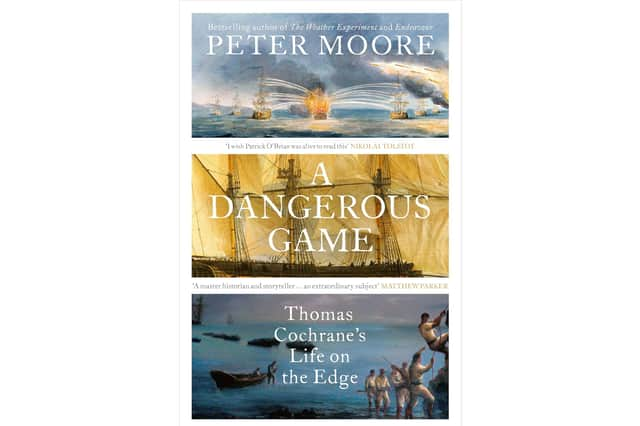
A Dangerous Game: Thomas Cochrane's Life on the Edge by historian Peter Moore is published by Chatto & Windus
Comments
Want to join the conversation? Please or to comment on this article.