
Why Scotland’s first female MP, the ‘Red Duchess’, must never be forgotten
Conservative politician Kitty Atholl initially opposed women’s suffrage, but changed her mind based on her experiences of the First World War; supported the Spanish Republican government against the fascist rebels; and fell out with Neville Chamberlain over his policy of appeasing Hitler


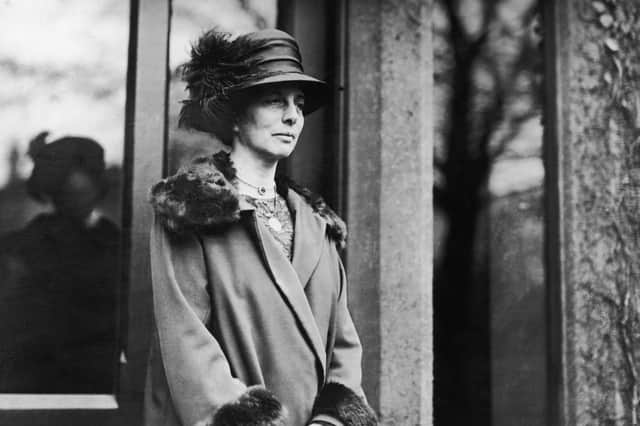
The Duchess of Atholl was a disappointment to parliamentary fashion watchers who closely scrutinised what the tiny band of women MPs wore in the 1920s. Scotland’s first woman MP usually dressed in a practical countrywoman’s uniform of loose blouse and tweed skirt, always with pockets for her smudged pencil notes.
Snobs and colleagues alike derided her for dressing “like a high school mistress” although she was “the premier Duchess of Scotland”. In some ways, too little has changed; less than a decade ago, some observers apparently found it remarkable that Nicola Sturgeon and Theresa May had legs.
But as a record number of women choose to leave Scottish politics next month, the life and career of their trailblazing foremother – unfairly forgotten by too many – may offer comfort to those who have not found public life easy.
The radical yet obvious choice
In researching my biography of Atholl, I traced her public life through the pages of this newspaper, which was a cheerleader in the early years of her marriage and career. As a beautiful young marchioness who was a brilliant pianist, she was an object of fascination. Unable to have children of her own, she devoted herself to improving the lives of others.
By the time she was elected for her home seat of Kinross and Western Perthshire in 1923, it was simultaneously a radical choice because of her sex and an obvious one because of her deep local roots and public profile. She had served on the Dewar Committee which recommended a precursor to the NHS for the Highlands and Islands and she nursed her husband’s soldiers through two wars.
Although she had been one of Scotland’s most prominent anti-suffrage speakers, she changed her mind after seeing the work of the Scottish Women’s Hospitals on the Western Front. She had come to see that policy affecting women and children is best made with a woman in the room. Hopefully, today’s women have not found themselves the only woman in the room as often as Atholl did.
As the first Unionist woman minister, she was diligent and loyal even though her boss repeatedly ignored and belittled her. She changed government policy on education funding and influenced the party’s male hierarchy to include a commitment on childcare in its manifesto, inspired by nursery schools she had seen in Dundee.
The wrong side of history
Once returned to the backbenches by Labour’s victory in 1929, Atholl worked across party lines in a way that is still too rare, particularly on issues relating to women and children. She cooperated with the independent MP Eleanor Rathbone, a former suffrage leader, to raise the topic of FGM in Britain’s African colonies in the House of Commons (to the disgust of Glasgow’s Independent Labour MP James Maxton).
And then there was foreign policy. By the 1930s, the duchess was almost a permanent fixture in The Scotsman’s letters pages. At first she was on the wrong side of history, arguing against greater self-government for India alongside Tory diehards.
But she fell out with those colleagues in her support for the Spanish Republican government against fascist-backed rebels. ‘The Red Duchess’, as she was nicknamed, travelled to Spain with Labour’s Ellen Wilkinson and regularly shared a platform with communists when fundraising for Spanish refugees.
Mr Chamberlain’s ‘skill and caution’
Prime Minister Neville Chamberlain removed the Conservative whip when she criticised his policy. A powerful lobby in her constituency wanted her to speak more about issues like the Milk Marketing Board and less about the Spanish Civil War.
A healthy politics has always needed room for disagreement within as well as between parties, but then, as now, blind loyalty was valued more than open debate.
By now, The Scotsman had a different view of the duchess; the editor was bewildered by her actions. He parroted the government line about “the skill and the caution with which Mr Chamberlain has steered the nation through such perilous times”. Atholl’s alarm about the consequences of appeasing Nazi Germany he found, by contrast, “excessive”.
When Atholl found out that Perthshire Unionists were interviewing alternative candidates, she triggered a by-election which was “the most spectacular electioneering campaign conducted in Scotland for many a day” according to The Scotsman; or, as one historian put it, “positively 18th century in the way that smears, dirty tricks and low-level bribery were deployed”.
A realist smeared as a warmonger
Chamberlain threw the might of the government at her: if she could be defeated in her husband’s fiefdom, it would discourage the other appeasement rebels. The pro-government lairds put government leaflets in with their quarterly rent bills.
Their canvassers told women voters that the duchess actively wanted another war. As a childless woman (a source of lifelong sadness which she couldn’t bring herself to discuss publicly), they said she couldn’t know the fear that her sons might be sent to war again.
The cynical campaigning worked (as it unfortunately still does). She lost.
Nine months later, Britain was at war. Though she had often been a voice crying in the wilderness, on this she had been right.
Sadly, any thought that our own century might be a more enlightened time for women in public life is daily challenged by a glimpse at social media. There are too many themes the duchess would recognise from the 1930s. But I’m not entirely despondent.
Two years ago, I spoke at a Holyrood event to mark the centenary of Duchess Kitty’s first election. It was organised by John Swinney, who represents the same part of the country, albeit for a very different party. Among the attendees were Kitty’s relatives, descendants of the Spanish refugee children she saved – and Scottish Conservatives.
We can learn from the past, as long as we do not allow ourselves to forget its more complex heroes.
Amy Gray will be speaking at the Boswell Book Festival about her book Red Duchess: Kitty Atholl, A Rebel in Westminster, published by The History Press.
Comments
Want to join the conversation? Please or to comment on this article.