
Why Scotland must make more of a great economic asset, the River Clyde
The future of poverty-stricken Greenock depends greatly on the Clyde – and who controls it, writes Martin Roche as he begins a road trip to discover the reality of life in modern Scotland


It’s 40 years ago this month that I left Scotland. I was off to run the Scottish New Towns’ London office. The job required drumming up inward investment leads and finding opportunities to get good press coverage for the towns, particularly with international media from leading economies.
Forty years on, and recently back home, I want to find out where Scotland stands today. So, I’m on a road trip to try to answer that question. I begin in Inverclyde.
My first stop is Lyle Hill and the Free French Memorial. It was funded by officers and men of the Free French navy, which had its wartime HQ in Greenock. It honours those Frenchmen killed in the Battle of the Atlantic and "the success of the Allied cause". French families still come to lay flowers. Its location offers one of Scotland’s greatest views.
The memorial’s great white anchor represents more than a homage to the French dead. It marks the unity of nations that saw the defeat of Nazism and the forging of the “Special Relationship” between the UK and the US. History lives here. Eighty years after the Second World War ended, today’s America seems set to support the invader, tyrant and aggressor Putin.
Poverty amid affluence
In 1978, when I left Inverclyde, Greenock was still one of the UK’s great industrial towns. IBM employed 5,000 people. Thousands more worked in the shipyards, marine engineering works, forges, sugar refineries, textile mills, and in companies making clothing, tents, margarine, tin boxes, mining equipment and rope. Almost all have gone. Greenock has been hollowed out as a place that makes things.
The town leads Scotland in deprivation and poverty. Yet it is sandwiched by affluence. To the west are leafy Wemyss Bay, Inverkip and Gourock, all with a touch of prosperity. In the east, Kilmacolm has its £1 million homes. Port Glasgow’s shopping is a retail success story.
Greenock’s centre has the air of a place just clinging on. My first appointment is with Karen Orr, a local hero who runs the multi-award-winning charity Rig Arts. Trained at Glasgow School of Art and a product of working-class Greenock, Orr’s creative fertility, energy and optimism should be bottled and sprinkled over political Scotland. “The creative industries have great potential to be part of economic regeneration. So has our waterfront. We need ambition. We need more imagination,” she tells me.
Greenock’s big hope
Stephen McCabe, the Labour leader of Inverclyde’s council, seems a bit worn down by the battle to propel Greenock up and away from its recent history. I meet him in the Victorian splendour of the municipal buildings.
Currently, the big hope for economic development rests on a joint venture the council has with port operators, Peel Ports, to create a marine industries hub called Inchgreen Marine Park. The taxpayer has pumped £11m into the deal, with Peel responsible for the marketing.
Maybe this is the new world, but in my time in the economic development business, attracting investors was the job of dedicated council staff working in tandem with national agencies like Scottish Enterprise. Scotland’s public agencies were, and remain, very good at inward investment attraction.
Peel controls most of the Clyde from Glasgow to Ardrossan. The river is privatised and now we’ve privatised a core element of building Inverclyde’s future. Publicly accountable public servants have been replaced by agents of a giant corporation that owns rival marine concerns in England, Ireland and the Netherlands. McCabe explains he must live with the fact that Peel owns the land and is the key to new jobs and a better economy. Time will tell.
Cruise ship passengers
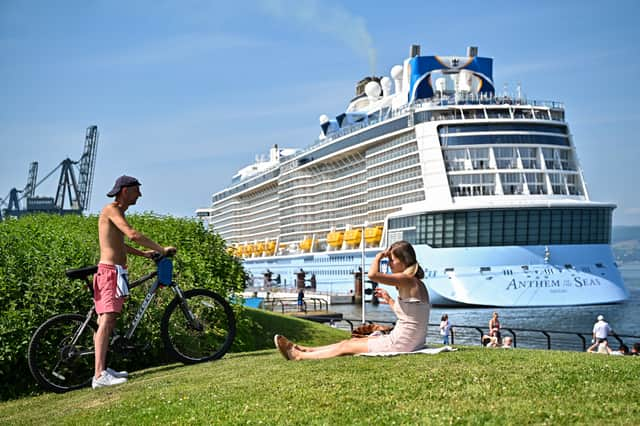
Asked about developing the local tourist trade, the council boss cites the cruise ships which dock at Peel Port’s Ocean Terminal, bringing a potentially lucrative income stream from tourists tempted to forgo Edinburgh or Glasgow for Inverclyde. It’s not clear how this is to be achieved. It doesn’t come over as an electrifying proposal.
McCabe would also rather Brexit had not happened and wants closer ties with the EU. He rejects the idea being championed by Scottish Labour leader Anas Sarwar of a new “Glasgow Super Region” with an all-powerful mayor with strategic economic development powers.
Sarwar argues it would empower a new wave of economic development in the West of Scotland. The Inverclyde man thinks such a move would see power and money sucked into Glasgow. What he wants is devolution of powers from Holyrood to existing local authorities.
The Why’s Man’s questions
McCabe is proud that Inverclyde has seven libraries for its 78,500 people: hubs for fun, skills development, recreation and education. He boasts about the record of the district’s secondary schools, which outperform national figures. And he’s delighted with the new Wyllieum, an art gallery that celebrates the life and work of the “Why’s Man”, the genius sculptor and long-time Gourock resident, the late George Wyllie.
Wyllie was forever asking questions of the world. There are questions to be asked about Inverclyde’s future. To me, the place seems to have handed its prospects to others. I couldn’t see a vision. I wasn’t energised.
Maybe the sharp suits of Peel Ports will turn the tide. Perhaps Holyrood will give the place more money and greater freedom in its spending. Sarwar’s dream of a super region mayor may do the trick.
Inverclyde has lots going for it, including the marvellous Continental Café on Gourock’s Kempock Street. That’s where I head to think about what I’d learned at the town hall. I’m stopped in the street by a man I hadn’t seen in decades. We’d been primary school friends.
He’s now retired from a successful business career. I tell him why I’m in town. Completely unbidden he says, “Peel Ports is holding us back.” I have no idea if this is true or otherwise. But it does raise questions about the influence this marine mammoth has over a great Scottish strategic, economic asset, the River Clyde.
Martin Roche had a 35-year career in international public relations
Comments
Want to join the conversation? Please or to comment on this article.