
'Please help us': Why Scotland must hear voices of Afghan women suffering under Taliban's gender apartheid
As Susan Dalgety listens to young Afghan women describe how they have been all but erased from society, she begins to cry. But her tears soon turn to anger
A tube of red lipstick is a symbol of resistance – and hope – in Afghanistan. In the country where women are denied the most basic of human rights, such as access to education, freedom of movement and free speech, many women and girls carry out hidden acts of rebellion every day.
In a network of salons across the country, women risk their lives to provide their clients basic beauty services. Masooma, 26, works underground in Kabul, hidden, she hopes, from the morality police who stalk the city. Before August 15, 2021, when the Taliban took over the country following the chaotic departure of American troops, she was at university.
She told the independent online newspaper, Kabul Now, that the ban on beauty salons is about far more than just hair and make-up. “It’s about the stripping away of women’s dignity and autonomy, their ability to make choices for themselves, their right to be seen and heard. It’s about the crushing weight of a regime that seeks to silence us, to erase us from the fabric of society,” she said.
READ MORE: Taliban’s shocking treatment of women shows why world must impose apartheid-style sporting boycott


Secret schools
Yal works in secret too. She is part of a team of female volunteers who help educate girls at home. “Our work is totally private, hidden in our homes,” she explains. “We connect via the internet, teaching girls from grades 7 to 12. At the beginning we had five students, now we have many more. Our goal is to give young women hope, as well as knowledge.”
Last Sunday, Yal, who is an Afghan contact for Women’s Declaration International (WDI), a group of women from more than 40 countries dedicated to protecting women’s sex-based rights, organised an online meeting with several of her students.
As I sat at my desk, listening to young women describe a daily life where they are all but erased from society, I started to cry. By the time our hour was up, and the meeting had been deleted from everyone’s phone or laptop, my tears had turned to anger.
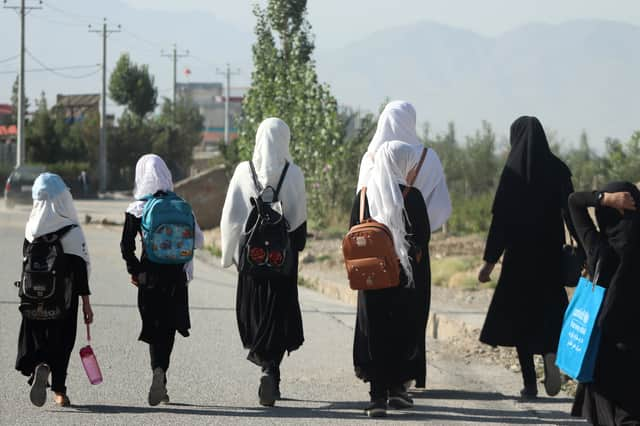
Why does the plight of Afghan women not dominate the headlines in the same way Gaza does? We are witnessing in live time the systematic erasure of 21 million women and girls, their faces and bodies covered in black burqas, their voices muted, their very humanity destroyed. Yet despite the work of global charities such Amnesty International and smaller ones like WDI and Women’s Rights Network, the world seems paralysed in the face of the Taliban’s cruelty.
UK abstains on UN resolution
Author and philanthropist JK Rowling spoke for many recently when she posted a plea on social media. “This breaks my heart,” she wrote in response to a message from WDI Afghanistan. “An ongoing human rights outrage, happening in plain sight, where women and girls are being treated worse than domestic pets. More has to be done to help these women.”
But what can be done? The United Nations’ General Assembly adopted a resolution last month which called for Afghanistan to “uphold” human rights and expressed “its serious concern about the grave, worsening, widespread and systematic oppression of all women and girls in Afghanistan by the Taliban”. But the UK was one of 12 countries – including Iran and Russia – to abstain on the vote, while the USA and Israel voted against it.
In the complex, nuanced world of global diplomacy, the UK’s abstention reflects our government’s reluctance to endorse a resolution perceived by many as too conciliatory towards the Taliban, while Iran criticised the text for not supporting “constructive dialogue” with the regime.
Amid the confusing and conflicting messages from the international community, life for Afghan women and girls continues to deteriorate. Last month, the Ministry for the Propagation of Virtue and the Prevention of Vice formalised its edict that women must cover their bodies entirely when in public. And from June, women in Kandahar province must be accompanied by a male relative when at work.
Afghan women must know we are listening
Baroness Emma Nicholson, chair of Amar International, the charity she founded in 1991, first met Taliban leaders in Afghanistan more than 20 years ago. She told me that she believes that countries closer to Afghanistan, such as India, Iran and Russia, will have more impact on the Taliban than the UK.
“India has a great influence on the whole region,” she said. And she urged women here to keep listening. “We ‘outside’ women must make sure that women of all ages in Afghanistan know we are listening to them, they will show us what we can do.”
Afghan and Iranian feminists have long argued that gender apartheid – the institutionalised oppression of women and girls – should be recognised in international law. Their grassroots End Gender Apartheid Campaign, launched in March 2023, has the support of high-profile women like Malala Yousafzai and global charities including Amnesty International and Human Rights Watch.
The UN is currently considering a Crimes Against Humanity treaty, which should be agreed by 2029, and some countries argue that this presents a unique opportunity to recognise gender apartheid as an international crime, just as race apartheid was in 1973, when the UN’s Apartheid Convention was agreed.
It took another 17 years before Nelson Mandela walked free from prison, signalling the end to apartheid in South Africa. Girls like Zainab, 14, should not have to wait two decades before she can live a life as a full human being. She told the meeting last Sunday that she feels very alone. “Please help us, we are truly in great need,” she said.
The cross-party, broad-ranging anti-apartheid movement, working with Mandela and others, was crucial to ending segregation based on race. Today, the women and girls of Afghanistan deserve nothing less than a global campaign to end the evil of apartheid based on their sex.
Comments
Want to join the conversation? Please or to comment on this article.