
Why Jack McConnell was the best First Minister Scotland has ever had – Susan Dalgety
Scotland would have been a much better place if politicians like Jack McConnell had been in charge for the last 20 years
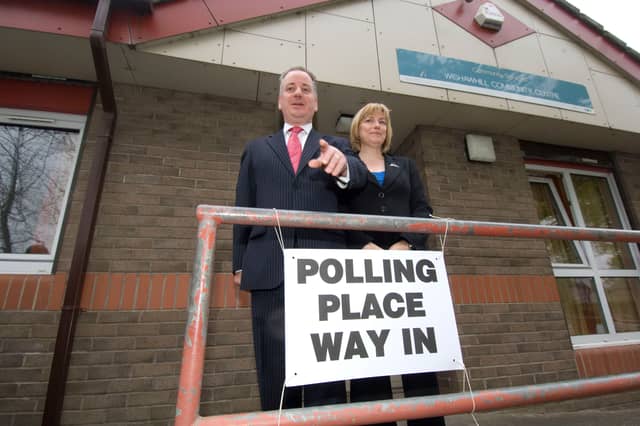

When Jack McConnell became First Minister 25 years ago, on November 22, 2001, he told the Scottish Parliament that the people of Scotland wanted “action on the priorities that matter most to them”.
He then went on to list those priorities: the NHS, schools, tackling crime, transport, skills, the economy and the environment. “In all of that, they want equality of opportunity,” he said. It was a typical McConnell speech. Serious intent. Carefully crafted. No rhetorical flourishes, but steeped in Labour values and, most importantly, focused on the Scottish people.
Before going any further, I need to declare an interest. I was in Jack McConnell’s team when he was First Minister. As his chief press officer, I spent my days defending his policies – sometimes even his clothes. Since 2007, when Labour’s reign in Scotland came to a stuttering close and a triumphant Alex Salmond landed in Holyrood, in a helicopter no less, he has become a good friend.
20 years of SNP psychodrama
I work with him on his international development work, advising his foundation and its programme to support girls' education in Malawi. Later today, I will be in the audience at an event in Stirling University where he will give a lecture about the historic links between Scotland and Malawi, bonds that he strengthened in November 2005 when he signed a bilateral agreement with President Bingu wa Mutharika. So, this column is not objective, but in my defence, opinion journalism is not supposed to be even-handed.
But I can’t be alone in thinking that McConnell’s time as First Minister represented Scotland’s golden years. He attracted criticism from media at the time – some of whom are still scribbling away, exhausted after nearly 20 years of SNP psychodrama. McConnell, by contrast, was accused of being too dull. Too cautious. Managerial. A technocrat with no political vision.
He may not have displayed the exuberant self-confidence of Salmond or the authoritarian air of Nicola Sturgeon, but judged by the impact of his six years in the top job, he was, arguably, a far more effective politician than either of them. Or their successors.
People are alive today because of his smoking ban in public places – the first in the UK. Young girls, 5,000 miles away, go to school because, without any fanfare, he has spent the last two decades working on development and conflict resolution, from Malawi to the Philippines.
He successfully persuaded even his most trenchant critics in the tabloid press that immigration was a positive thing for Scotland. He exposed the secret shame of sectarianism, bringing together, for the first time, the Orange Order and the Catholic Church to tackle it.
A fully paid-up member of the McConnell fan club
His work in improving Scotland’s schools, first as education minister, then as First Minister, stabilised a vital public service. As a former maths teacher, he put the needs of children first, before the demands of the all-powerful teaching unions.
And he was grappling with how best to support Neets – young people not in employment, education or training – long before Alan Milburn. In 2006, McConnell’s government’s strategy, More Choices, More Chances, anticipated Milburn’s recommendations published earlier this week.
But as a fully paid-up member of the McConnell fan club, I would say he was the best First Minister we’ve had to date, wouldn’t I? A more objective analysis comes from a senior Labour figure who was one of his most cutting critics while he was in charge.
He argues that McConnell was the last First Minister to make decisions on the basis of whether they would help people, rather than how it would serve his party. He says: “Today, decisions are only seen through one test – does it advance the cause of independence? In which case, do it whether it helps people or not. And if it doesn’t help the cause, don’t spend any energy on it no matter how important it might be.”
Crucially, he insists that McConnell understood that Scotland’s sense of itself as a nation mattered post devolution, and that, unlike many of his Labour colleagues at Westminster and even some at Holyrood, he wrestled with the tensions of working with the UK government where he could and challenging it where necessary.
“That tension is a very real one,” the former critic says. “For the SNP, it is not something to be managed but to be harvested for grievance and discontent. And I do think he took policy seriously. He understood, for example, the need to support economic growth at a local as well as a national level. People and place were fundamental to him, long before Andy Burnham became Mayor of Manchester.”
READ MORE: Why UK was wrong to cut overseas aid and Scotland must keep trying to 'make poverty history'
The importance of rigorous law-making
As a young Labour councillor in the 1990s, who campaigned for devolution in the belief that things could only get better once Holyrood opened its doors, I welcomed McConnell’s seriousness in office. It was a privilege to be on his team. He was a tough boss, expecting those around him to take their role as earnestly and with the same commitment as he expended on his job as First Minister.
He showed what the new Scottish Parliament could do with its new powers, not by promising ‘freedom’ tomorrow but by building a national consensus on the issues that mattered – jobs, tackling crime, public health, Scotland’s place in the world.
He grasped the importance of rigorous law-making in a way that today's lawmakers simply can't be bothered to do. In his first job, as Finance Minister, he introduced the Public Finance and Accountability Bill which established the framework for the parliamentary scrutiny of public spending.
It may be dull, managerial even, but it remains in place today, underpinning the work of Holyrood. Above all else, Jack McConnell understood that the job of First Minister was to serve the interests of the Scottish people, first and last. John Swinney, take note.
Comments
Want to join the conversation? Please or to comment on this article.